

On this page
You have probably heard that spider silk is "stronger than steel". The honest answer depends on whether you compare equal thickness or equal weight, and whether "strong" means strength or toughness.
Is spider silk stronger than steel?
A 1999 paper by J. M. Gosline and colleagues at the University of British Columbia (Gosline et al., 1999) compares the dragline silk of the European garden spider, Araneus diadematus, with engineering materials:
Breaking stress: dragline silk 1.1 GPa, high-tensile steel 1.5 GPa.
Stretch before breaking: silk 27%, steel 0.8%.
Energy absorbed before breaking: silk 160 MJ/m³, steel 6 MJ/m³.
Stiffness (Young's modulus): silk 10 GPa, steel 200 GPa.
So for the same thickness, steel is stronger and far stiffer. The steel figures come from textbooks, and the authors say they show relative magnitude rather than exact values.
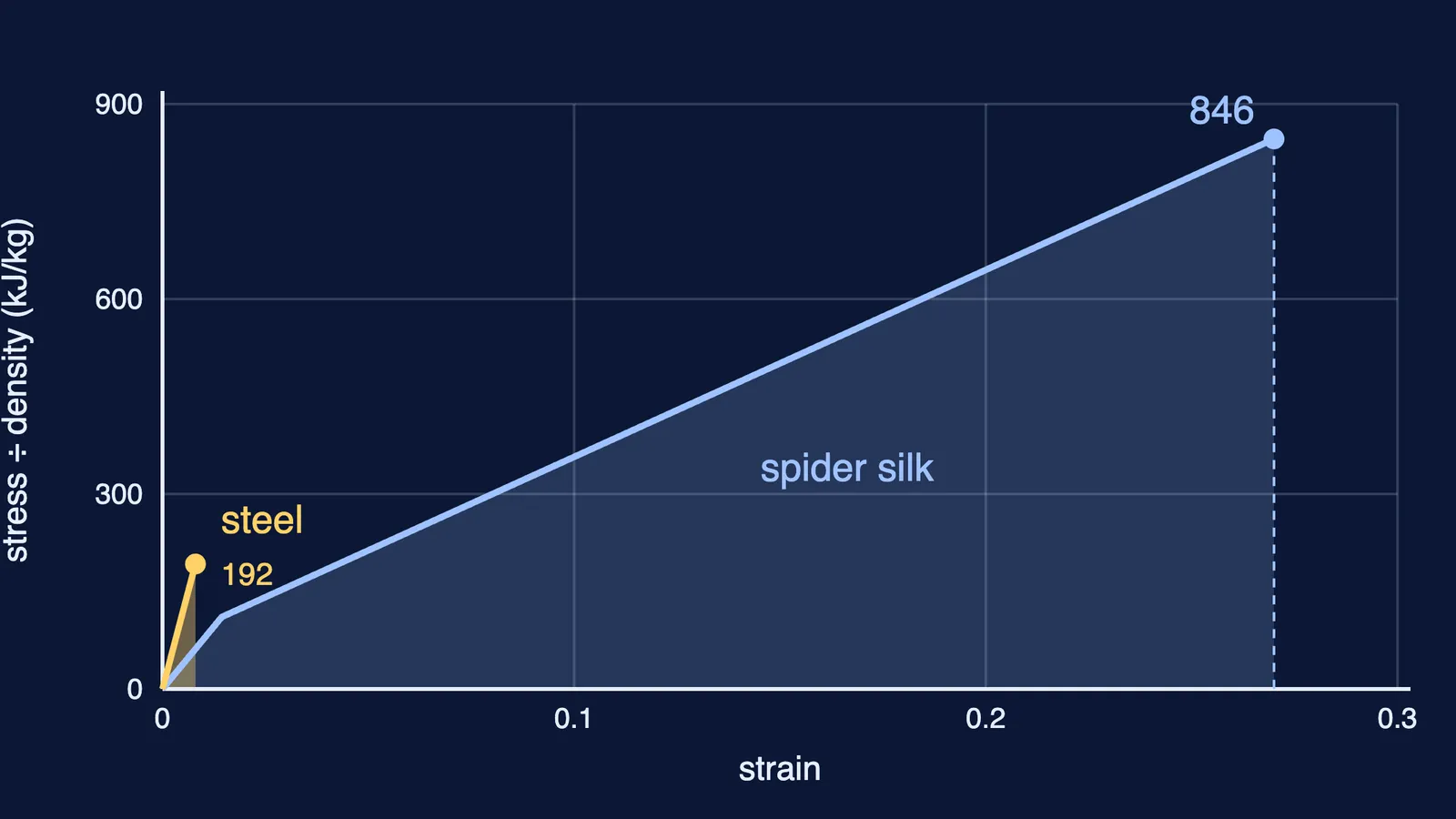
Silk wins on toughness. Tensile strength is the stress at which a material breaks. Toughness is the energy a material absorbs per unit volume before breaking, the area under its stress-strain curve (see how to read the stress-strain curve of a wire). Gosline's team found dragline silk "3–10 times tougher than its engineering counterparts" because it stretches so far before snapping.
How much stronger is spider silk by weight?
Silk is a protein, so it is light. Spider silk has a density of about 1.3 g/cm³, according to a 2021 review in Environmental Chemistry Letters (Belbéoch et al., 2021). Steel's density is about 7.8 to 7.9 g/cm³, the range of handbook values collected by The Physics Factbook.
Now divide, using these densities and the figures from Gosline et al. (1999):
Strength per kilogram (specific strength) is strength divided by density. Silk: 1.1 GPa ÷ 1300 kg/m³ ≈ 846 kJ/kg. Steel: 1.5 GPa ÷ 7800 kg/m³ ≈ 192 kJ/kg. Silk is about 4.4 times stronger by weight.
Toughness per kilogram is toughness divided by density. Silk: 160 MJ/m³ ÷ 1300 kg/m³ ≈ 123 kJ/kg. Steel: 6 MJ/m³ ÷ 7800 kg/m³ ≈ 0.77 kJ/kg. Silk absorbs about 160 times as much energy per kilogram.
Breaking length is how long a thread can hang before its own weight snaps it: L = σ ÷ (ρg). Silk: 1.1 × 10⁹ ÷ (1300 × 9.8) ≈ 86 km. Steel: 1.5 × 10⁹ ÷ (7800 × 9.8) ≈ 20 km.
Stiffness is the exception: steel's 200 GPa ÷ 7800 kg/m³ ≈ 26 MJ/kg beats silk's 10 GPa ÷ 1300 kg/m³ ≈ 8 MJ/kg.
Steel grades vary, so treat these as one fair comparison, not universal constants. Some silks go further: a 2010 study measured silk pulled from Darwin's bark spider, Caerostris darwini, at an average toughness of 350 MJ/m³ (Agnarsson et al., 2010).
Why is spider silk so tough?
The answer is in the protein, called fibroin, a long fibrous protein (see fibrous vs globular proteins). Gosline's paper describes dragline fibroins built from repeating blocks: a poly-alanine stretch 8 to 10 amino acids long and a glycine-rich stretch 24 to 35 amino acids long (Gosline et al., 1999).
During spinning, the poly-alanine blocks form tiny β-sheet crystals that cross-link the chains into a network; X-ray studies of a related spider, Nephila clavipes, cited in the paper put them at roughly 2 nm × 5 nm × 7 nm. The glycine-rich chains between them are far less ordered, and the paper links their deformation to silk's large stretch.
Picture hard bricks tied together by long ropes: the crystals stiffen and strengthen, the chains allow stretch. The paper also reports that about 65% of the kinetic energy the silk absorbs from a flying insect turns into heat, so the prey is not flung back out like a trampoline.
Why does a spider not spin on its thread?
A spider hanging from its dragline barely twists. In 2006, Olivier Emile, Albert Le Floch and Fritz Vollrath reported "Shape memory in spider draglines" in Nature (Emile et al., 2006).
As Phys.org reported, the Oxford and Rennes team tied a small rod to garden-spider dragline, Kevlar and copper threads and twisted it through 90 degrees. Kevlar responded elastically, wasting little energy. Copper damped the motion but became brittle after several trials. Silk damped the oscillation after a few twists and kept that behaviour through several cycles. Professor Fritz Vollrath described it as "a shape-memory material that does not need any external stimulus to give total recovery, even if it does take time."
How do you answer a silk-vs-steel question in an exam?
Name the property: breaking stress, stiffness, toughness, or a per-kilogram version of one of them.
Same thickness: compare stresses directly. Steel wins on strength and stiffness.
Same weight: divide by density before comparing. Silk wins on strength and toughness; steel still wins on stiffness.
Energy before breaking: compare areas under the stress-strain curves. Silk wins by a wide margin.
The usual slip is mixing steps 2 and 3. If you stall on which comparison a question wants, Fermi's AI tutor works out what you already know and builds a plan for the session, drawing the figure as it goes. For ideas that are easier to see than to read, the Fermi Simulation Lab has interactive simulations.
For the animal itself, start with why a spider is not an insect.


