

On this page
The keratin in your hair does not dissolve when you wash it, yet serum albumin, the most plentiful protein in blood plasma according to PDB-101's page on serum albumin, stays dissolved in water. The difference is shape.
What is the difference between fibrous and globular proteins?
NCERT classifies proteins into two types on the basis of molecular shape (NCERT Class 12 Chemistry, Unit 10: Biomolecules).
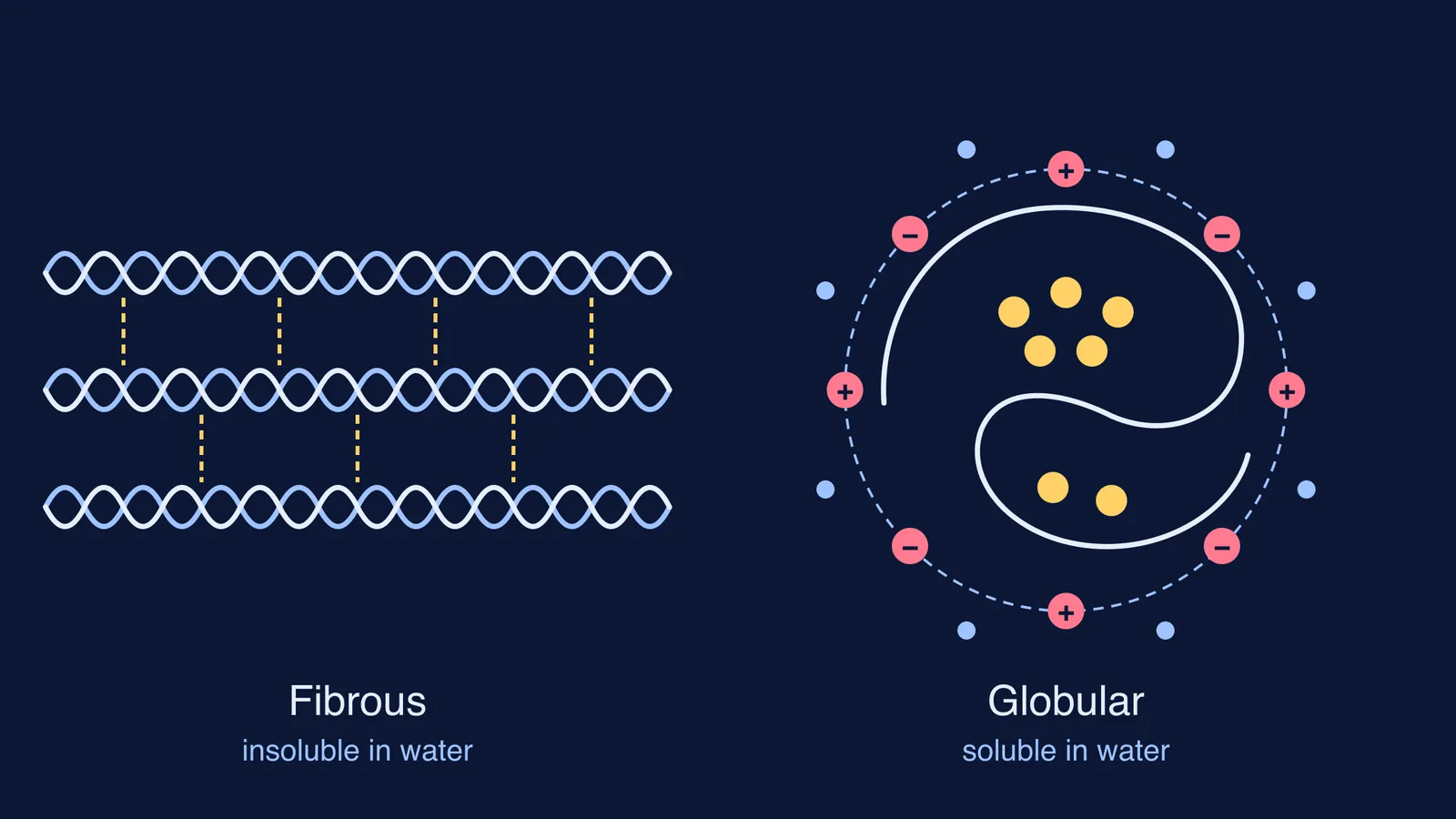
Fibrous proteins: the polypeptide chains run parallel and are held together by hydrogen and disulphide bonds, forming a fibre-like structure. They are generally insoluble in water. NCERT's examples are keratin (hair, wool, silk) and myosin (muscle).
Globular proteins: the polypeptide chains coil around to give a spherical shape. They are usually soluble in water. NCERT's examples are insulin and albumins.
The chapter places this split at the tertiary level, the overall folding of the chain, and states that almost all enzymes are globular proteins. If the four levels of structure are hazy, start with our walk-through of protein structure from primary to quaternary.
Why are globular proteins soluble and fibrous proteins not?
Solubility follows from which side chains face the water. In insulin, carbon-rich amino acids such as leucine and isoleucine cluster in the middle of the molecule, while charged amino acids such as arginine and glutamate cover the surface, where they interact favourably with water, as the PDB-101 page on insulin describes. A globular protein is a small ball with a water-friendly skin.
Albumin puts that solubility to work: its deep crevices bury the carbon-rich tails of fatty acids away from water, and each molecule can carry seven fatty acids (PDB-101 on serum albumin).
A fibrous protein is built the other way round: chains laid side by side and bonded to their neighbours (NCERT Biomolecules), giving a long bundle rather than separate small balls. That suits hair or muscle, which bear load. In muscle, about 300 myosin molecules bind together with their long tails packed tightly into one thick filament (PDB-101 on myosin).
Keratin, myosin, insulin and albumin: what do the numbers say?
Here are the four textbook examples, with figures from the UniProt protein database:
Keratin (fibrous). Keratin 31, a type I hair keratin, is a 416-amino-acid chain with a central coiled-coil rod domain; it is made in the cortex of growing hair (UniProt Q15323). For why that hair is no longer living tissue, see why cutting your hair and nails does not hurt.
Myosin (fibrous). Muscle myosin is built from two heavy chains and four light chains; in the heavy chain MYH7, which is 1,935 amino acids long, residues 839 to 1,935 form a coiled-coil tail (UniProt P12883).
Insulin (globular). Mature insulin is two chains, an A chain of 21 amino acids and a B chain of 30, linked by two disulphide bonds (UniProt P01308). That is the 51 amino acids NCERT quotes.
Albumin (globular). The mature human serum albumin chain has 585 amino acids; it is secreted into plasma, and its main function is thought to be regulating the colloidal osmotic pressure of blood (UniProt P02768).
How do you answer 'differentiate between fibrous and globular proteins'?
This exact question is exercise 10.15 in the NCERT Biomolecules chapter. Write five matched points, fibrous first, globular second, so the examiner can tick each pair:
Shape: long, thread-like fibres versus compact, roughly spherical molecules.
Chain arrangement: chains run parallel, held by hydrogen and disulphide bonds, versus chains that coil around into a sphere.
Solubility in water: generally insoluble versus usually soluble.
Role: mainly structural (hair, muscle filaments) versus mainly functional (enzymes, hormones, transport).
Examples: keratin and myosin versus insulin and albumin.
Then check yourself, answering aloud before reading on.
Why does egg white turn solid when you boil it? Heat disturbs the hydrogen bonds, the globules unfold and the protein is denatured; NCERT uses this exact example and notes that the primary structure stays intact.
Is maltase, the enzyme that splits maltose into glucose, fibrous or globular? Globular, because almost all enzymes are.
Which stays dissolved in plasma, albumin or keratin? Albumin, because it is a globular protein, and globular proteins are usually soluble in water.
For a globular protein with four chains, compare the two oxygen carriers in our haemoglobin vs myoglobin guide.
If a definition still feels like words without a picture, the Fermi Concept Library gives every concept in biology and chemistry its own lesson and its place in the map. When you want practice, the Fermi Problem Library has worked problems with a step-by-step solver that explains the reasoning rather than printing an answer.
Before your next revision, sketch one bundle and one ball and label where the water goes.


