On this page
Spiders and insects are relatives, which is why they get mixed up. Both belong to Arthropoda, the animals with a hard exoskeleton and jointed legs. The NCERT Class 11 Biology chapter on the animal kingdom calls Arthropoda the largest phylum of Animalia and says over two-thirds of all named species on earth are arthropods. Inside that huge phylum, spiders and insects sit in different groups. Insects are Insecta. Spiders are Arachnida, along with scorpions, harvestmen and mites.
If you want the bigger picture first, our guide to Arthropoda features and why it is the largest phylum sets out the shared traits.
What makes an animal an insect?
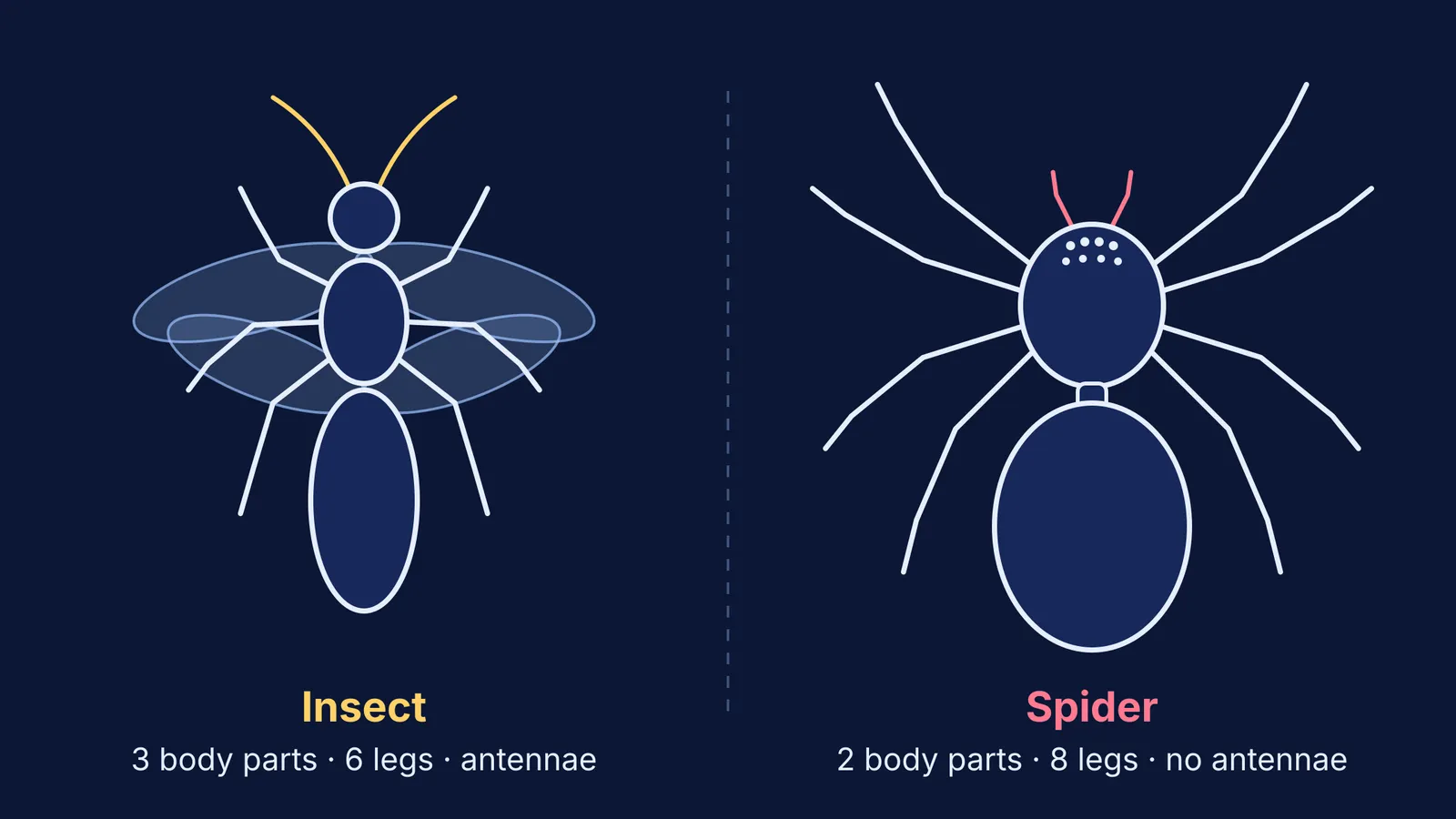
The Australian Museum's insect page gives a clean definition. An insect has a body in three parts (head, thorax and abdomen), six jointed legs attached to the thorax, a pair of antennae and an exoskeleton. The same page adds that most adult insects also have one or two pairs of wings.
Notice the word "most". Wings are the weakest of these tests, because some adult insects have none. The body plan, the leg count and the antennae matter more.
What makes a spider an arachnid?
The British Arachnological Society says arachnids have four pairs of legs, a pair of jaws called chelicerae and a second pair of appendages called pedipalps. It also says plainly that arachnids do not have antennae or wings. Their body is usually divided into two parts, the prosoma (also called the cephalothorax) and the opisthosoma (the abdomen).
The Australian Museum's spider page describes what that looks like in a spider. The cephalothorax combines the head and thorax and carries the eyes, mouthparts and legs. A slim waist joins it to the abdomen, which holds the silk-spinning organs (spinnerets). Spiders usually have eight eyes, though some have fewer.
Spiders are not a small group either. The World Spider Catalog lists 54,239 described spider species, in 139 families, as of 30 October 2026.
Why is a spider not an insect, feature by feature?
Put the two definitions side by side and spiders fail every insect test:
Body parts: insect 3 (head, thorax, abdomen); spider 2 (cephalothorax, abdomen).
Legs: insect 6, on the thorax; spider 8, on the cephalothorax.
Antennae: insect 1 pair; spider none.
Wings: most adult insects 1 or 2 pairs; spider none.
Front appendages: insects carry antennae; spiders carry jaws (chelicerae) and pedipalps for handling food.
So a spider is not an "insect with extra legs". It is built on a different plan.
How can you tell an arachnid from an insect in 30 seconds?
Use this check on any small creature, in a garden, a textbook figure or an exam diagram. Ask the questions in this order, because the first ones are the most reliable.
Count the body parts. Three clear sections points to an insect. Two sections joined by a waist points to an arachnid.
Count the walking legs. Six means insect. Eight means arachnid. Leave out the pedipalps.
Look for antennae. Any pair of feelers on the head means insect. Arachnids have none.
Check for wings last. Wings confirm an insect, but no wings proves nothing on its own.
Now try it on two cases.
A harvestman ("daddy-long-legs"). It can look like one round blob. The British Arachnological Society notes that mites and harvestmen have the two body parts fused, so question 1 is unclear. Questions 2 and 3 settle it: eight legs, no antennae, so it is an arachnid.
A wingless creature with six legs and antennae. Question 4 says nothing, but questions 2 and 3 do: it is an insect.
The same reasoning works for the other arachnid that confuses students. Our explainer on whether a scorpion is an arachnid or an insect walks through it, and crab and prawn features shows a third arthropod plan, the crustaceans.
What should you write in an exam answer?
Be careful with one line in your textbook. NCERT's Arthropoda section says the body consists of head, thorax and abdomen. That is the general arthropod plan. In a spider, the head and thorax are fused into one cephalothorax, so do not write "spiders have a head, thorax and abdomen".
A two-mark answer could read: "A spider is an arachnid, not an insect. Its body has two parts, a cephalothorax and an abdomen, with four pairs of walking legs, chelicerae and pedipalps, and no antennae or wings. An insect has three body parts, three pairs of legs and one pair of antennae."
If classification still feels like a list of facts to memorise, the Fermi Concept Library gives every concept in biology its own lesson and its place in the map, so you can see how the ideas connect.
Next time you see a spider in the corner of the room, count its legs. Eight legs and no antennae: arachnid.