On this page
If you spot a scorpion, your first instinct might be to call it a "bug" or an insect. But biologically, scorpions sit on a completely different branch of the animal kingdom. Scorpions are arachnids, placing them in the same class as spiders, ticks and mites.
While both insects and arachnids are arthropods (animals with exoskeletons and jointed limbs), their body plans are fundamentally different. Knowing these anatomical differences is a classic requirement for school biology and competitive exams, where taxonomic classification is frequently tested.
Why is a scorpion an arachnid and not an insect?
The distinction between the class Arachnida and the class Insecta comes down to how their bodies are built. You can tell them apart by looking for three main anatomical features:
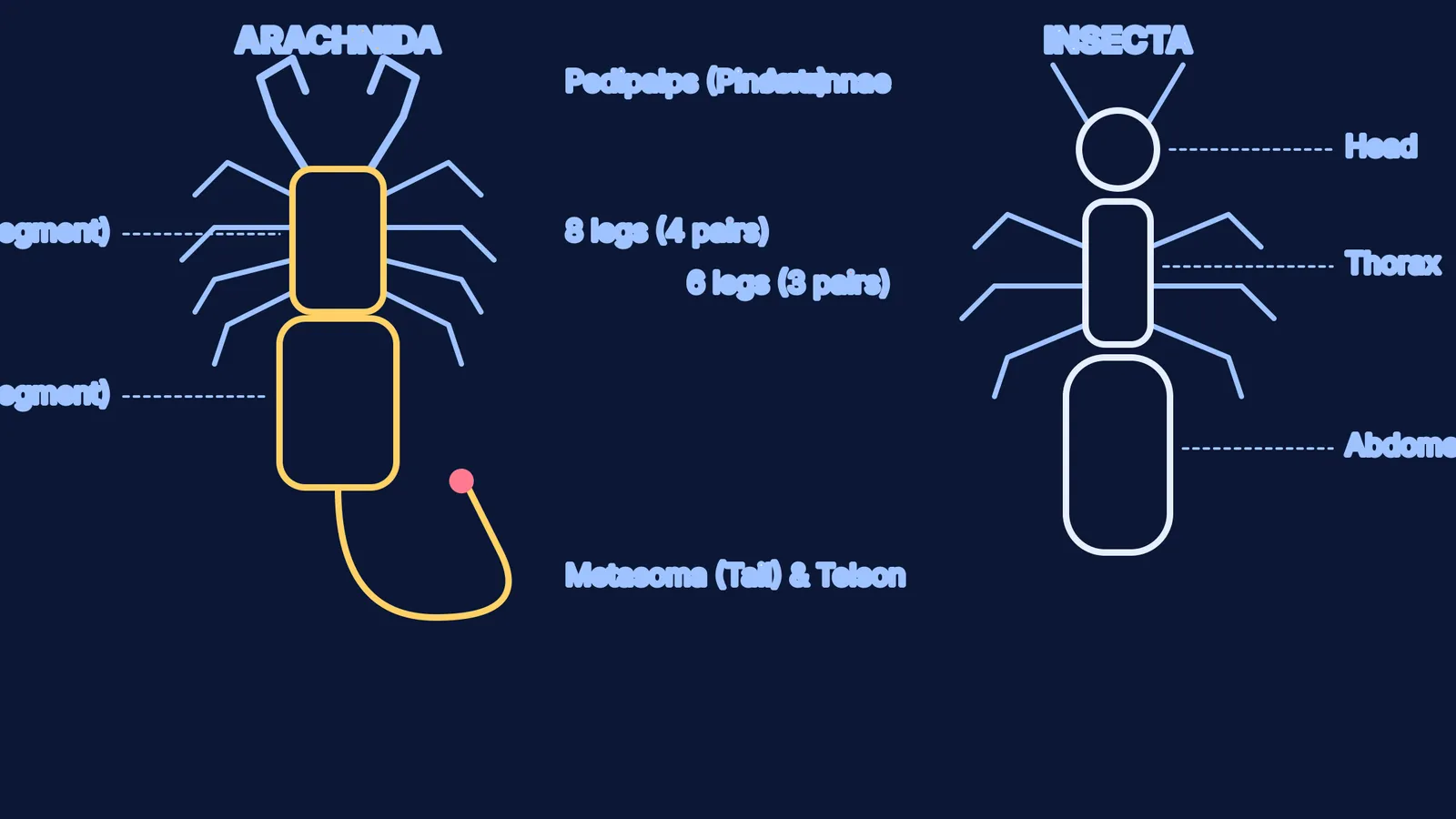
Number of legs: Scorpions have exactly eight walking legs (four pairs), whereas insects only ever have six legs (three pairs) (Wikipedia).
Body segments: A scorpion's body is divided into two main sections: the front part (cephalothorax or prosoma) and the back part (abdomen or opisthosoma) (Wikipedia). Insects, on the other hand, have their bodies divided into three distinct segments: the head, the thorax, and the abdomen.
Antennae: Insects have one pair of antennae on their heads used for sensing their environment. Scorpions do not have antennae at all. Instead, they rely on sensory hairs and specialized organs underneath their bodies to feel vibrations in the ground.
To explore the biological branches of arthropods, the Fermi Concept Library maps every concept across biology, each with its own lesson and its place in the broader tree of life.
What are the unique parts of a scorpion's body?
While scorpions share their basic two-segment body plan with spiders, they have evolved highly specialised appendages for hunting and defence.
Pedipalps: The large, crab-like pincers at the front of a scorpion are not walking legs. They are pedipalps, which are modified appendages used to grab and crush prey.
The tail and stinger: The back half of the abdomen narrows into a five-segmented structure called the metasoma, which we commonly call the tail (Wikipedia). At the very tip is the telson, the bulbous stinger that delivers venom to subdue struggling prey.
Unlike insects, which often rely on wings to escape, scorpions are built entirely for the ground. As arthropods, they have rigid exoskeletons that cannot grow with them. Because of this, they are known for the moulting process of ecdysis, where they must periodically shed their old exoskeleton to expand.
How many scorpion species exist today?
Scorpions are a highly successful group of nocturnal predators. There are over 2,500 described species of scorpions living today, spread across 22 different extant families (Wikipedia).
They have adapted to survive in almost every terrestrial habitat on Earth, from the harshest deserts to tropical rainforests. The sheer diversity of arthropods can sometimes lead to misleading animal common names, but a scorpion's distinct shape—characterised by its raised tail and heavy pincers—makes it hard to confuse with any other animal.
How long have scorpions been on Earth?
Scorpions are among the oldest land-dwelling animals on the planet. Their evolutionary history stretches back to the early Silurian Period, approximately 435 million years ago (Wikipedia). They later underwent significant diversification during the Devonian and early Carboniferous periods.
For context, this means scorpions were crawling across the Earth long before the first dinosaurs appeared. The oldest known scorpion fossil, *Dolichophonus loudonensis*, which was discovered in Scotland, proves that their basic body plan — the pincers, the segmented tail, and the eight legs — has barely changed in hundreds of millions of years. This incredible evolutionary stability makes them a fascinating subject when studying the taxonomic hierarchy of life. Their ancient lineage reminds us that when nature finds a highly successful blueprint for survival, it keeps it largely untouched across eons of geological time.