

On this page
According to the National Testing Agency, over 24 lakh students registered for the NEET-UG exam in 2024. A significant portion of the biology paper tests the animal taxonomy rules laid out in the NCERT Class 11 textbook. This is where common names become traps.
Every year, the zoology section of the paper includes questions specifically on the animal kingdom. The examiners know that students tend to rely on intuition rather than rigorous classification. In biology, a true fish belongs to the superclass Pisces, a mammal has mammary glands and hair, and insects have jointed appendages and an exoskeleton. However, common names were coined long before Carl Linnaeus formalised modern taxonomy. Sailors, farmers and early naturalists named animals based on how they looked or where they lived. This leaves a legacy of deceptive names that the NEET exam frequently tests.
Is a sea horse a true fish?
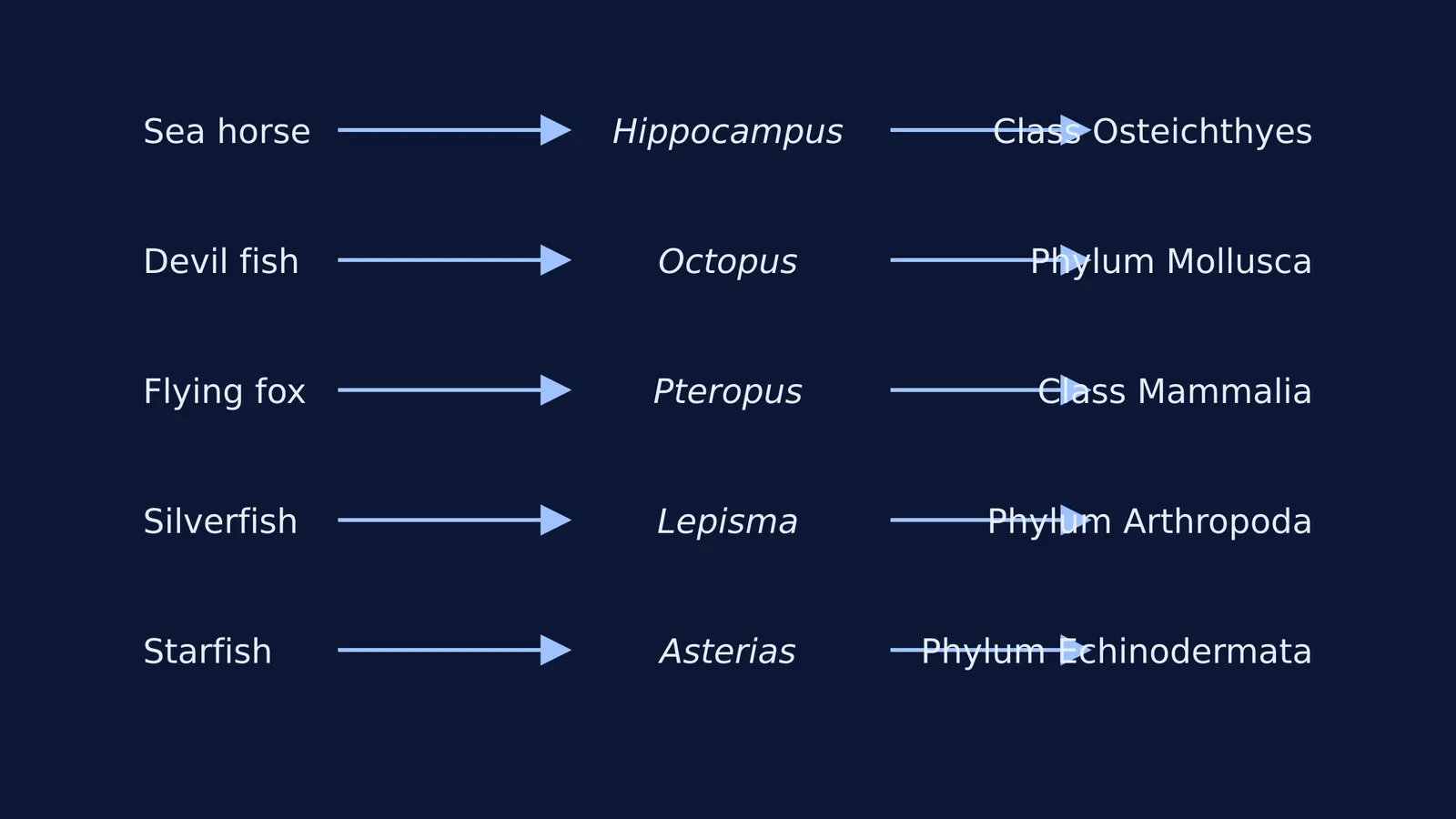
Despite its horse-like head and upright posture, the sea horse (*Hippocampus*) is a true bony fish. It belongs to the phylum Chordata and the class Osteichthyes.
If you look closely at a sea horse, it has gills for breathing, a swim bladder, and fins to manoeuvre through the water—the defining features of a fish. It also has a bony endoskeleton. In a NEET question, if you are asked to pick the true fish from a list containing a jellyfish, starfish and sea horse, the sea horse is the correct answer.
What are devil fish, silverfish and starfish?
Many animals with "fish" in their names are actually non-chordate invertebrates. The syllabus requires you to classify these animals into their correct phyla without being distracted by their common names.
**Devil fish (*Octopus*):** The devil fish is an octopus, which belongs to the phylum Mollusca. It has a soft body, no skeleton, and tentacles. It lacks a backbone completely.
**Silverfish (*Lepisma*):** If you open an old book, you might see a tiny, silvery creature darting across the page. This is the silverfish. It is not an aquatic animal at all; it is a wingless insect belonging to the phylum Arthropoda. It shares this phylum with spiders, crabs and cockroaches.
**Starfish (*Asterias*):** The starfish, or sea star, belongs to the phylum Echinodermata. It has radial symmetry as an adult, a spiny skin, and a unique water vascular system that it uses for movement and capturing food. Its body plan is built on a five-part symmetry, which is distinct from the bilateral symmetry of true fish.
If you find it hard to picture the water vascular system of a starfish or the mantle cavity of an octopus, you can look them up in the Fermi Concept Library.
Is a flying fox a bird or a mammal?
The flying fox (*Pteropus*) has wings and can fly, but it is not a bird, nor is it related to foxes. It is a large fruit bat.
In biological classification, the flying fox belongs to the phylum Chordata and the class Mammalia. Like all mammals, it is viviparous (gives birth to live young) and nourishes its offspring with milk from mammary glands. It also has hair on its body and a four-chambered heart. The wings of a flying fox are actually modified forelimbs with skin stretched between elongated finger bones, which is completely different from the feathered wings of a bird (class Aves).
How to memorise animal classification for NEET
The animal kingdom chapter relies heavily on memory. To avoid losing marks to misleading names, you need a systematic approach.
Focus on the scientific names: The NCERT textbook pairs each common name with its scientific name in brackets. Whenever you read "silverfish", immediately mentally translate it to "*Lepisma* (Arthropoda)".
Group by phylum, not by habitat: Do not group animals by where they live. A whale, a sea horse and a starfish all live in the ocean, but they belong to entirely different classes and phyla.
Build a fake fish list: Create a master list of deceptive names from the textbook. This list should include the jellyfish (*Aurelia* - Coelenterata), cuttlefish (*Sepia* - Mollusca), devil fish (*Octopus* - Mollusca), silverfish (*Lepisma* - Arthropoda), and starfish (*Asterias* - Echinodermata).
When you revise biological classification, you will also need to review viruses, viroids and lichens, which sit outside the five-kingdom system. You can also group animals by other features, such as their excretion methods (ammonotelic, ureotelic and uricotelic animals). Sticking strictly to the textbook definitions is the only way to navigate these traps and secure your marks.


