

On this page
When you look at a crab on the beach or a prawn on a dinner plate, it is easy to see they are related. But where do they fit in the animal kingdom? They are not fish, despite living in the water. Instead, they belong to the phylum Arthropoda, sharing a lineage with insects and spiders.
To be precise, crabs and prawns are part of the subphylum Crustacea. There are almost 67,000 described species of crustaceans, ranging from microscopic water fleas to giant spider crabs. If you are preparing for exams like NEET-UG, understanding the exact traits that place these animals into their biological boxes is essential.
Why are crabs and prawns classified as arthropods?
The word "arthropod" comes from the Greek for "jointed foot". All animals in the phylum Arthropoda share a few non-negotiable traits:
Jointed limbs: Their legs bend at distinct joints, acting as levers for walking, swimming or feeding. This mechanical advantage allows them to move efficiently both on land and in the water.
A hard exoskeleton: They are encased in a tough cuticle made of chitin, a complex carbohydrate. In crustaceans, this exoskeleton is often heavily hardened (calcified) with calcium carbonate, making it much thicker than the shell of a typical insect.
Segmented bodies: The body is divided into repeated segments, though some of these may fuse together during development to form specialised regions.
Moulting (Ecdysis): Because their rigid exoskeleton cannot stretch, arthropods must shed it periodically to grow. They grow a soft new shell underneath, burst out of the old one, and expand their bodies before the new armor hardens.
Crabs and prawns check every box on this list. Their jointed walking legs and protective, calcified shells make them undeniable members of the arthropod family, placing them in the same broad category as beetles and butterflies, rather than with the fish they swim alongside.
What are the key crab and prawn crustacean features?
While all crustaceans are arthropods, not all arthropods are crustaceans. The subphylum Crustacea has its own specific hallmarks that separate it from other groups. If you are looking at an arthropod and want to know if it is a crustacean, look for these features:
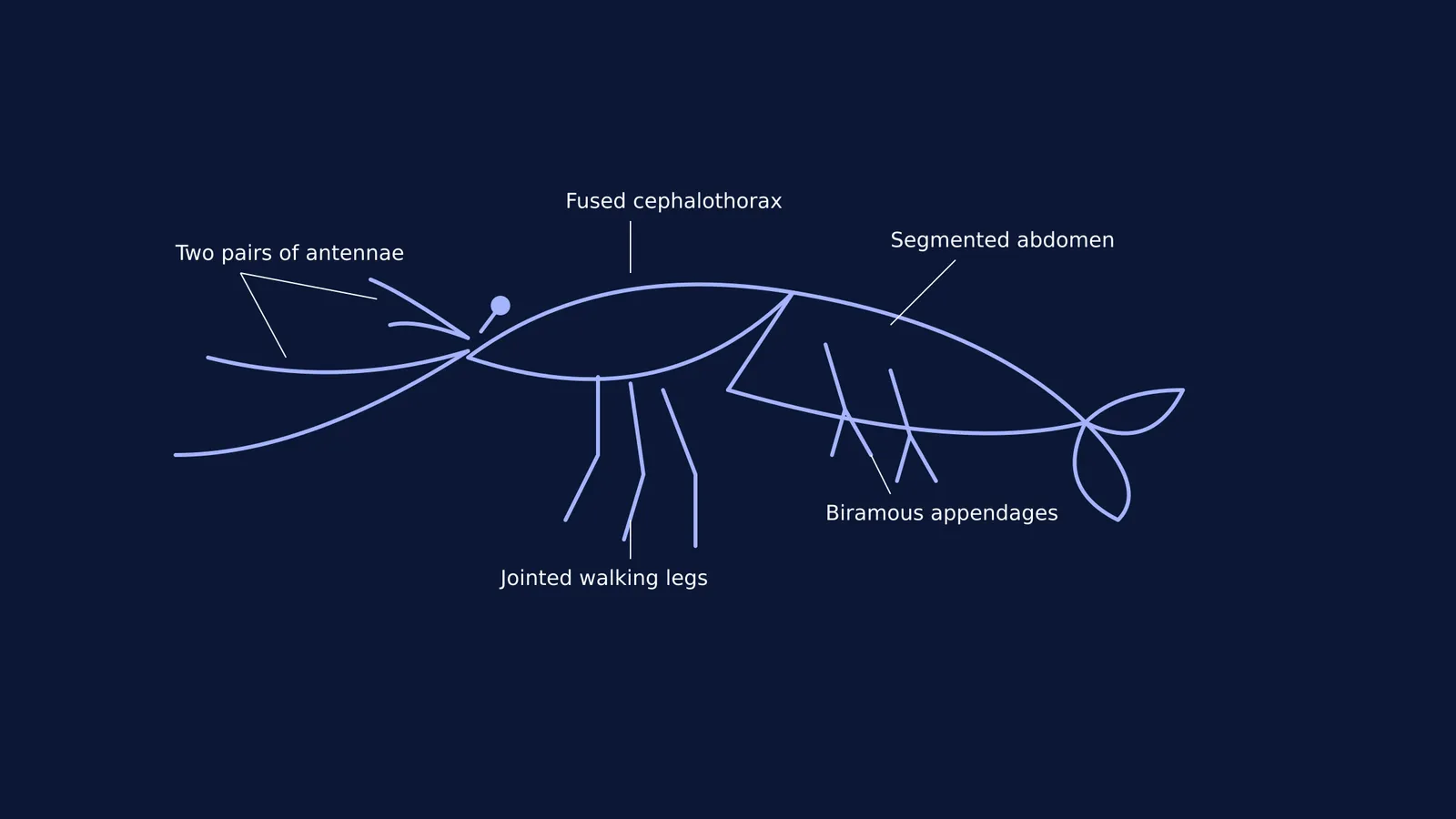
Two pairs of antennae: This is the absolute defining feature of a crustacean. They possess one pair of smaller antennules and one pair of longer antennae. Both pairs are densely packed with sensory receptors used for touching, smelling, and navigating their environment.
Gills for respiration: Because most crustaceans are aquatic, they breathe through gills rather than lungs or tracheae. In crabs and prawns, these feathery gills are usually tucked away safely under the carapace (the large, continuous shield covering their head and thorax). As water flows over the gills, oxygen is absorbed directly into their bloodstream.
A fused cephalothorax: The head and the thorax (the middle section) are often fused together into a single unit called the cephalothorax, leaving a distinct, flexible abdomen behind it.
Biramous appendages: Unlike the single-branched legs of insects (uniramous), the limbs of many crustaceans are branched into two parts. While this is obvious in their swimming legs (pleopods), it is sometimes harder to see in their main walking legs without a closer look.
If you are trying to memorise the defining features of different phyla for your biology exams, the Fermi Concept Library connects every concept in biology so you can see exactly how these groups relate to one another and why specific traits matter.
How do crustaceans differ from insects and arachnids?
It is common to mix up the different branches of the arthropod family tree, especially when memorising taxonomy tables. Here is how you can tell the major groups apart at a glance:
Insects (like ants and bees) have only one pair of antennae, three distinct body parts (head, thorax, and abdomen), and typically exactly three pairs of legs. They breathe through a network of internal tubes called tracheae, not gills, because they evolved primarily for life on land.
Arachnids (like spiders and scorpions) have no antennae at all. They have two main body parts and four pairs of walking legs. They also lack the mandibles (chewing mouthparts) found in crustaceans and insects.
Crustaceans (like crabs and prawns) stand out because they have two pairs of antennae and usually breathe through gills. They also have a varying, often larger number of legs depending on the species. Prawns and crabs belong to an order called Decapoda, meaning they have ten legs, including their large claws.
If you sit down to study and do not know where to start with animal classification, Fermi's AI tutor can work out what you already know and build a plan for the session, testing your recall of these crustacean traits as you go.
Whether you are looking at a tiny, translucent shrimp or a massive, heavily armoured lobster, you are observing a highly successful body plan. By relying on a hard calcified exoskeleton, highly articulated jointed limbs, efficient gills, and two pairs of sensory antennae, crustaceans have managed to conquer almost every aquatic environment on Earth.
Related reading:


