

On this page
If you are revising the Animal Kingdom chapter, Arthropoda is the one phylum you cannot skim. Its four key features turn up often as one-mark facts, assertion-reason pairs and odd-one-out questions. Here is why the phylum is so large, what each feature means, and a four-question test you can run on any animal.
Why is Arthropoda the largest phylum?
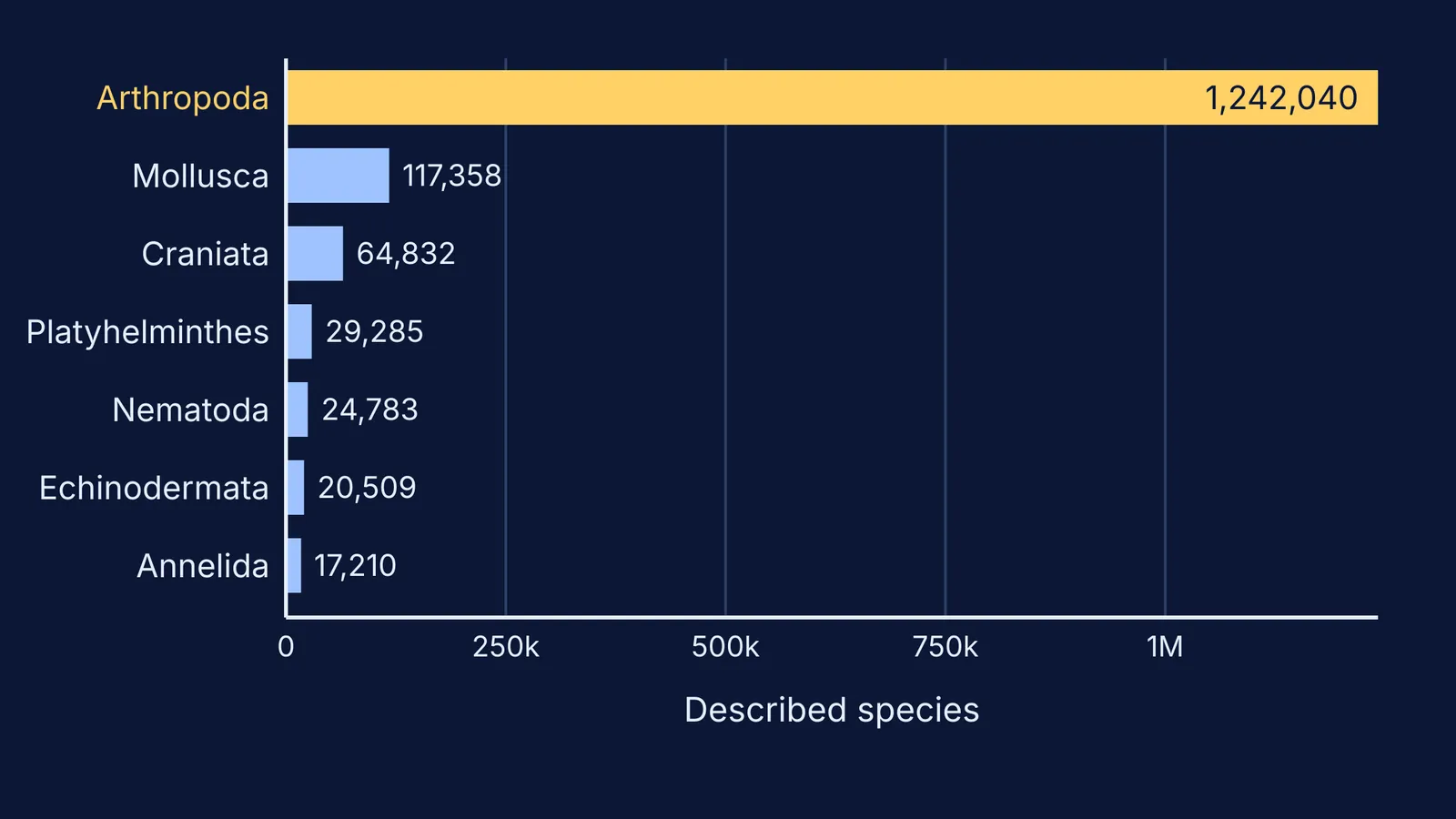
The short answer is the species count. A 2011 survey of animal diversity by Zhi-Qiang Zhang in Zootaxa counted 1,552,319 described animal species, of which 1,242,040 (about 80%) are arthropods. In the same survey, insects alone account for 1,020,007 species, about 66% of all described animals. The next largest phylum, Mollusca, has 117,358 described species, less than a tenth of the arthropod total.
Your textbook says the same thing in different words. NCERT's Class 11 Biology calls Arthropoda "the largest phylum of Animalia which includes insects" and states that "over two-thirds of all named species on earth are arthropods" (NCERT, Animal Kingdom, section 4.2.7). The two figures do not clash: Zhang's 80% is a share of animals only, while NCERT's two-thirds is measured against all named species on earth.
What are the main features of Arthropoda?
NCERT describes arthropods as bilaterally symmetrical, triploblastic, segmented and coelomate, with organ-system level of organisation and a body divided into head, thorax and abdomen (section 4.2.7). Four features carry most of the marks:
Jointed appendages. The name is the definition: arthros means joint and poda means appendages.
Chitinous exoskeleton. The body is covered by an exoskeleton made with chitin. Moulting depends on making new chitin: in a 2025 study on the Chinese mitten crab, long-term silencing of the chitin synthase gene led to a thinner procuticle, abnormal moulting and high mortality (International Journal of Molecular Sciences).
Open circulatory system. In an open system, blood pumped by the heart passes through large vessels into open spaces or body cavities called sinuses (NCERT, Body Fluids and Circulation, section 15.3). A 2020 review by Julián Hillyer and Günther Pass in the Annual Review of Entomology describes the insect version as a dorsal heart plus accessory pulsatile organs that supply haemolymph to the appendages. Our explainer on why insect blood is not red covers haemolymph in more detail.
Malpighian tubules. Excretion takes place through Malpighian tubules. In a classic 1958 study on the stick insect in the Journal of Experimental Biology, J. A. Ramsay found that small soluble substances pass from the haemolymph into the tubules, and useful ones such as amino acids and sugars are taken back up in the rectum. For the organ numbers NCERT expects you to know, see our post on cockroach ommatidia and Malpighian tubule counts.
NCERT also lists the respiratory organs (gills, book gills, book lungs or a tracheal system) and notes that arthropods are mostly dioecious and oviparous, with fertilisation usually internal.
How is open circulation different from closed circulation?
This is where students lose marks. NCERT's chapter on circulation states that open circulatory systems are found in arthropods and molluscs, while annelids and chordates have a closed system in which blood always moves through a closed network of vessels (section 15.3).
So segmentation alone does not make an animal an arthropod. Earthworms are segmented too, but Annelida has a closed circulatory system and excretes through nephridia, not Malpighian tubules (NCERT, section 4.2.6). And open circulation alone is not enough either, because molluscs share it.
How do you identify an arthropod in an exam question?
Run these four questions, in this order, on any animal you are given:
Does it have jointed legs or other jointed appendages?
Is the body covered by a chitinous exoskeleton?
Is circulation open, with blood flowing into sinuses?
Is excretion through Malpighian tubules?
Worked example. Which of these is not an arthropod: prawn, scorpion, Limulus, earthworm?
Prawn: jointed appendages and an exoskeleton. It is one of NCERT's pictured examples of Arthropoda.
Scorpion: also pictured in NCERT's Arthropoda figure. Our post on whether a scorpion is an arachnid or an insect explains where it sits inside the phylum.
Limulus: the king crab, which NCERT lists as a "living fossil" arthropod.
Earthworm: segmented, but no jointed appendages, a closed circulatory system and nephridia. It fails questions 1, 3 and 4.
The answer is the earthworm. The trap option is the one that shares a single feature (segmentation) with the right group.
Learn NCERT's example list as groups: economically important insects (Apis, Bombyx, Laccifer), vectors (Anopheles, Culex, Aedes), a gregarious pest (Locusta) and a living fossil (Limulus) (section 4.2.7).
If a feature such as open circulation still feels fuzzy, the Fermi Concept Library covers every concept in biology, each with its own lesson and its place in the map, so you can see how one idea connects to the next instead of memorising a list.
Tonight, close the book and write the four features from memory, then check them against section 4.2.7.


