

On this page
When you prepare for biology exams, remembering structural numbers is crucial. The NCERT biology syllabus uses the American cockroach (*Periplaneta americana*) as a model insect, providing specific counts for its organs. Because these numbers are absolute in the textbook, they are frequently tested as straightforward, one-line questions in competitive exams and board papers. Scoring well often depends on having these specific data points committed to memory.
Why does NCERT test cockroach numbers?
The NCERT Class 11 textbook specifies exact anatomical counts for the cockroach. While real-world biology involves natural variation—for instance, Wikipedia notes adult cockroaches can have over 3,500 individual lenses—the official syllabus expects students to memorise the standardised counts provided in the text. Knowing these exact figures helps examiners test a student's precision and recall of the syllabus material without ambiguity, ensuring fairness in grading.
How many ommatidia does a cockroach have?
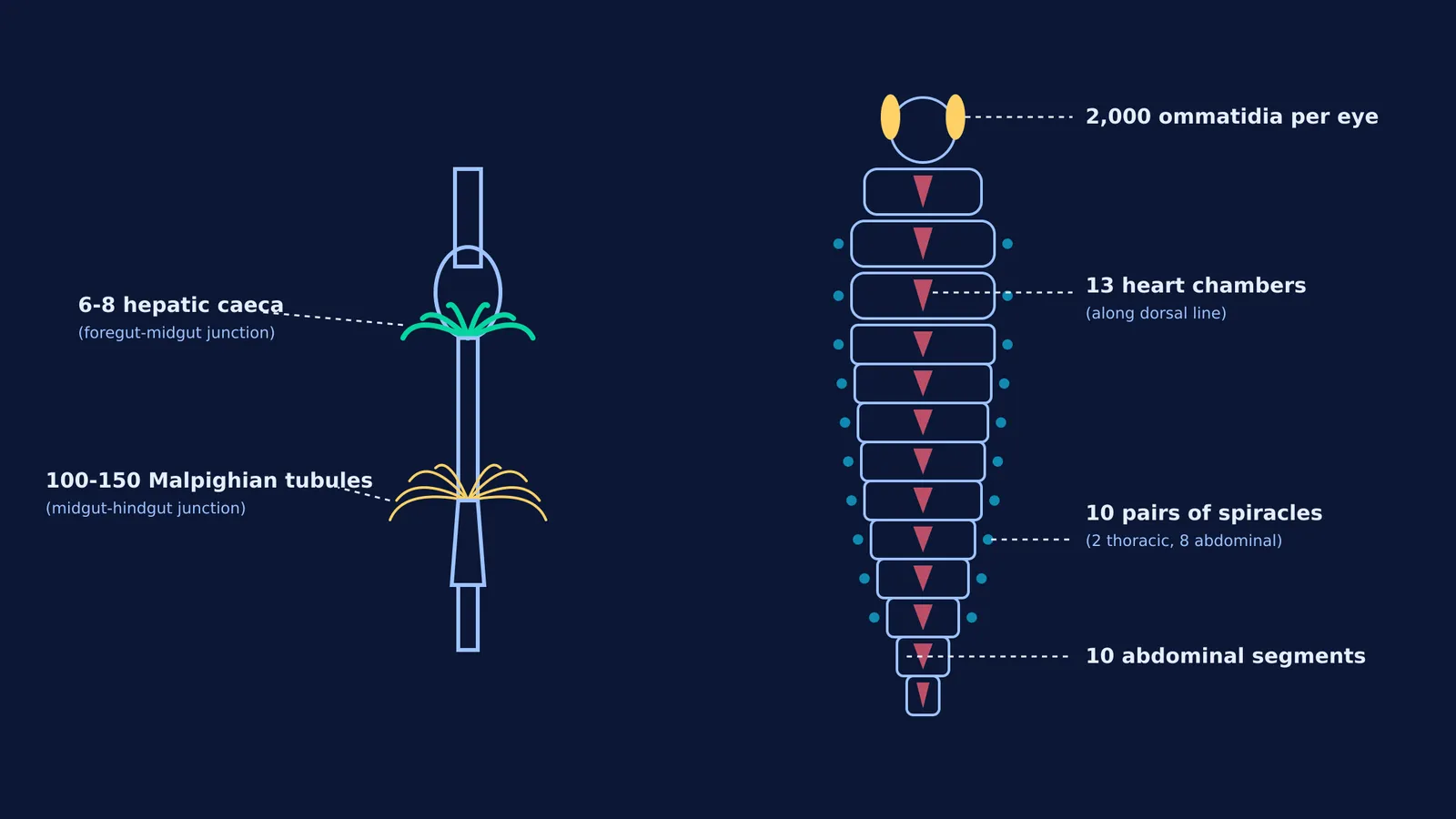
The cockroach has a pair of large compound eyes situated dorsally on its head. According to the official curriculum, each compound eye contains approximately 2,000 hexagonal ommatidia. These units allow the insect to receive multiple images of an object simultaneously. This mosaic vision offers high sensitivity to motion but low resolution, an optical adaptation perfectly suited for the cockroach's nocturnal environment.
What is the number of Malpighian tubules and hepatic caeca?
Students often confuse the digestive and excretory tubules. As detailed in the NCERT Class 11 textbook, at the junction of the foregut and midgut, there is a ring of 6 to 8 blind tubules called hepatic or gastric caeca. These secrete digestive juice. Further down, at the junction of the midgut and hindgut, sits a ring of 100 to 150 yellow coloured thin filamentous tubules known as Malpighian tubules. These are the primary excretory organs that remove uric acid from the haemolymph, allowing the cockroach to conserve water.
How many heart chambers and spiracles are there?
According to the NCERT textbook, the cockroach has an open circulatory system with a long, muscular tube lying along the mid-dorsal line. It is divided into 13 funnel-shaped chambers, each with ostia on either side. The respiratory system opens to the outside through 10 pairs of small holes called spiracles on the lateral side of the body. Two pairs are in the thorax, and eight pairs are in the abdomen. Finally, the abdomen in both males and females consists of 10 segments.
If you struggle to recall whether the heart has 13 or 14 chambers, or need a structured way to review other anatomical facts, the Fermi Concept Library has every concept in biology, each with its own lesson and its place in the map.
A checklist for cockroach counts
Here is a framework from the NCERT Class 11 textbook to secure your marks on cockroach anatomy:
Vision: 2,000 ommatidia per eye.
Digestion: 6–8 hepatic caeca.
Excretion: 100–150 Malpighian tubules.
Respiration: 10 pairs of spiracles (2 thoracic, 8 abdominal).
Circulation: 13 heart chambers.
Reproduction: 8 ovarioles per ovary (16 total); 9–10 oothecae produced, each containing 14–16 eggs.
Structure: 10 abdominal segments.
Make a habit of writing these pairs down together. Similar to memorising the counts of formed elements of blood or the cilia and flagella structures, practicing these numbers as a checklist ensures you do not lose easy marks in an exam. If you misread a question and choose 8 hepatic caeca instead of 8 ovarioles, practicing with the Fermi Problem Library gives you worked problems with a step-by-step solver that explains the reasoning rather than printing an answer, catching these slip-ups before exam day.


