On this page
When a mosquito is swatted and leaves a red stain, it is because of the mammalian blood it just drank, not its own fluids. The fluid inside an insect, called haemolymph, is typically clear, yellowish, or slightly green as described in the Wikipedia article on hemolymph. This striking difference comes down to how insects manage two vital tasks: delivering oxygen and circulating nutrients.
Why is insect blood not red?
In vertebrates like humans, blood is red because of haemoglobin, an iron-rich protein that binds to oxygen. Because oxygen is heavy and chemically demanding to carry, we need a dedicated, closed network of arteries and veins to pump it from our lungs to every tissue in the body.
Insects do not use their blood to transport oxygen. Without the need for haemoglobin, insect blood never evolved a red colour. Some arthropods use a copper-based protein called haemocyanin, which turns blue-green when oxygenated, but in most insects, the fluid remains largely colourless or takes on the pigments of their plant diet.
How do insects deliver oxygen without haemoglobin?
If the haemolymph does not carry oxygen, how do insect cells survive? They rely on an entirely separate respiratory network. In the 1660s, the Italian biologist Marcello Malpighi discovered that insects breathe through small holes in their exoskeleton called spiracles according to his biography.
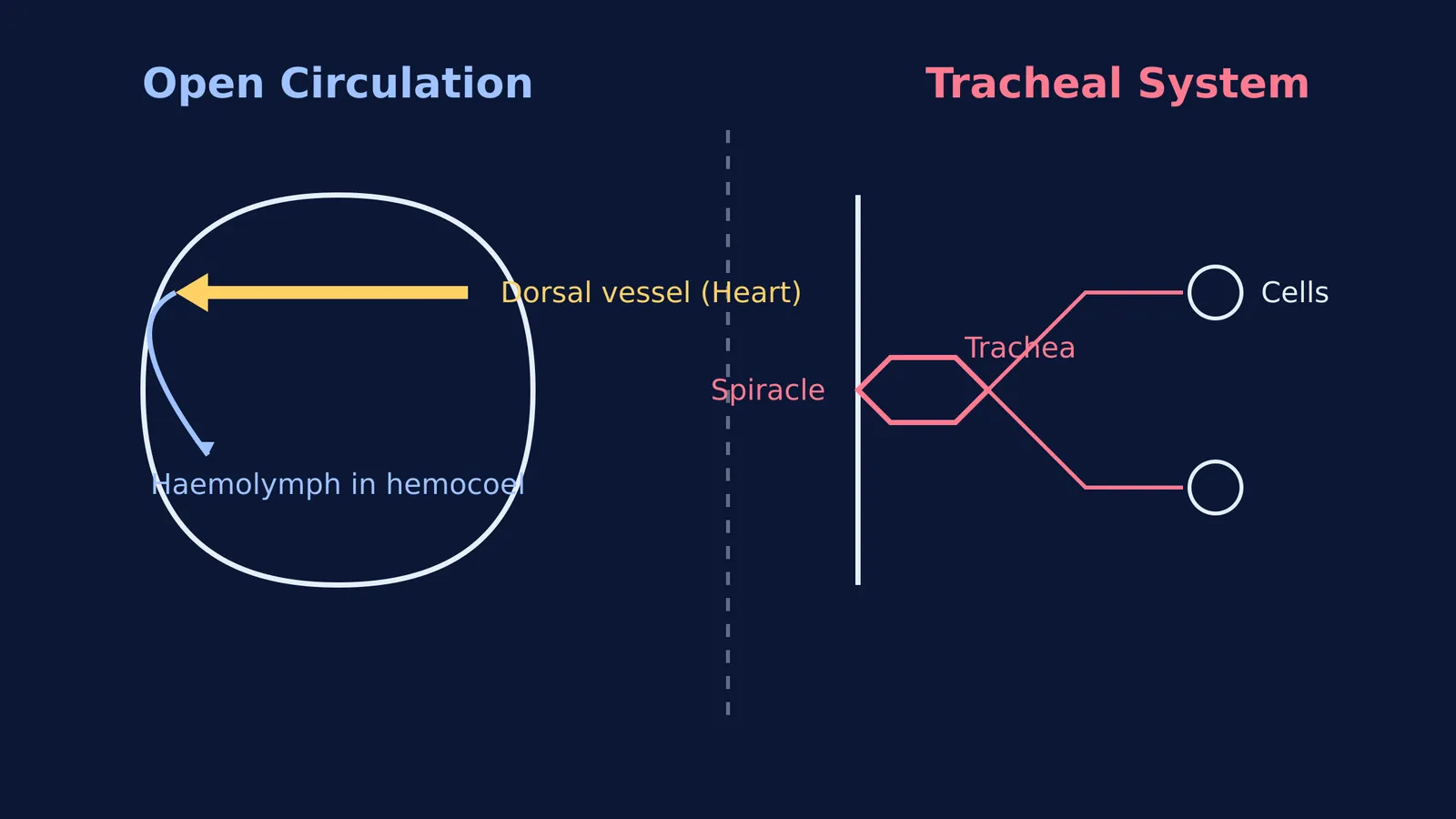
These spiracles open into a branching network of air-filled tubes called tracheae, which divide further into microscopic tracheoles. This system delivers oxygen as a gas directly to individual cells as explained in the Wikipedia article on the respiratory system of insects.
Because the oxygen diffuses directly across the thin, moist walls of the tracheoles, the insect's circulatory system is relieved of its gas-transport duties. This direct delivery limits how large insects can grow; ancient dragonflies could only reach massive sizes when atmospheric oxygen was significantly higher millions of years ago.
Students often struggle to visualise these interconnected microscopic systems. The Concept Library contains every concept in physics, chemistry, biology, mathematics and computing, each with its own lesson and its place in the map. Checking the entry on open circulation makes the distinction immediately clear.
What is the difference between open and closed circulation?
Because haemolymph does not carry oxygen under high pressure, the insect circulatory system is "open". Instead of being confined to a closed loop of blood vessels, haemolymph flows freely through the main body cavity, known as the hemocoel, directly bathing the internal organs.
A simple dorsal vessel runs along the insect's back, acting as a rudimentary heart. It pumps the fluid forward toward the head, and then the fluid simply sloshes back through the body cavity. This low-pressure system is energy-efficient, though it would be far too slow to sustain the oxygen demands of a mammal.
If you are comparing this to human biology, you might want to review the Mechanism of Inspiration and Expiration: Diaphragm and Intercostals to see exactly how closed respiratory and circulatory systems interact under pressure.
Why do insects need haemolymph at all?
Even without oxygen transport, haemolymph is essential for survival. It acts as the insect's internal transport and hydraulic system:
Nutrient Transport: It carries sugars (like trehalose), proteins, and lipids from the digestive tract to tissues throughout the body.
Waste Removal: It moves metabolic byproducts like uric acid to the Malpighian tubules for excretion.
Immune Defence: It contains specialised cells called hemocytes that identify and destroy pathogens, analogous to human white blood cells. (For a comparison with human immunity, see our guide on Humoral vs cell-mediated immunity: How T cells reject organ grafts).
Hydraulic Pressure: Insects use the fluid pressure of their haemolymph to shed their old exoskeleton during molting and to pump up their soft wings into rigid structures.
Checklist: Comparing blood and haemolymph for biology exams
When revising for biology exams or NEET, use this quick checklist to structure your answers on animal circulation (and compare it with primitive closed systems, such as those found in Cyclostomata features: how lampreys and hagfish feed and spawn):
Colour pigment: Mammalian blood uses iron-based haemoglobin (red); insect haemolymph lacks it entirely or uses copper-based haemocyanin (blue-green).
Main function: Blood transports oxygen and nutrients; haemolymph transports only nutrients, hormones, and immune cells.
Vessel confinement: Blood operates in a high-pressure closed system of veins and arteries; haemolymph operates in a low-pressure open system (the hemocoel).
Respiratory connection: Blood must travel to the lungs for gas exchange; haemolymph is physically separate from the insect's tracheal breathing tubes.