

On this page
What makes Cyclostomata unique among vertebrates?
Within the subphylum Vertebrata, the division Agnatha contains only one surviving class of living jawless vertebrates: Cyclostomata. According to the official NCERT Class 11 Biology curriculum, all living members of the class Cyclostomata are ectoparasites on some fishes. Their body plan lacks the defining features seen in advanced fishes, possessing neither jaws, paired fins, nor scales.
Cyclostomes possess an elongated body equipped with 6 to 15 pairs of gill slits for respiration, as documented in the NCERT Animal Kingdom text. Their cranium and vertebral column remain entirely cartilaginous throughout life, meaning bone tissue is completely absent. Unlike non-vertebrate chordates, cyclostomes have a closed circulatory system with a two-chambered heart that pumps blood forward through the ventral aorta.
Understanding where this class sits in chordate phylogeny is essential when you study animal kingdom classification for NEET. Because their circular, suctorial mouth lacks true jaws, cyclostomes cannot chew. Instead, their oral apparatus creates suction, allowing them to anchor securely to swimming marine hosts.
How do lampreys feed and migrate to spawn?
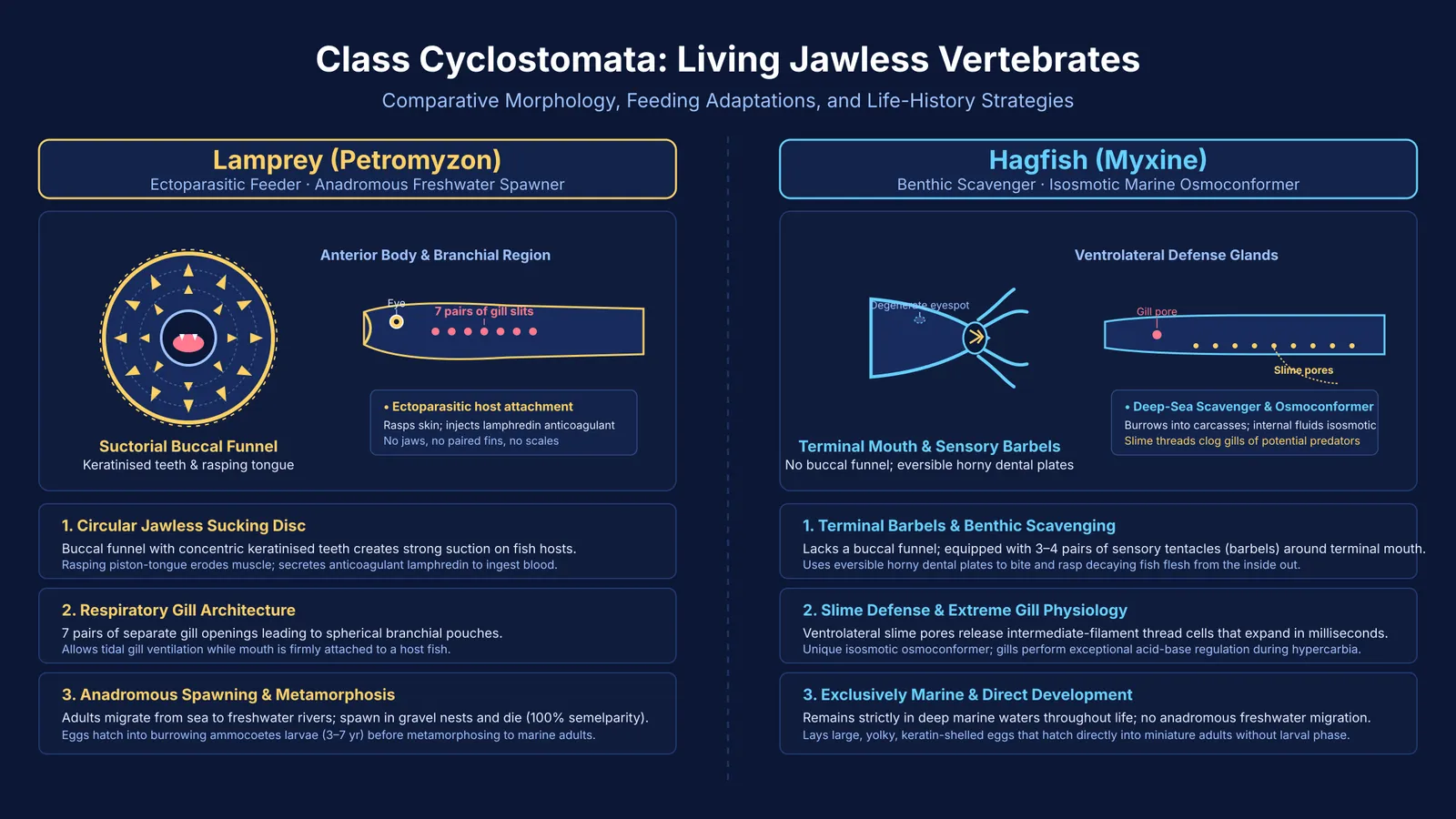
Adult sea lampreys (*Petromyzon marinus*) demonstrate a specialised parasitic life cycle centered on their circular buccal funnel. Research in the Canadian Journal of Zoology shows that during metamorphosis from the larval stage, lampreys develop concentric rings of keratinised horny teeth and a piston-like rasping tongue. The adult attaches to host fish using suction, rasps away the skin, and secretes an anticoagulant called lamphredin to ingest host blood.
Although adult lampreys feed in the sea, they are anadromous animals that migrate upstream into freshwater rivers to spawn. As documented in Conservation Physiology, upstream-migrating sea lampreys downregulate ion-uptake mechanisms in their gills, cease feeding entirely, and mobilise their bodily energy reserves solely for migration and gonad development.
After constructing gravel nests with their sucking mouths, the adults spawn. In line with the 100% semelparity documented in Conservation Physiology and the NCERT curriculum, adult sea lampreys die within a few days of spawning. Their eggs hatch into toothless larvae called ammocoetes. An ammocoetes larva burrows into river silt for 3 to 7 years according to life-history data in the Canadian Journal of Zoology, filter-feeding before undergoing metamorphosis to return to the ocean.
How do hagfish differ from lampreys?
The second cyclostome group consists of hagfish (*Myxine glutinosa*). While lampreys are active ectoparasites with functional eyes, hagfish are deep-sea benthic scavengers that burrow inside dead fish. Hagfish possess degenerate eyes covered by skin and lack a buccal funnel, relying on sensory tentacles around their terminal mouth and keratinised dental plates to rasp decaying tissue.
Physiologically, hagfish represent an evolutionary landmark. A study in Scientific Reports showed that hagfish maintain internal fluids isosmotic with seawater, making them the only true osmoconformers among living craniates. Their gill pouches also play an extraordinary role in systemic acid-base regulation during hypercarbia.
To deter predators, hagfish discharge copious slime from ventrolateral pores along their body. As documented in comparative genomic analyses in Nature, specialized gland thread cells express expanded clusters of alpha-keratins derived from ancestral skin elements. When ejected into seawater, these tightly coiled protein threads unravel in milliseconds to form an expansive fibrous slime that clogs the gills of predatory fish. Unlike lampreys, hagfish undergo direct development: they lay large, yolky eggs encased in horny shells, hatching directly into miniature adults without an intervening larval stage.
How can you solve Cyclostomata questions in NEET?
NEET biology papers regularly feature Cyclostomata in tricky statement-based questions that mix lamprey and hagfish traits. As you refine your strategy for analysing NCERT lines closely alongside the official NCERT Animal Kingdom text, you must evaluate each diagnostic characteristic systematically.
When tackling statement-based questions in NEET, apply this four-step diagnostic framework:
Check body appendages: Cyclostomes have an elongated body devoid of scales and paired fins, bearing 6 to 15 pairs of gill slits.
Verify skeleton: Cranium and vertebral column are purely cartilaginous; any claim of bone is incorrect.
Identify mouth morphology: A jawless, circular sucking mouth confirms Agnatha; biting jaws are absent.
Separate life cycles: Anadromous migration and ammocoetes larvae belong to *Petromyzon*, while slime glands and direct development belong to *Myxine*.
Consider this classic question: "Which statement is incorrect regarding *Petromyzon*? (A) It has a circular mouth without jaws. (B) Cranium and vertebral column are cartilaginous. (C) It migrates to ocean waters for spawning. (D) Larva returns to ocean after metamorphosis."
The incorrect statement is (C). *Petromyzon* lives in marine water but migrates to fresh water for spawning, dying shortly after egg deposition.
When mapping chordate classification, the Fermi Concept Library gives each concept its own lesson and its place in the map, helping you trace every structural milestone across vertebrate evolution. To practice evaluating tricky multiple-choice options, the Fermi Problem Library provides worked problems with a step-by-step solver that explains the reasoning rather than printing an answer.


