

On this page
A woodpecker drums its beak into wood many times a second and flies off with no sign of a headache. For decades the popular answer was a shock absorber built into its skull. Recent measurements say otherwise: the skull is a stiff hammer, and the main protection appears to be the small size of the brain.
How hard does a woodpecker hit a tree?
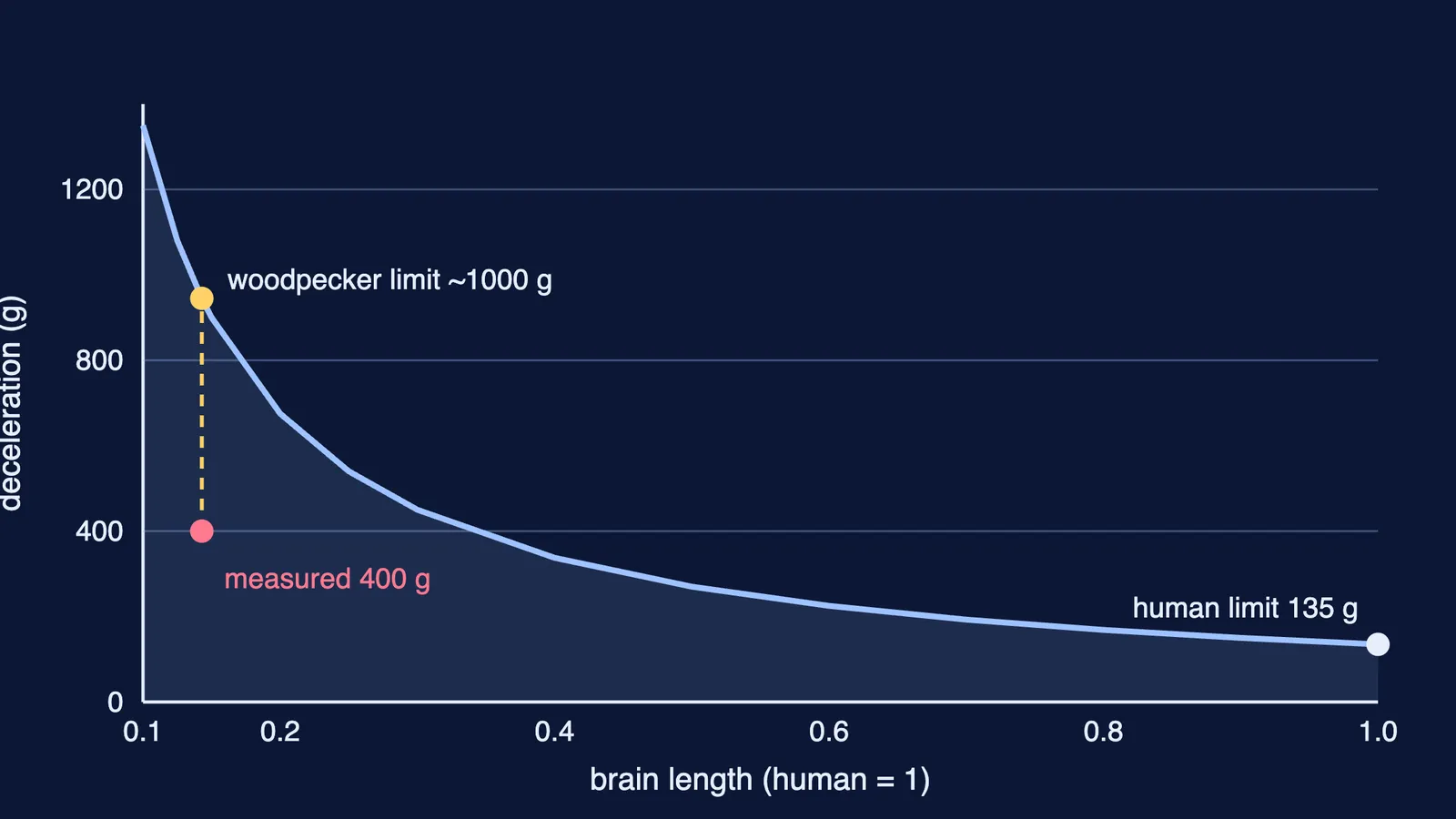
In a 2024 Physics Today article, biologists Sam Van Wassenbergh and Maja Mielke write that woodpeckers generally strike trees at speeds of 20 kilometres per hour and can drum at up to 30 times per second. Their high-speed videos showed woodpecker brains decelerating at up to 400 g, where g is the acceleration due to gravity. The same article puts the estimated concussion threshold for humans at 135 g.
Older estimates ran higher. Lorna Gibson's 2006 analysis in the Journal of Zoology describes decelerations on the order of 1,000 g, and a 2018 PLOS ONE paper says woodpeckers experience forces of up to 1,200 to 1,400 g.
Do woodpeckers have shock absorbers in their skulls?
Apparently not. A zone of spongy bone between the beak and the braincase was long thought to cushion each blow. In a 2022 Current Biology study, Van Wassenbergh and colleagues filmed black, pileated and great spotted woodpeckers pecking. They found that the cranial skeleton works as a stiff hammer that improves pecking, not as a shock-absorbing system that protects the brain.
The Physics Today summary explains the evidence: across more than 100 pecks, the braincase showed no reduced deceleration compared with the beak, so nothing in between was cushioning the hit. Psychiatrist Philip May and his coworkers made the same point in a 1976 Lancet article, as that summary recounts: "If the beak absorbed much of its own impact, the unfortunate bird would have to pound even harder."
So why don't woodpeckers get concussions?
Mostly size. Gibson's 2006 analysis found three keys: a small brain, which feels less stress for the same deceleration; a very short impact, which raises the deceleration a brain can tolerate; and the brain's orientation in the skull, which increases the area of contact between brain and skull.
The size effect has a simple rule. According to Van Wassenbergh and Mielke, the pressure in the brain during a sudden stop is proportional to deceleration times brain-tissue density times brain length in the direction of the hit. A woodpecker's brain is roughly one seventh as long as a human's, so it can take about 7 x 135 g, or roughly 1,000 g, before reaching the pressure that concusses a person.
How can you check the numbers yourself?
With the figures from the Physics Today article and Class 11 kinematics, you can check the claim on paper:
Convert the speed: 20 km/h divided by 3.6 is about 5.6 m/s.
Convert the deceleration: 400 g is about 400 x 9.8, or 3,920 m/s squared.
Stopping time, if the deceleration were steady: t = v/a, about 5.6 / 3,920, or 1.4 milliseconds.
Stopping distance: s = v squared / 2a, about 31 / 7,840, or 4 millimetres. The 400 g is a peak, so the average deceleration is lower and the real stop a little longer; treat this as a rough estimate.
Scale the threshold: 135 g x 7 is about 945 g, a safety margin of about 2.4 times over the measured 400 g.
Flip it: with a human-length brain, the same 400 g peck would be about 3 times over the 135 g line.
Are woodpecker brains completely unharmed?
Possibly not. In the 2018 PLOS ONE study, researchers at Boston University examined the brains of 10 ethanol-preserved woodpeckers and 5 red-winged blackbirds. Silver-stained deposits appeared in 8 of the 10 woodpecker brains, and accumulations of tau, a protein studied in human brain trauma, showed up in 2 of the 3 woodpeckers tested for it. The control birds showed none. The sample was small, and the authors say only that pecking may cause this build-up and that more research is needed.
What does this mean for your own head?
Your brain is far longer than a woodpecker's, so you need what the bird skips: padding that stretches out the stop. Our explainer on how a bike helmet protects your head works through the impulse and pressure, and how the brain is protected by the skull, meninges and CSF covers the layers you already have. For the force-and-time maths behind both, see change in momentum from force and time.
If scaling arguments like this feel slippery, Fermi's AI tutor can work out what you already know and build a plan for the session. For more impulse questions, the Fermi Problem Library has a step-by-step solver that explains the reasoning rather than printing an answer.


