

On this page
When your head hits the road, the danger is how suddenly its speed drops to zero, and how small the patch is that takes the blow. A helmet's foam makes the stop slower; its hard shell makes the patch bigger. Those are two ideas from Class 9 and Class 11 physics: impulse and pressure.
How does a bike helmet protect your head in a crash?
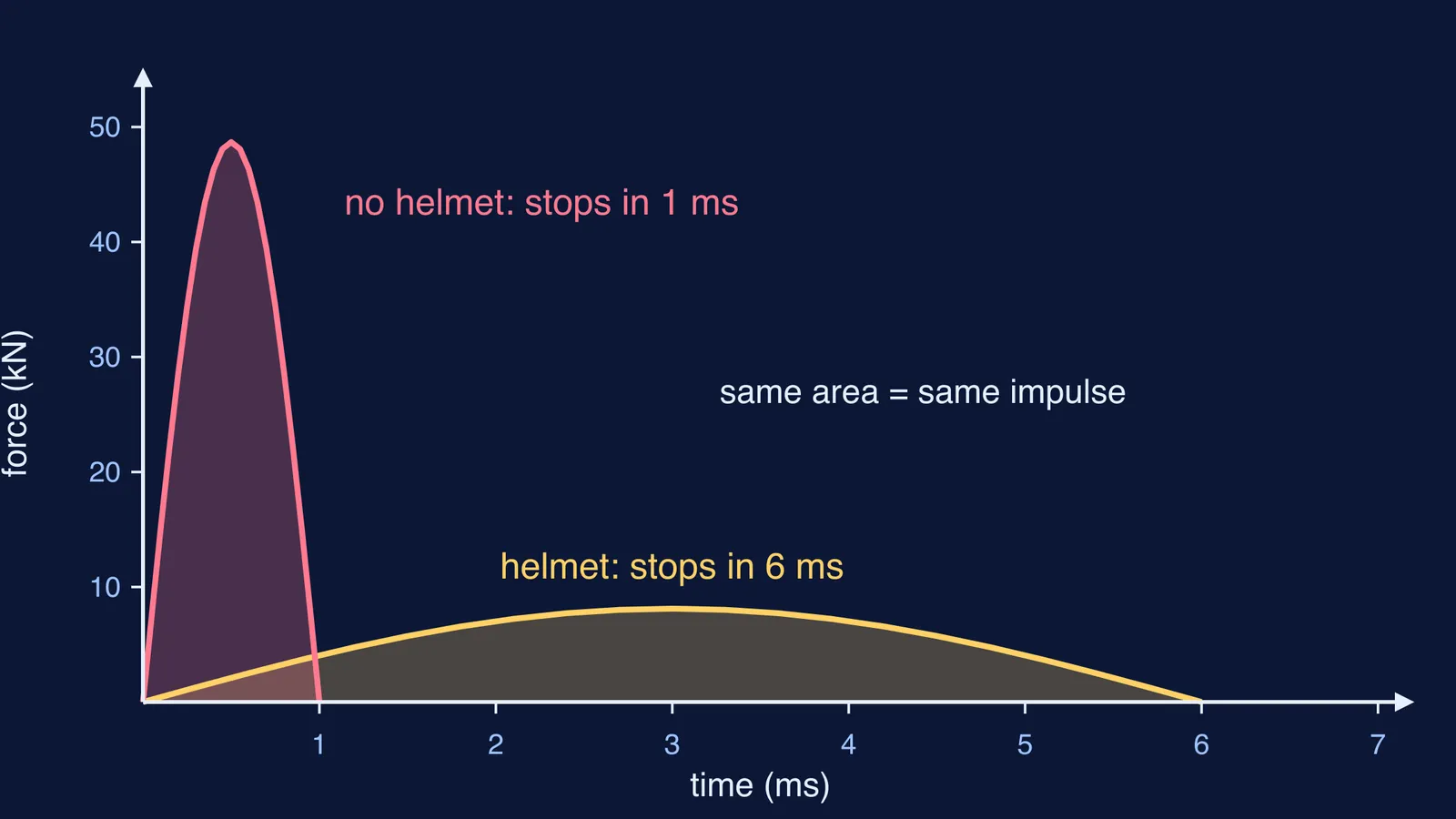
According to the Bicycle Helmet Safety Institute, most bike helmets use a liner of expanded polystyrene (EPS) foam. A helmet slows the stopping process so that the head stops in about six milliseconds rather than one millisecond or less. The foam does this by crushing: its cell walls crush on impact and slow the head gradually, turning a small part of the crash energy into heat along the way. The main gain is the longer stop.
The shell has a different job. It is stiff, so when it meets a stone or a kerb edge it does not let that sharp point dig into one spot of foam. It shares the load across a wide area of liner.
Why does a longer impact time mean less force?
Newton's second law can be written as force = change in momentum ÷ time. The change in momentum, called impulse, is fixed by the crash: your head was moving, and it ends up stopped. The only thing a helmet can change is the time.
Here is a worked example using the US safety standard for bicycle helmets, 16 CFR 1203, which drops helmets onto a flat steel anvil at 6.2 m/s, from a minimum height of 2 metres. Take a head of 5 kg, a round number we chose for easy arithmetic.
Momentum before the hit: 5 kg × 6.2 m/s = 31 kg·m/s. This is the impulse the ground must deliver to stop the head.
No helmet, stop in 1 ms: average force = 31 ÷ 0.001 = 31,000 N, about the weight of a three-tonne truck.
Helmet, stop in 6 ms: average force = 31 ÷ 0.006 ≈ 5,200 N.
Average deceleration with the helmet: 6.2 ÷ 0.006 ≈ 1,030 m/s², or about 105 g. Without it, 6.2 ÷ 0.001 = 6,200 m/s², about 630 g.
The same standard says the peak acceleration of any impact shall not exceed 300 g (16 CFR 1203.12). In our example, even the bare head's average, 630 g, is far past that limit. The helmeted head's average is 105 g; its peak is higher than the average (about 165 g if the force rises and falls smoothly) but still under 300 g. Six times the stopping time means one-sixth of the average force.
The same idea explains how seatbelts reduce injury in a crash and why a cushion stops an egg breaking. For ideas like this that are easier to see than to read, the Fermi Simulation Lab has interactive simulations.
What does the hard shell do for pressure?
Pressure is force divided by the area it acts on. A force spread wide can be survivable when the same force on one point would crack bone.
Take the 5,200 N from the example, landing through a stone edge on a patch of 2 cm². That is 5,200 ÷ 0.0002 = 26 million pascals. If the shell spreads the same force over 40 cm², the pressure falls to 1.3 million pascals, twenty times less. (These areas illustrate the idea; they are not helmet measurements.)
It is the reason behind why stiletto heels press harder than elephant feet.
Do bike helmets actually reduce head injuries?
The largest review we found is a 2016 meta-analysis in the International Journal of Epidemiology by Jake Olivier and Prudence Creighton. It reviewed 43 studies, pooling 40 of them, with data from over 64,000 injured cyclists. Among these cyclists, helmet use was linked to lower odds of head injury (odds ratio 0.49), serious head injury (0.31) and fatal head injury (0.35). In plain terms, the odds of a serious head injury were about 69% lower with a helmet.
A 60-second helmet check before you ride
Physics only helps if the helmet is in the right place. These checks come from the Bicycle Helmet Safety Institute fit guide:
The helmet sits level, its front just above your eyebrows (or just above your glasses frame).
The side straps meet in a Y just below each ear.
The chin strap is snug: when you open your mouth wide, you feel the helmet pull down a little.
Shake your head hard, then push the front edge up and back with your palm. It should not move more than about an inch from level.
After any crash where the helmet hit something, replace it. The Institute's liner guide advises replacing EPS helmets after every impact, because the foam is one-use and the crushing can be hidden by the outer shell.
If you want to practise impulse numericals like the one above, the Fermi Problem Library has worked problems with a step-by-step solver that explains the reasoning rather than printing an answer.


