

On this page
In short When a car stops suddenly, seatbelts protect you by stretching slightly to increase the time it takes your body to stop. According to the National Highway Traffic Safety Administration, this increased stopping time reduces the peak force exerted on you, lowering the risk of fatal injury by 45% in passenger cars.
When a car crashes, the vehicle stops in a fraction of a second. But what happens to the people inside?
The answer lies in Newton’s first law of motion: an object in motion stays in motion. If a car is travelling at highway speeds and hits a wall, the car stops, but the passengers keep moving forward at the same speed until something stops them. If they are not wearing a seatbelt, that "something" is the steering wheel, dashboard or windshield.
Seatbelts are designed to stop your body before you hit the interior of the car. But they do not just hold you rigidly in place; they use fundamental physics to make that stop survivable.
How does the impulse-momentum theorem explain seatbelts?
To stop a moving object, you have to change its momentum to zero. In physics, a change in momentum is called an impulse. Momentum is simply the product of an object's mass and its velocity. When you are travelling in a fast-moving vehicle, you possess a significant amount of momentum. To bring that momentum down to zero during a crash, an impulse must be applied to your body.
Impulse depends on two factors: the average stopping force applied, and the time over which that force acts. This is expressed in the equation J = F × Δt, where J is the impulse, F is the force, and Δt is the time interval. Because the required change in momentum is entirely fixed by your body mass and how fast you were going before the impact, the total impulse required to stop you is always the exact same amount. You cannot change the impulse, but you can change how it is delivered.
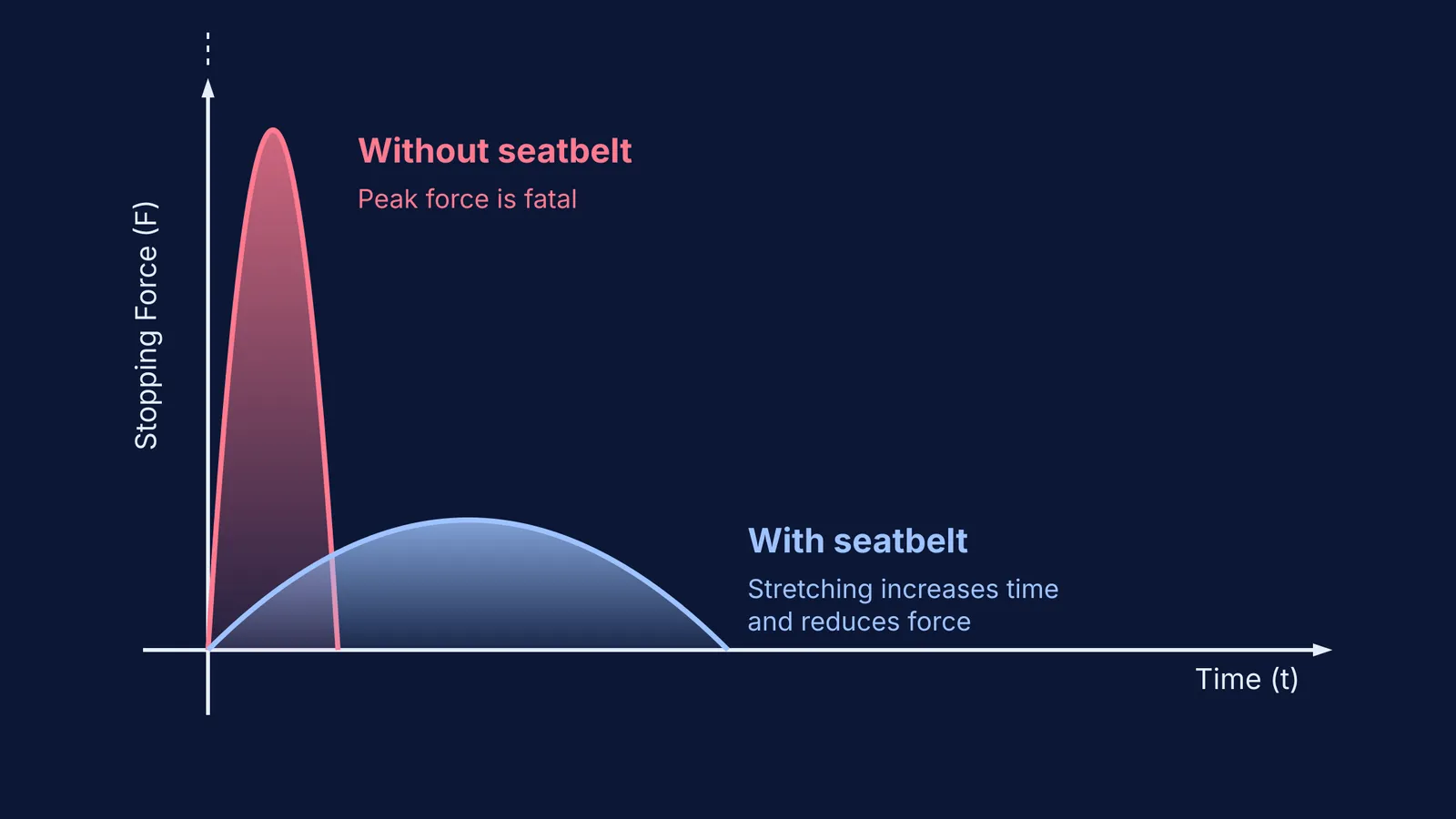
This means that the stopping force and the stopping time are inversely proportional. If you hit a hard, unyielding surface like a dashboard or a steering wheel, you come to a stop almost instantly. Because the time interval (Δt) is tiny—often just milliseconds—the force (F) must be correspondingly massive to deliver the necessary impulse. This sudden spike in force is what breaks bones and causes severe or fatal internal injuries.
A seatbelt is made of a special woven fabric that is specifically designed to stretch slightly under an immense load. This engineered stretch increases the time it takes for your body to come to a complete halt. By spreading the deceleration over a longer period, the peak stopping force drops significantly. You still experience the same overall change in momentum, but the seatbelt ensures the force never reaches a lethal threshold.
How does a seatbelt spread the pressure?
Seatbelts also rely on the physics of pressure, which is defined as force divided by the area over which it is applied (P = F / A). Even if the total stopping force is reduced by the seatbelt stretching, it still matters exactly where that force is applied to your body.
If you hit a steering wheel, the entire stopping force is concentrated on a small, vulnerable area like your head or chest. Because the area (A) is small, the resulting pressure (P) is enormous, which easily punctures organs or fractures delicate bones. A standard lap and shoulder seatbelt works entirely differently. The wide straps spread the stopping force across a much larger surface area of your body, drastically reducing the pressure at any single point.
More importantly, they apply that force to your strongest structural bones: the pelvis and the rib cage. These bones form rigid cages that are biologically equipped to handle high-stress impacts much better than your softer organs, abdomen, or neck.
How can you visualise the forces of a crash?
In mechanics problems for exams like JEE Main, this trade-off between force and time is a classic concept. You might see it tested as the normal force of a car over a hump or as the elastic energy in a stretched wire. However, visualising how those variables change together can be difficult when you are just staring at equations.
If you are struggling to picture the maths, the Fermi Simulation Lab provides interactive simulations for the ideas that are easier to see than to read.
What can you do to stay safe?
The physics of a crash are entirely predictable, which means the protection is too.
Wear the lap and shoulder belt correctly. The lap belt should sit low across your hips (pelvis), not high on your stomach. The shoulder belt should cross the middle of your chest and collarbone.
Understand kinetic energy. Kinetic energy scales with the square of velocity (Eₖ = 1/2 m v²). Even at low speeds, the energy to be dispersed is too high for human arms to brace against.
Use the physics. When studying impulse or momentum for school, think of the seatbelt. Connecting abstract formulas to everyday safety makes the concepts stick much better than rote memorisation.


