

On this page
It sounds like a trick question from a physics exam: what exerts more pressure on the floor, a multi-ton African elephant or a person walking across the room in high heels?
The answer comes down to the fundamental difference between force and pressure. While an elephant exerts a much larger total force due to its massive weight, a stiletto heel focuses its wearer's weight onto a tiny point. This creates a pressure high enough to dent hardwood floors that the elephant could safely walk across.
What is the difference between force and pressure?
Force is the total push or pull on an object. For a standing animal or person, that downward force is simply their weight. An African elephant weighs around 6,000 kilograms, meaning it exerts a massive downward force on the ground (The Physics Factbook).
Pressure is defined as force divided by the area over which it is applied.
When an elephant walks, its massive weight is distributed across four large, circular feet. Research published in *Science* confirmed that an elephant's foot contains a thick, fibrous fat pad and a bone acting as a "sixth toe" (Science). This internal strut and fat pad expand when the elephant steps down, spreading the weight over a huge surface area. Because of this large area, the pressure exerted by an elephant is only about 50 to 100 pounds per square inch (PSI).
Why do stiletto heels press harder than elephant feet?
A person wearing stilettos weighs far less than an elephant—perhaps 60 kilograms (130 pounds), and a stiletto heel concentrates a large portion of that weight into an area as small as a quarter of a square inch (The Physics Factbook).
Because the area is so small, the resulting pressure is immense. A standard stiletto heel concentrates a person's weight into a tiny point, resulting in pressures exceeding 1,500 PSI.
This means a person in stilettos exerts 15 to 30 times more pressure on the ground than an elephant. This extreme pressure is why stiletto heels can permanently crack soft tiles and sink immediately into grass, whereas an elephant can walk across the same surface without puncturing it. This same principle dictates why snowshoes keep you from sinking into deep snow, and why a sharp knife cuts better than a dull one.
How do you visualise pressure?
If you want to build an intuition for how force and area interact, reading the maths is a good start, but seeing it happen is better. In the Fermi Simulation Lab, you can adjust the weight and surface area of an object to instantly see how the pressure changes. Fermi's AI tutor works alongside the simulation, checking understanding as it goes and guiding you through the reasoning step-by-step.
Where do we see pressure in real life?
This principle of adjusting area to control pressure is used everywhere in design and engineering. When you need to reduce pressure, you increase the surface area:
Tractor treads: Heavy construction vehicles use wide treads instead of wheels to spread their massive weight, preventing them from sinking into mud.
Camels in the desert: Similar to elephants, camels have broad, flat feet that distribute their weight so they can walk on soft sand.
When you need to increase pressure, you decrease the surface area:
Nails and pins: A small push on the head of a drawing pin translates into a massive pressure at the sharp tip, easily piercing a wall.
Ice skates vs. blades: While a flat ice skate glides smoothly over the ice by distributing your weight, the sharp edges of the blade concentrate your weight to cut into the ice for steering.
How do you calculate pressure?
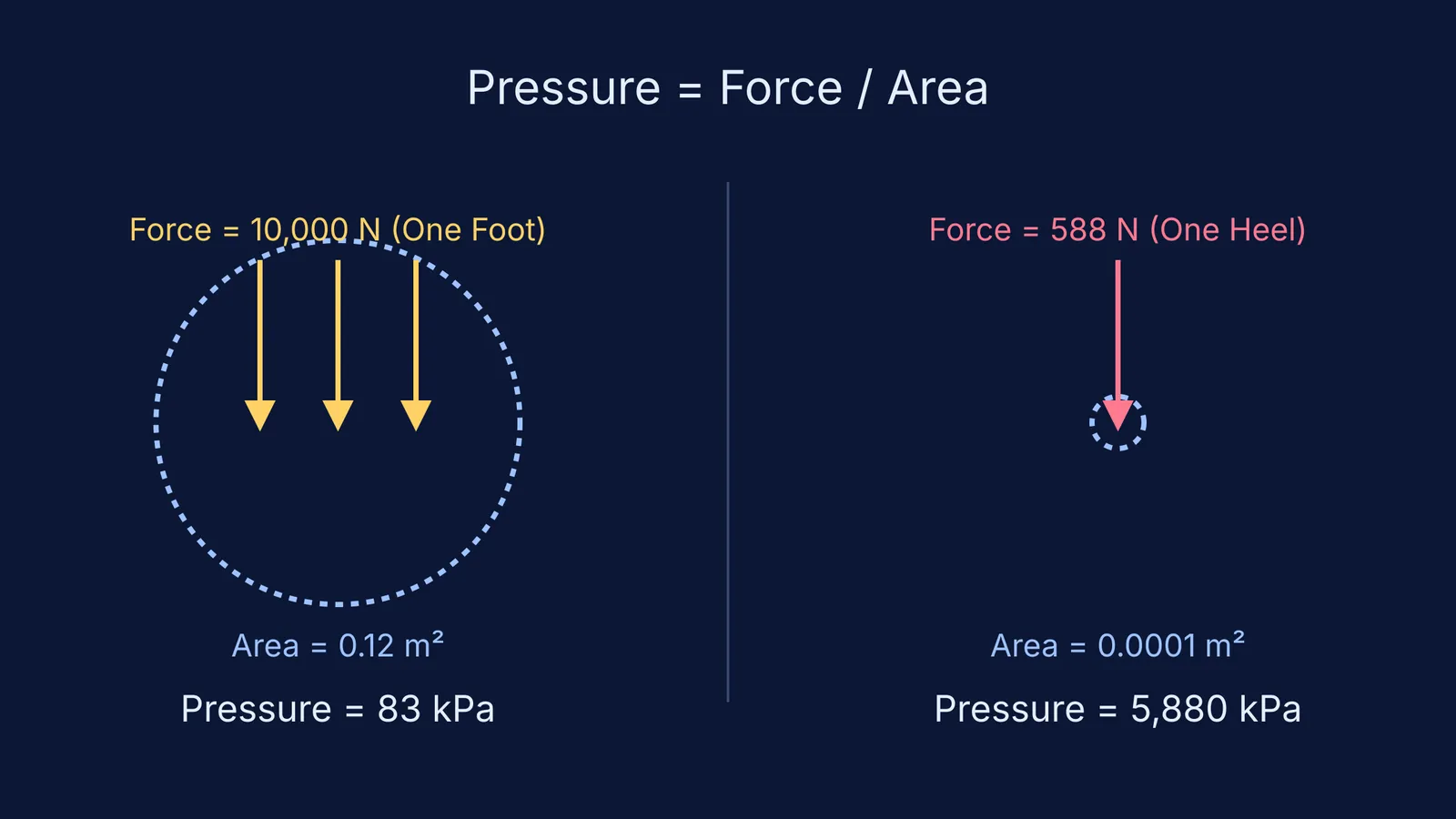
Let's calculate the exact pressure for a 60-kilogram person balancing their weight on one heel with an area of 1 square centimetre (0.0001 square metres) (The Physics Factbook).
Calculate force: Weight equals mass times gravity (F = mg).
60 kg × 9.8 m/s² = 588 Newtons.
Calculate pressure: Pressure equals force divided by area (P = F / A).
588 N / 0.0001 m² = 5,880,000 Pascals (Pa).
That is nearly 6 million Pascals (or 6,000 kPa) of pressure concentrated on a tiny point. By comparison, if an elephant's foot pushes down with a force of 10,000 Newtons over an area of 0.12 square metres, the pressure is roughly 83,000 Pascals—less than a seventieth of the stiletto's pressure.
For more practice with hydrostatics and everyday forces, exploring Force and pressure in Class 8 or reviewing Pressure at depth and gauge pressure: hydrostatics problems are great next steps.


