On this page
Walk into the great stage, the mahamandapam, of the Vittala temple at Hampi and you will see pillars that are not single blocks. Many are clusters of thinner stone columns, and a tap of a finger makes them ring. Scientists have measured why, and you can test the physics on your desk tonight.
What did scientists find inside Hampi's musical pillars?
A 2008 paper in The Journal of the Acoustical Society of America by Anish Kumar and colleagues at the Indira Gandhi Centre for Atomic Research, Kalpakkam, describes itself as the first scientific investigation of these pillars.
The team studied the 11 most popular pillars of the mahamandapam, those that produce sounds of specific musical instruments, according to the paper's abstract. They recorded each pillar's sound and examined the columns with low-frequency ultrasonic testing, impact-echo testing and in situ metallography, methods that do not damage the stone.
Three findings matter most, as Physics Today reported in November 2008:
Ultrasound and impact-echo testing showed all the columns to be solid shafts.
Metallography showed the granite has typical microstructures.
The sound arises from the flexural mode of vibration: the column bends from side to side.
The key result: the peak frequencies in the sound had excellent correlation with flexural frequencies calculated from the columns' measured dimensions and ultrasonic velocities, as the JASA abstract states. In other words, standard beam physics accounts for the notes.
Physics Today also notes that the temple is more than 500 years old and that several multi-column pillars sound similar to the ghanta (bell), mridanga (percussion) or veena (strings).
Why does a stone column make a musical note?
Think of each column as a stiff beam held at its base and top. A tap pushes it sideways, its stiffness pulls it back, it overshoots, and it keeps swinging. Those swings push on the air as a note, the idea in our explainer on how sound is produced by vibrating objects.
The Kumar paper calculated flexural frequencies from each column's dimensions and ultrasonic velocity. For a slender solid beam, textbook bending theory (the Euler-Bernoulli beam) gives the frequency of each mode as
f = (k / L²) × d × √(E/ρ)
where L is the column's length, d its thickness, E the stone's stiffness (Young's modulus), ρ its density, and k a number fixed by the mode, the shape of the cross-section and how the ends are held. The quantity √(E/ρ) is roughly the speed of sound in the stone, which is why a measured sound speed lets you predict the note.
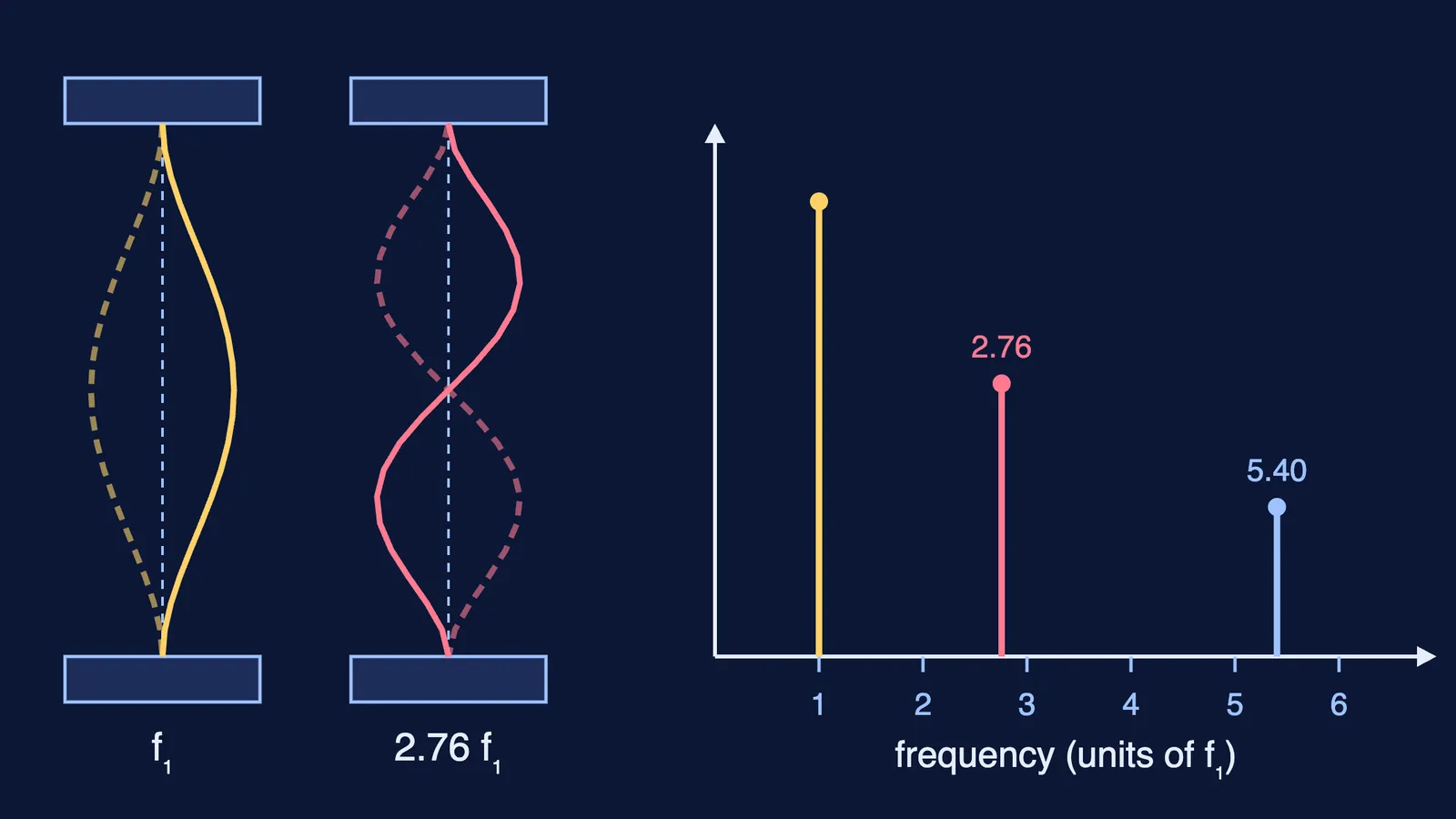
For an idealised column fixed at both ends (the diagram above), the same theory puts the second mode at about 2.76 times the first frequency, not twice. A string's overtones are whole-number multiples (see which harmonics a plucked string makes); a beam's are not, one reason a struck bar sounds so different from a plucked string.
How much does length change the pitch?
Frequency goes as 1/L², so length is the strongest lever. A worked example:
Column A and column B are the same granite and the same thickness.
Column B is a fifth shorter, so L_B = 0.8 L_A.
f_B / f_A = 1 / 0.8² = 1 / 0.64 = 1.56.
Column B rings at about 1.56 times column A's frequency, a jump of roughly 7.7 semitones, a little more than a musical fifth.
Thickness works the other way and more gently: a column a tenth thicker rings about a tenth higher.
How can you hear beam physics at home?
A steel ruler pressed onto a table is a beam fixed at one end, and its frequency also goes as 1/L².
Press a steel ruler flat on a table with 10 cm hanging over the edge. Flick the free end and listen.
Slide it in until 5 cm hangs over. Halving the length should raise the frequency fourfold, two octaves.
Record both on a free phone spectrum-analyser app and read the peak frequencies. Check whether the ratio comes out near 4.
Short overhangs work best: a long one vibrates too slowly for a clear tone. If the ratio misses 4, your hand is not a perfectly rigid clamp, a normal gap between model and object. Our post on why a ruler sounds higher when you shorten its overhang covers the same desk-edge effect.
If mode shapes are hard to picture, the Fermi Simulation Lab has interactive simulations for the ideas that are easier to see than to read.
What are scientists still studying at Hampi?
A 2012 conference paper by Hemant Patil and Shrishail Gajbhar presented an acoustical analysis of a musical pillar of the same great stage. In 2025, Shashank Aswathanarayana and Braxton Boren of American University analysed the acoustic response of the Vijaya Vittala temple and found low-frequency amplification like that at other cultural heritage sites.
Next time a textbook asks for the frequency of a vibrating rod, remember that the same physics explains these centuries-old ringing columns.