

On this page
Press one end of a ruler flat on your desk, let the other end hang over the edge, and flick it. You get a buzz. Slide it back so less hangs over, flick again, and the buzz jumps higher. A MnSTEP classroom activity hosted by Carleton College sums it up as "the shorter the ruler, the higher the sound". The more useful question for a Class 9 or Class 11 student is how much higher, and why.
What is the ruler doing when it buzzes?
The overhanging part is a cantilever: a beam held fixed at one end and free at the other. Flicked, it bends, springs back past its resting position, and keeps swinging until friction and air drain the energy. Every full swing pushes the air once, so the sound repeats at the same rate the ruler swings. That rate is the frequency, measured in hertz (swings per second).
Your ear turns frequency into pitch. In the words of OpenStax College Physics, "Perception of frequency is called pitch." Faster swings give a higher note.
Why does the pitch change when the ruler vibrates over a shorter length?
A shorter overhang is stiffer and has less moving mass. Push the tip of a short one and it barely bends; a long one sags easily. More stiffness pulls the ruler back harder, and less mass responds faster, so both raise the frequency.
Beam theory puts a number on it. For a beam clamped at one end, the lowest natural angular frequency is ω₁ = (3.516 / L²) × √(EI/μ), as set out in the Euler–Bernoulli beam theory article. E is how stiff the material is, I describes how the ruler's cross-section resists bending, μ is its mass per metre, and L is the free length. When you slide the ruler along the desk, only L changes.
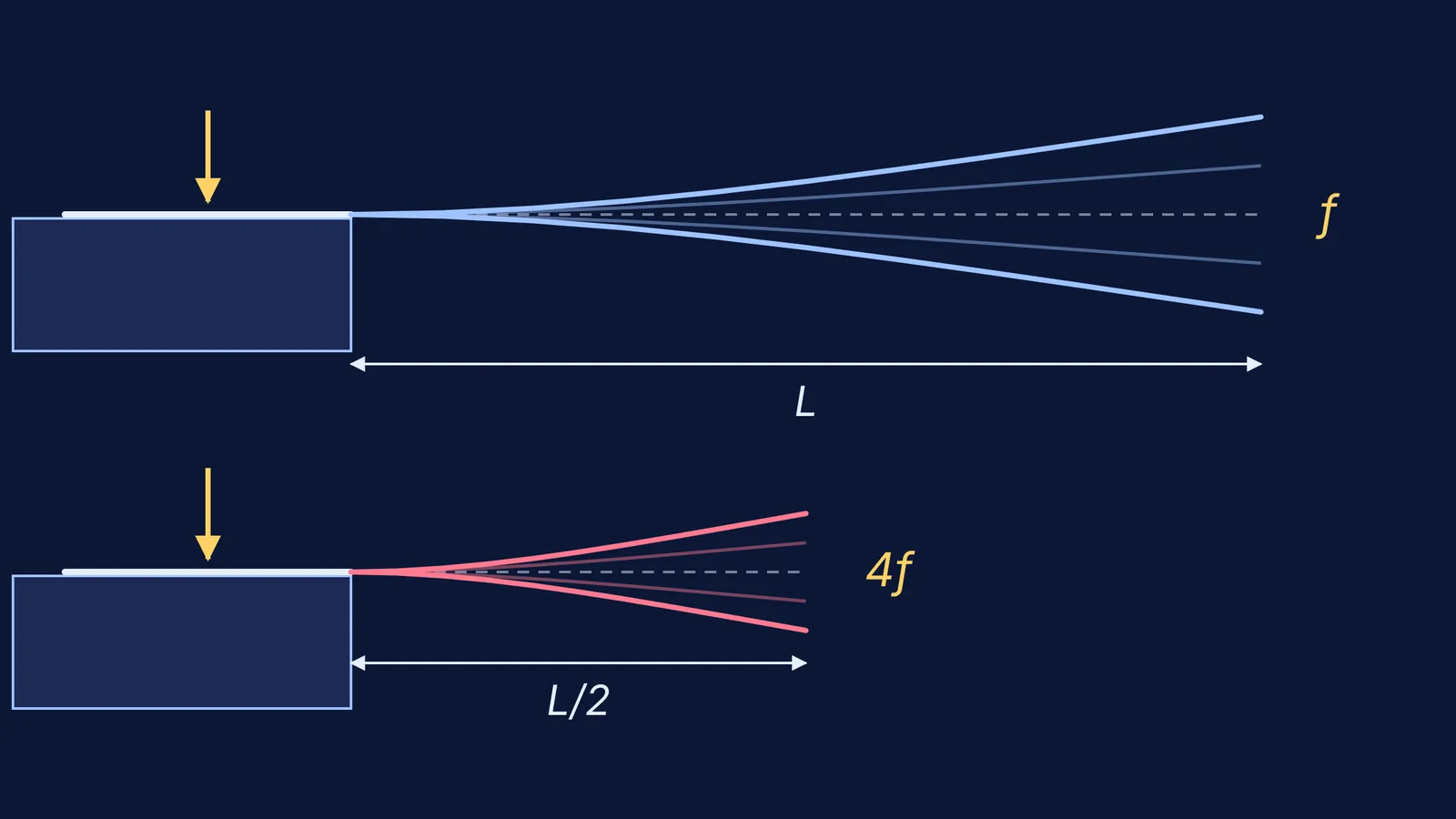
The ruler's frequency is proportional to 1/L², so halving the overhang makes it vibrate four times faster.
Four times the frequency is two octaves, because an octave is "an interval between two tones, one having twice the frequency of vibration of the other" (Octave, Wikipedia).
How much higher does it get? A worked example
You do not need to know E, I or μ to predict the change. Measure one frequency, then scale by the square of the length ratio from the cantilever formula. Say your ruler swings at 15 Hz with 20 cm hanging over (an example; yours will differ):
20 cm overhang: 15 Hz, your reference
15 cm overhang: 15 × (20/15)² ≈ 27 Hz
10 cm overhang: 15 × (20/10)² = 60 Hz
5 cm overhang: 15 × (20/5)² = 240 Hz
A quarter of the length gives sixteen times the frequency. This shortcut is for clamped rulers and beams; strings and pendulums follow different length rules.
Real rulers drift from the ideal. Your palm is not a perfect clamp, so the true free length is a little longer than the one you mark, and the mismatch matters most at the shortest overhangs.
How do you run the ruler experiment safely at home?
The Carleton activity's one safety note is that wooden and plastic rulers "might break" (MnSTEP), so keep the flicks small. Then:
Use a 30 cm plastic or wooden ruler and mark overhangs of 20, 15, 10 and 5 cm with a pencil.
Press the part on the desk down firmly with your palm, right at the edge.
Keep your face well back from the free end, and flick it with the same small push each time.
Measure the frequency with a free tuner or spectrum app on a phone, or film in slow motion and count swings across a known number of frames.
For each length, write down f and work out f × L². If the 1/L² rule holds, these products come out roughly equal.
For extra credit, plot log f against log L. The points should fall close to a straight line with a slope of about −2.
If you want to see an idea move before you test it, the Fermi Simulation Lab has interactive simulations for ideas that are easier to see than to read.
Why can you see a long ruler wobble but hear no note?
People hear sound in roughly the range of 20 to 20,000 Hz, according to OpenStax College Physics. A long overhang can swing slower than 20 times a second. You see it wobble, but you hear only the clack against the desk. Shorten it and the swings climb into the range your ear treats as a note.
The ruler also vibrates in higher patterns. From the roots in the beam theory article, the second runs about 6.3 times faster than the first, not a whole-number multiple, which may be part of why a ruler buzzes rather than sings a clean note.
If 1/L² or angular frequency still feels shaky, the Fermi Concept Library has a lesson for every concept in physics, oscillations included, so you can go back one step and try again.


