

On this page
Hear a shehnai at a wedding and it cuts through everything; hear a flute in the next room and it floats. Both are tubes of air, and so is a trumpet. The physics that sets their notes is the Class 11 chapter on waves: a standing wave in a pipe. What differs is the part at the top that keeps the air moving.
How does a shehnai produce sound?
The Horniman Museum in London classifies the shehnai as a reed pipe "with double (or quadruple) reeds with conical bore with fingerhole stopping" (Horniman Museum record). This one, from northern India, has seven fingerholes and a nickel silver bell.
The player blows through the reed, usually two thin blades with a narrow gap between them. When the pressure inside falls, the reed tends to close and let less air in; when it rises, the reed opens a little and lets more in (UNSW, how woodwinds work). For a double reed, "the reed acts like an oscillating valve" (UNSW, double reed acoustics).
The reed does not choose the note. The air column does: the reed is "forced to vibrate at the natural frequency of the air in the tube", says the same woodwind page. Pressure pulses run down the bore, reflect at the open end and come back in time to push the reed open or shut.
Reed, lips or air jet: what is the difference?
Each turns a steady breath into an oscillating flow.
Shehnai (reed): the double reed opens and closes with the pressure in the bore.
Trumpet (lips): "the lips act as a vibrating valve that modulates the air flow into the instrument" (UNSW, brass acoustics). Most of a trumpet's bore is cylindrical, with a flare and bell at one end.
Flute (air jet): there is no solid valve. The air jet works "in cooperation with the resonances in the air", and the flute is open at both ends (UNSW, flute acoustics).
Why does the length of the pipe set the note?
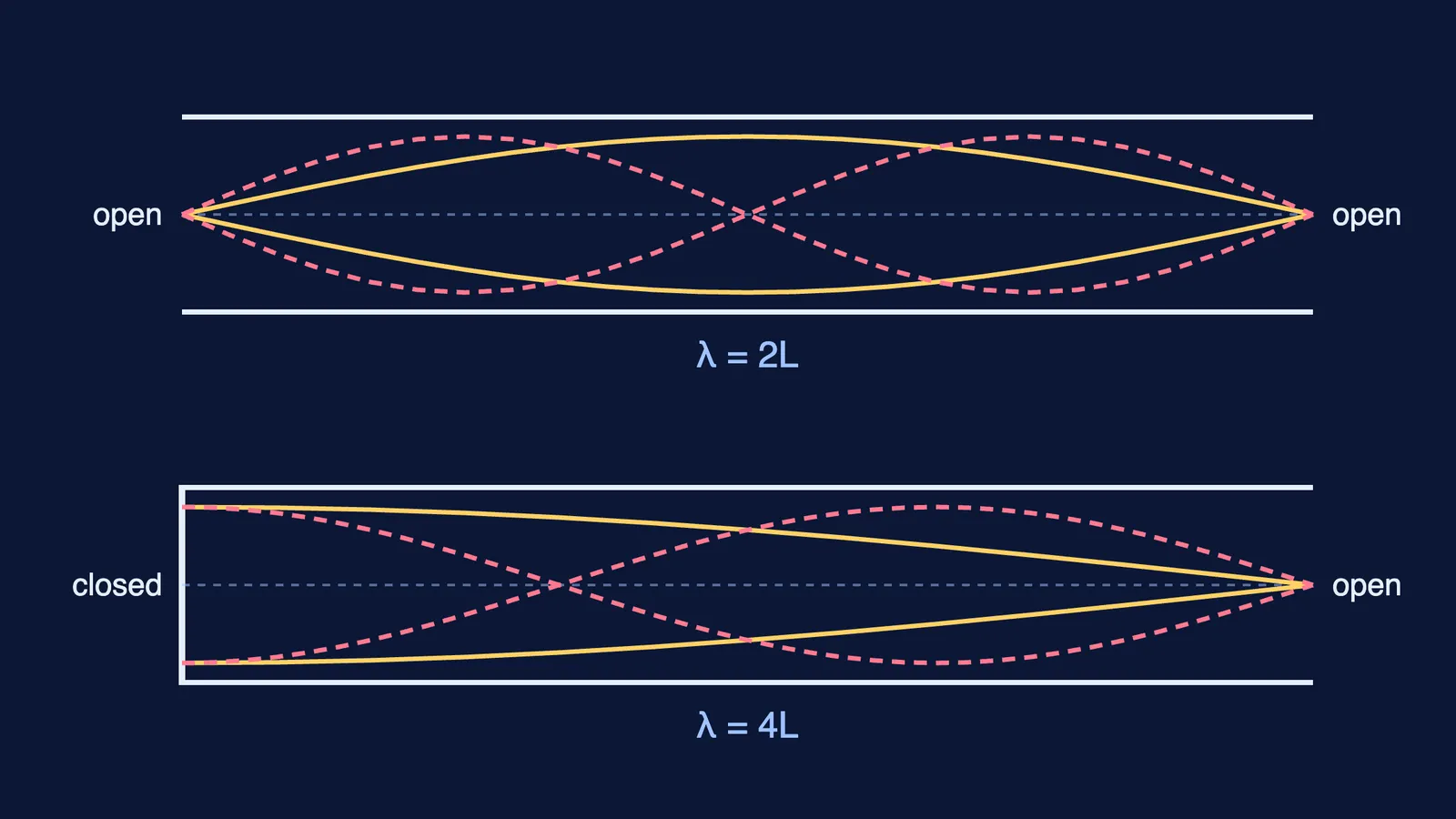
A standing wave has to fit the pipe. At an open end the pressure stays close to atmospheric, a pressure node; at a closed end the pressure swings most.
An open pipe's longest wavelength is twice its length, λ = 2L, and it plays the complete harmonic series (UNSW, flutes v clarinets).
A pipe closed at one end, like a clarinet, has λ = 4L and only odd harmonics.
A conical bore, like the oboe's or the shehnai's, is closed at the reed end yet has the same frequencies as an open pipe of the same length (UNSW, how woodwinds work).
For a simple cylinder, the open end acts as if the pipe were longer by about 0.6 times its radius, the textbook end correction (UNSW, flutes v clarinets).
Worked example: how high is a shehnai's lowest note?
The Horniman's shehnai M33-1985 has an overall length of 336 mm (Horniman Museum record). For the speed of sound in warm, moist air, UNSW uses 345 m/s (UNSW, brass acoustics).
The bore is conical, so treat it as an open pipe: f = c/2L.
f = 345 / (2 × 0.336) ≈ 513 Hz.
A closed cylinder of the same length would give f = c/4L ≈ 257 Hz, an octave lower.
Check: a flute's lowest note, C4, is about 260 Hz (UNSW, flute acoustics), so L = c/2f ≈ 0.66 m, about twice our shehnai.
Step 2 is an estimate: the reed, the cut-off tip of the cone and the end correction all lower the real note. The lesson holds: halve the length and you double the frequency.
How do holes and valves change the note?
An open tone hole gives a "low impedance 'short circuit' to the outside air", and opening holes is "rather like making the pipe shorter" (UNSW, flute acoustics). On the modern Boehm flute, each opened tone hole raises the pitch by a semitone. The shehnai's seven fingerholes (Horniman Museum record) do the same job.
A trumpet has no holes. Its valves insert extra lengths of pipe, so the column gets longer and the note lower, and the player picks a note from the harmonic series with the lips: "high lip tension gives high frequency" (UNSW, brass acoustics).
A checklist for any pipe question
Which ends are open? Open at both ends or conical: λ = 2L, all harmonics. Closed at one end: λ = 4L, odd harmonics only.
Is there an end correction? For a cylinder, add about 0.6r at each open end (UNSW, flutes v clarinets).
Which speed of sound? It changes with temperature, which is why an organ pipe's frequency shifts when the air warms.
The Fermi Simulation Lab has interactive simulations for ideas like this, and our resonance tube walkthrough uses a pipe closed at one end to measure the speed of sound. If you're unsure where your gaps in waves are, Fermi's AI tutor works out what you already know and builds a plan for the session.


