On this page
Gum karaya is a tree gum that smells faintly of vinegar. The Bureau of Indian Standards turns that smell into a pass mark. IS 12408:1988, the specification for food-grade gum karaya, requires at least 10% volatile acid, calculated as acetic acid. The test hydrolyses the gum with phosphoric acid, distils off the acetic acid and titrates it with NaOH. Each step is a Class 11 or Class 12 idea, and the arithmetic makes a neat titration numerical.
What is gum karaya and what does BIS require?
Clause 2.1 of IS 12408 defines gum karaya as "a dried gummy exudation obtained from the stems and branches" of Sterculia urens and S. villosa. Clause 2.2 says it is white to amber and has "a slightly acetous odour and a mucilaginous and slightly acetous taste". Acetous means vinegar-like. The foreword says gum karaya is permitted in food as an emulsifier, stabiliser and thickening agent.
Table 1 of the standard sets the limits. A few that matter here:
Loss on drying: at most 16% by mass.
Starch: nil.
Volatile acid, as acetic acid: at least 10% by mass (method A-9).
The explanatory note at the end of the standard says what the gum is made of. It "consists mainly of high molecular-weight acetylated polysaccharides, which on hydrolysis yield galactose, rhamnose, and galacturonic acid, together with minor amounts of glucuronic acid."
Where does the vinegar smell come from?
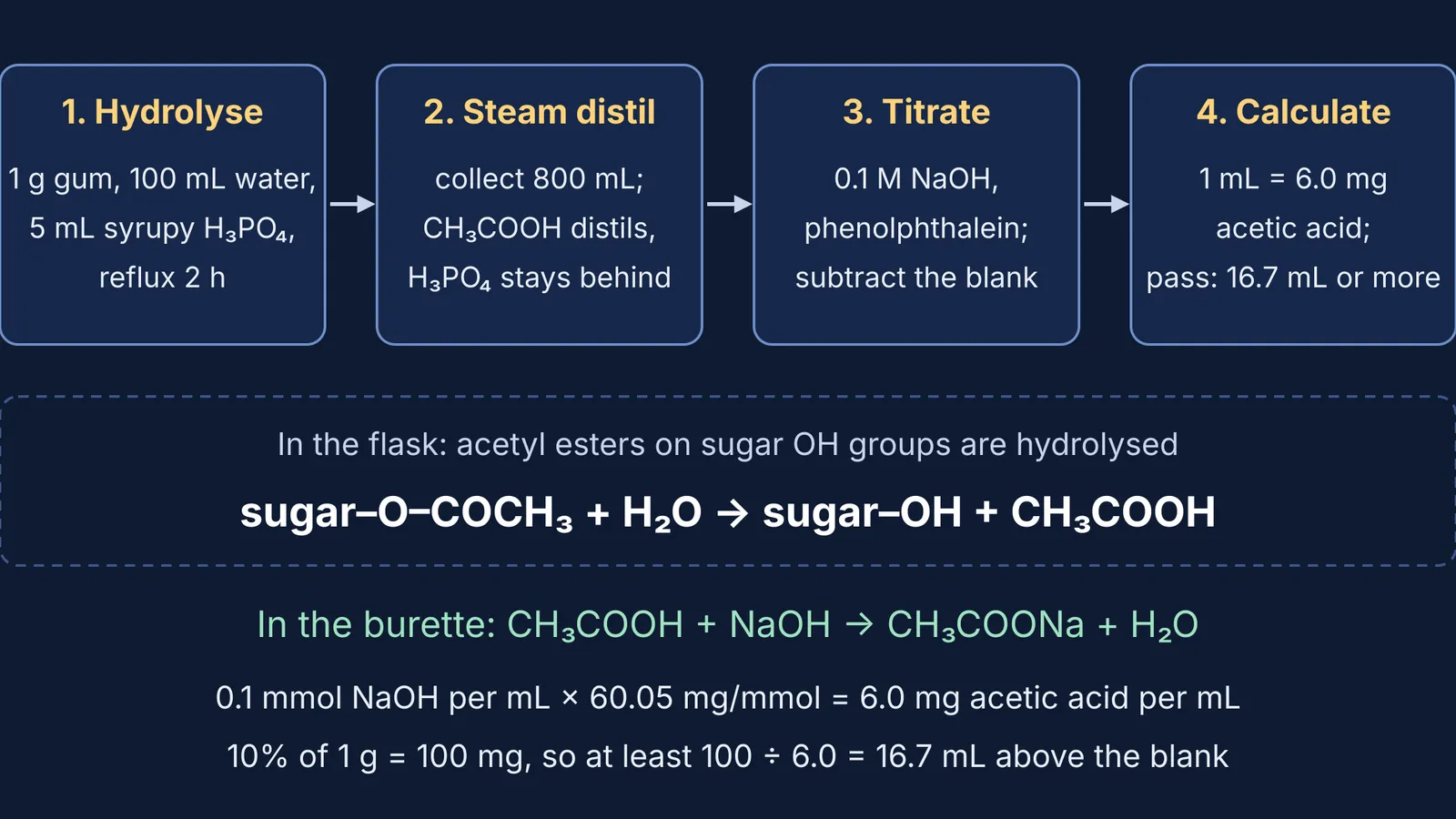
"Acetylated" means that some of the sugar OH groups carry acetyl groups, –O–CO–CH₃. Each one is an ester of acetic acid with a sugar hydroxyl, the same link you make when you acetylate glucose to its pentaacetate. Hot acid hydrolyses these esters:
sugar–O–COCH₃ + H₂O → sugar–OH + CH₃COOH
H⁺ is the catalyst. The large excess of water drives this ester hydrolysis forward, and distillation removes the acetic acid. If you want the mechanism step by step, see acid and base hydrolysis of esters.
Note that the standard counts acetic acid released, not acetyl groups. An acetyl group (CH₃CO, 43.0 g/mol) is lighter than acetic acid (60.05 g/mol), so the 10% limit is about 7.2% acetyl by mass.
How does the BIS volatile-acid test work?
Method A-9 of IS 12408 runs like this:
Put 1 g of gum in a 700 mL long-necked flask with 100 mL of water and 5 mL of syrupy orthophosphoric acid.
Let it stand "for several hours or until the gum is completely swollen", then boil gently under reflux for two hours.
Steam distil until 800 mL of distillate has collected and about 20 mL of acid residue is left.
Titrate the distillate with 0.1 M NaOH, using phenolphthalein.
Repeat the whole procedure without the gum. The difference between the two titres is the alkali used by the volatile acid.
The titration reaction is CH₃COOH + NaOH → CH₃COONa + H₂O, 1:1. Phenolphthalein suits a weak acid against a strong base, whose equivalence point is above pH 7.
Why phosphoric acid, and why so much distillate?
The standard gives no reasons, so this is our own chemistry. The acid catalyst must stay in the flask. Hydrochloric acid would distil over with the steam and be titrated along with the acetic acid, giving a falsely high result. Orthophosphoric acid is not volatile in steam, so only the acetic acid reaches the receiver. Concentrated sulphuric acid is also non-volatile, but it is a strong dehydrating and oxidising agent and could char the sugars.
The large volume has a different cause. NCERT's principle of steam distillation is about a liquid that does not mix with water. Acetic acid mixes with water completely, and it is less volatile than water (it boils at about 118 °C). Each portion of steam carries only part of the acid over, so you must keep distilling, 800 mL in all, to collect most of it.
The blank catches any acid that comes from the reagents and water rather than the gum.
Worked example: does this sample pass?
A 1.000 g sample needs 19.4 mL of 0.1 M NaOH. The blank needs 0.6 mL.
Moles per mL. 1 mL of 0.1 M NaOH holds 0.1 mmol of NaOH.
Mass per mL. 0.1 mmol × 60.05 mg/mmol = 6.0 mg of acetic acid. This is the standard's factor: "each ml of 0.1 M sodium hydroxide is equivalent to 0.006 g of volatile acid calculated as acetic acid."
Corrected titre. 19.4 − 0.6 = 18.8 mL.
Mass of acid. 18.8 × 6.0 = 112.9 mg.
Percentage. 112.9 mg ÷ 1000 mg × 100 = 11.3%. The limit is 10% minimum, so the sample passes.
Turn it round. 10% of 1 g is 100 mg, and 100 ÷ 6.0 = 16.7 mL. Any corrected titre below 16.7 mL fails.
You can also ask how heavily acetylated the gum is. 100 mg of acetic acid is 100 ÷ 60.05 = 1.67 mmol, so a gum at the limit carries 1.67 mmol of acetyl per gram, or one acetyl group for every 600 g of gum. Take away the 42 g the acetyl adds and about 558 g is left: roughly 3.4 sugar residues of 162 g (C₆H₁₀O₅), or 3.2 if they were galacturonic acid residues of 176 g. These are model numbers; the real gum is a mixture that also holds water and ash.
For more titration numericals with blanks and back-titrations, the Fermi Problem Library has a step-by-step solver that explains the reasoning at each stage.
What do the identity tests show?
Clause 2.3 reads like a Biomolecules revision sheet.
Hydrolysis, then a copper test (2.3.4). A gum mucilage is boiled with concentrated HCl, made alkaline with 5 M NaOH and heated with potassium cupritartrate, a Fehling-type reagent. "A red precipitate is formed." The polysaccharide itself is not a reducing sugar. Acid hydrolysis breaks the glycosidic links and frees sugars with open aldehyde groups, which reduce Cu²⁺ to red Cu₂O: RCHO + 2Cu²⁺ + 5OH⁻ → RCOO⁻ + Cu₂O + 3H₂O. The NaOH is needed because the copper test only works in alkali. See Benedict vs Fehling solution for the tartrate's job.
Starch (A-3). Boil with water, cool and add iodine. A blue colour means starch, and the standard requires none.
Swelling (2.3.1 and 2.3.2). In water the gum forms a stiff gel that is "acid to litmus". The uronic acids in the note (galacturonic and glucuronic) carry COOH groups. The gum also swells in 60% ethanol, which the standard says "distinguishes gum karaya from other gums".
Colour tests (2.3.3 and 2.3.5). HCl gives "a permanent red or pink colour" and 5 M NaOH a brown one. The standard does not explain either.
Where is this in the syllabus?
Class 12 Biomolecules: polysaccharides, hydrolysis to reducing sugars, Fehling's test, the starch–iodine test.
Class 12 Aldehydes, Ketones and Carboxylic Acids: ester hydrolysis, acetic acid.
Class 11: steam distillation, acid–base titration, mole calculations.
Quick checklist
Gum karaya is an acetylated polysaccharide; acid hydrolysis releases acetic acid.
BIS requires at least 10% volatile acid, as acetic acid, by mass.
1 mL of 0.1 M NaOH = 6.0 mg of acetic acid; the pass mark is 16.7 mL above the blank for 1 g.
10% as acetic acid is about 7.2% as acetyl groups.
After hydrolysis, the sugars reduce cupritartrate to red Cu₂O.