On this page
The copper wire inside your wall switch is full of electrons that are moving fast even when no current flows. Cool the wire towards absolute zero and they keep moving at about 1,570 km/s. Heat cannot explain that speed. The Pauli exclusion principle can, and a short count of standing waves in a box gives the number. This post builds that count from the one-dimensional box. The three-dimensional counting is beyond the NCERT syllabus, so treat it as reading for curiosity and for olympiad-level problems, not as board-exam material.
Why can't the electrons in copper all sit still?
In the free-electron picture, each copper atom gives one electron to a shared "gas" that moves through the whole metal. Classical particles would all come to rest at 0 K.
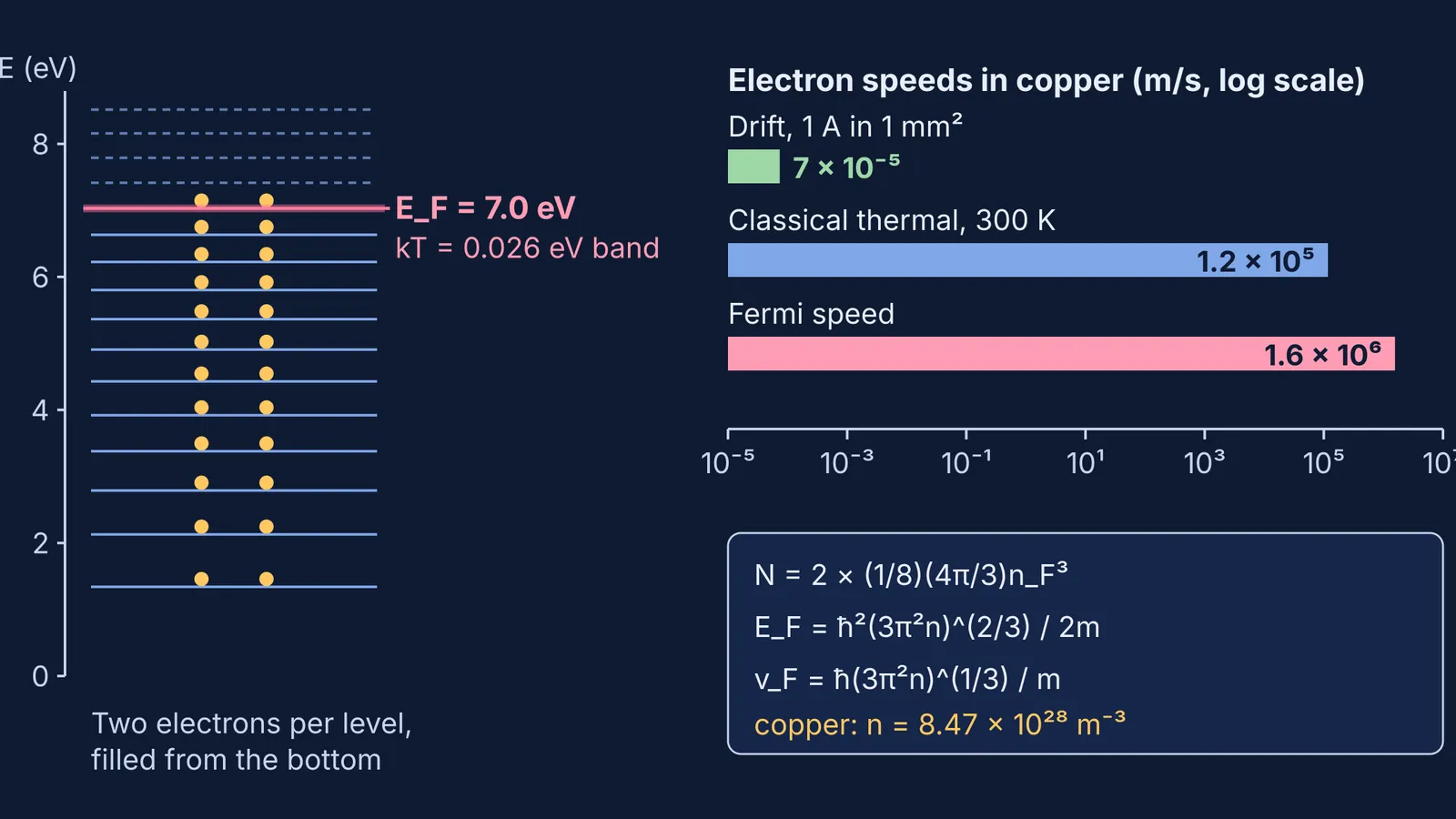
Electrons are fermions. The exclusion principle that Wolfgang Pauli stated allows at most one electron in each quantum state. Each allowed wave pattern (a "level") can hold two electrons, one spin up and one spin down. So the electrons cannot all crowd into the lowest level. They stack up, two per level, from the bottom. The energy of the highest filled level at 0 K is the Fermi energy, E_F, and the speed of an electron with that kinetic energy is the Fermi speed, v_F.
What are the energy levels of an electron in a box?
Start with a particle of mass m trapped in a line of length L. Its de Broglie wave must fit with nodes at both ends, so a whole number n of half-wavelengths fits: L = nλ/2. With p = h/λ, the kinetic energy is
Eₙ = p²/2m = n²h²/8mL², with n = 1, 2, 3, ...
Now make the box a cube of side L. The wave must fit along x, y and z separately, so it needs three whole numbers:
E = (h²/8mL²)(n_x² + n_y² + n_z²)
Each set of positive whole numbers (n_x, n_y, n_z) is one standing-wave pattern. Plot each set as a point on axes n_x, n_y, n_z: the points form a cubic grid, one per unit volume. Patterns of equal energy lie on a sphere of radius n = √(n_x² + n_y² + n_z²).
How many levels do the electrons fill?
Since only positive n values count, the filled states make up one eighth of a sphere. Fill them up to radius n_F. The number of grid points inside is the volume of that eighth, and each point holds two electrons:
N = 2 × (1/8)(4π/3)n_F³ = (π/3)n_F³
So n_F = (3N/π)^(1/3). The top electron has E_F = (h²/8mL²)n_F². Put in n_F and write n = N/L³ for the number of free electrons per cubic metre:
E_F = (h²/8m)(3n/π)^(2/3)
The box size L has cancelled. Only the electron density matters. Advanced books write the same result as E_F = ħ²(3π²n)^(2/3)/2m, and the Fermi speed then follows from ½mv_F² = E_F:
v_F = ħ(3π²n)^(1/3)/m
Worked example: the Fermi energy and speed of copper
Step 1. Electron density. Ashcroft and Mermin's tables, reproduced by HyperPhysics at Georgia State University, give n = 8.47 × 10²⁸ m⁻³ for copper. Check it with one electron per atom: copper's density is about 8.93 g/cm³ and its molar mass 63.55 g/mol, so n = (8933 kg/m³ ÷ 0.06355 kg/mol) × 6.022 × 10²³ ≈ 8.46 × 10²⁸ m⁻³. They agree to about 0.1%.
Step 2. Fermi energy. With h = 6.626 × 10⁻³⁴ J s and m = 9.109 × 10⁻³¹ kg (CODATA values from NIST):
3n/π = 8.09 × 10²⁸ m⁻³, and its 2/3 power is 1.87 × 10¹⁹ m⁻²
h²/8m = 6.02 × 10⁻³⁸ J m²
E_F = 6.02 × 10⁻³⁸ × 1.87 × 10¹⁹ = 1.13 × 10⁻¹⁸ J = 7.03 eV
The table quotes 7.00 eV. The small gap is rounding in the inputs.
Step 3. Fermi speed. v_F = √(2E_F/m) = √(2 × 1.13 × 10⁻¹⁸ / 9.109 × 10⁻³¹) = 1.57 × 10⁶ m/s, about 1,570 km/s, or roughly 0.5% of the speed of light. The same table lists 1.57 × 10⁶ m/s.
Step 4. Compare with heat. Classical kinetic theory would give an electron at 300 K an rms speed √(3kT/m) = 1.17 × 10⁵ m/s. The Fermi speed is 13.5 times larger. You would need a temperature near 54,000 K for heat alone to give that speed. In temperature units, E_F/k = 81,600 K.
Step 5. Compare with the current. For 1 A in a 1 mm² copper wire, the drift speed is v_d = I/(neA) = 7.4 × 10⁻⁵ m/s, which is about 0.07 mm/s. The Fermi speed is about 2 × 10¹⁰ times larger. The drift velocity post explains why that tiny drift still carries current.
Why does the Fermi speed not depend on temperature?
E_F depends only on n, and n barely changes with temperature. Heating a metal can only lift an electron into an empty level. Deep in the stack, every level within reach is already full, so most electrons cannot take up heat at all. Only electrons within about kT of the top can move up. At 300 K, kT = 0.026 eV, which is about 0.4% of 7.0 eV.
This explains a puzzle the classical model could not solve. In Paul Drude's free-electron model, every electron should add (3/2)k to the heat capacity, yet experiments find the electrons add only a small fraction of that. Arnold Sommerfeld's quantum version of the model, published in 1928, fixed this. It gives a ratio of about (π²/3)(kT/E_F), which is about 1.2% for copper at 300 K.
The thermal de Broglie wavelength post uses this speed to show that electron waves in copper overlap. At v_F, the wavelength h/mv_F is 0.46 nm, still about twice the spacing between electrons.
How do other metals compare?
The same table, using the same free-electron formula, gives:
Sodium: E_F = 3.24 eV, v_F = 1.07 × 10⁶ m/s
Silver: E_F = 5.49 eV, v_F = 1.39 × 10⁶ m/s (n = 5.86 × 10²⁸ m⁻³)
Aluminium: E_F = 11.7 eV, v_F = 2.03 × 10⁶ m/s (n = 18.1 × 10²⁸ m⁻³, three electrons per atom)
Since E_F ∝ n^(2/3), more free electrons per cubic metre push the top level higher.
Two cautions. First, the model ignores the lattice of ions. Real Fermi surfaces are not perfect spheres; copper's has necks where it touches the edges of the zone. Second, the numbers are approximate, because the free-electron density is a model value. Even so, the free-electron E_F is a good first estimate for simple metals, which is why textbooks quote it.
If the de Broglie and Pauli steps still feel shaky, the Concept Library covers each concept on its own, and the Fermi Problem Library has a step-by-step solver that explains the reasoning for box-energy problems.
Quick checklist
One-dimensional box: Eₙ = n²h²/8mL².
Three-dimensional box: count points in one eighth of a sphere, two electrons each.
E_F = (h²/8m)(3n/π)^(2/3); the box size cancels.
Copper: n = 8.47 × 10²⁸ m⁻³, E_F ≈ 7.0 eV, v_F ≈ 1.57 × 10⁶ m/s.
That speed is 13.5 times the classical 300 K value and does not fade on cooling.
Only electrons within about kT of E_F can absorb heat.