On this page
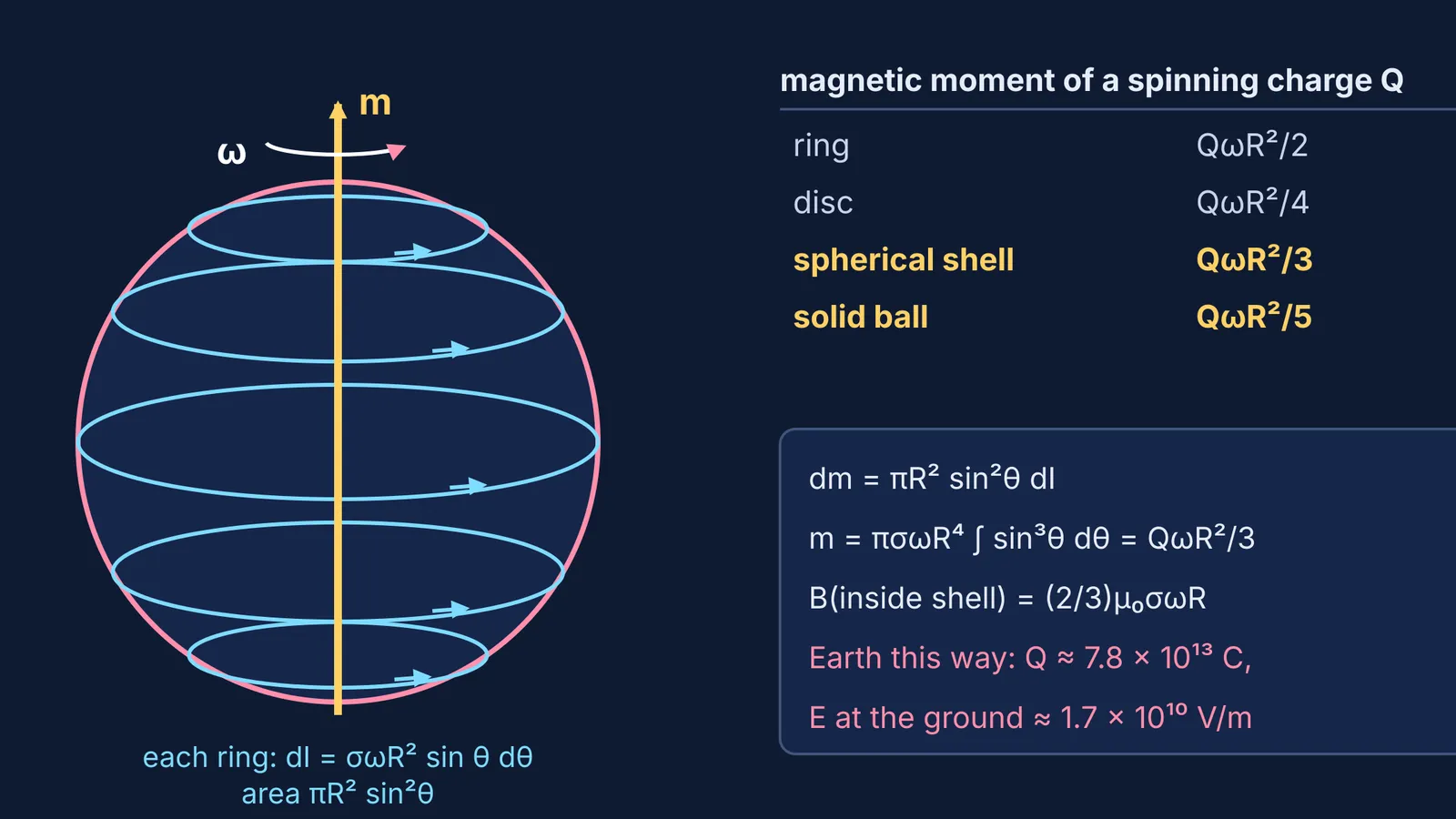
A charged ball sitting still makes only an electric field. Spin it, and its charge goes round in circles: each circle is a current loop, and the ball becomes a magnet. For a thin shell the magnetic moment is QωR²/3, and for a solid ball QωR²/5. The same sum lets you test an old idea: could Earth's magnetism come from charge on its spinning surface? The numbers say no, by a factor of about a hundred million.
You need two Class 12 ideas: the magnetic moment of a loop, m = IA, and adding up thin pieces. Our post on the spinning charged ring and its q/2m ratio works the ring (QωR²/2) and the disc (QωR²/4). The sphere is the next step.
How does a spinning charged shell make a current?
Take an insulating spherical shell of radius R carrying charge Q spread evenly, so the surface density is σ = Q/4πR². Spin it at angular speed ω about a vertical axis. The charge is fixed to the shell and moves with it.
Slice the shell into thin horizontal rings. Use the polar angle θ, measured from the top of the axis.
Charge on one ring. The ring has radius R sin θ and width R dθ, so its area is 2πR sin θ × R dθ. Its charge is dq = σ × 2πR² sin θ dθ.
Current. The ring goes round once every 2π/ω seconds, so dI = dq × ω/2π = σωR² sin θ dθ.
Area enclosed. π(R sin θ)² = πR² sin²θ.
Moment of one ring. dm = dI × area = πσωR⁴ sin³θ dθ.
Add the rings from θ = 0 to π: m = πσωR⁴ ∫ sin³θ dθ.
Where does the 1/3 come from?
The whole answer hangs on ∫₀^π sin³θ dθ. Write sin³θ = (1 − cos²θ) sin θ and put u = cos θ, so du = −sin θ dθ. The integral becomes ∫ from −1 to 1 of (1 − u²) du = 2 − 2/3 = 4/3.
So m = (4/3)πσωR⁴. Substitute σ = Q/4πR²:
m = (4/3)π × (Q/4πR²) × ωR⁴ = QωR²/3
Every ring points its moment the same way, along ω for positive charge, so nothing cancels. The rings near the equator are largest and carry the most charge, which is why the shell beats the disc's 1/4 but not the ring's 1/2.
What about a solid charged ball?
Build the ball from shells. A shell of radius r and thickness dr holds charge dQ = Q × 3r² dr/R³, and its moment is dQ ωr²/3. Adding them:
m = (Qω/R³) ∫₀^R r⁴ dr = QωR²/5
A numerical sum over 200,000 thin shells gives 0.2000 QωR². If the mass is spread the same way as the charge, the angular momentum is L = (2/5)MR²ω, so m/L = Q/2M again, as for the shell, where L = (2/3)MR²ω.
What is the field inside the shell?
Inside a uniformly charged spinning shell, the magnetic field is exactly uniform:
B = (2/3)μ₀σωR, along the axis.
This is a standard result of the full calculation, and it is beyond the NCERT syllabus, so treat it as given. A quick check: written in terms of m, it is μ₀m/2πR³, which is exactly the dipole field on the axis at the poles, just outside the shell. The field is continuous there, as it must be. Inside a solid ball the field is not uniform.
Worked example 1: a sphere on a lab bench
These are illustrative numbers. An insulating sphere of radius 10 cm is charged to 30 kV and spun at 100 revolutions per second.
Charge. For an isolated sphere, Q = 4πε₀RV = 4π × 8.854 × 10⁻¹² × 0.10 × 30,000 = 3.3 × 10⁻⁷ C.
Angular speed. ω = 2π × 100 = 628 rad/s.
Moment. m = QωR²/3 = 3.34 × 10⁻⁷ × 628 × 0.010 / 3 = 7.0 × 10⁻⁷ A m².
Field inside. σ = Q/4πR² = 2.66 × 10⁻⁶ C/m², so B = (2/3) × 4π × 10⁻⁷ × 2.66 × 10⁻⁶ × 628 × 0.10 = 1.4 × 10⁻¹⁰ T.
That is about five millionths of Earth's field at the equator, worked out below. Check the units: A × m² gives A m², and T = N/(A m).
Could Earth's magnetism come from a spinning surface charge?
Earth's main field is close to a dipole. The International Geomagnetic Reference Field, distributed by NOAA NCEI, gives the first Gauss coefficients for 2025 in its IGRF-14 coefficient table: g₁⁰ = −29,350 nT, g₁¹ = −1,410 nT and h₁¹ = 4,546 nT. Together they give a dipole field of B₀ = 29,700 nT at the equator, and a dipole moment m = 4πa³B₀/μ₀ = 7.7 × 10²² A m², with a = 6,371.2 km.
Worked example 2: the charge Earth would need
Earth's spin. One turn per sidereal day of 86,164 s gives ω = 7.29 × 10⁻⁵ rad/s.
Charge. From m = QωR²/3, Q = 3m/ωR² = 3 × 7.69 × 10²² / (7.29 × 10⁻⁵ × (6.371 × 10⁶)²) = 7.8 × 10¹³ C.
Electric field at the ground. E = Q/4πε₀R² = 1.7 × 10¹⁰ V/m.
Now compare. A Physics Today review of the global electric circuit by Bering, Few and Benbrook (1998) gives a fair-weather field of 100 to 300 V/m at the surface. The required field is about a hundred million times larger, and thousands of times beyond the roughly 3 × 10⁶ V/m at which dry air breaks down. Earth's real surface charge, about 5 × 10⁵ C as worked out in how fast Earth's surface charge would leak away, is too small by a similar factor.
So the idea fails. NOAA NCEI's geomagnetism FAQ says that more than 90% of the field we measure is generated in Earth's conducting, fluid outer core: currents in moving molten iron, not charge riding on a spinning surface.
The Fermi Problem Library has magnetic-moment and integration problems with a step-by-step solver that explains the reasoning. If you are preparing for JEE Main & Advanced, Fermi Test Prep offers personalised preparation with an AI tutor, live classes, adaptive mocks, mentorship and a study plan that updates based on mastery.
Quick checklist
Ring at angle θ: dI = σωR² sin θ dθ, area πR² sin²θ.
∫₀^π sin³θ dθ = 4/3, so the shell gives m = QωR²/3.
Solid ball, from shells: m = QωR²/5.
m/L = Q/2M whenever charge and mass are spread alike.
Field inside a spinning shell: uniform, (2/3)μ₀σωR.
Earth would need 7.8 × 10¹³ C and 1.7 × 10¹⁰ V/m at the ground; its field comes from the outer core instead.