On this page
In August 1890, in Wilhelm Ostwald's laboratory in Leipzig, a young American chemist, Arthur A. Noyes, signed off a paper that tested the rule behind every Ksp problem you solve: in a saturated solution, the product of the ion concentrations stays constant even when you add another salt. He saturated water with thallium(I) chloride, TlCl, then added either extra Tl⁺ (as TlNO₃) or extra Cl⁻ (as HCl). The solubility fell, and it fell by the same amount whichever ion he added. His numbers also missed the simple prediction in a growing way, for a reason your textbook skips.
The paper is A. A. Noyes, "Über die gegenseitige Beeinflussung der Löslichkeit von dissociierten Körpern" (on how dissociated substances affect each other's solubility), Z. phys. Chem. 6 (1890) 241–267 (scan on the Internet Archive). The idea he tested came from W. Nernst, Z. phys. Chem. 4 (1889) 372 onwards (scan). Translations are ours. Noyes received his PhD from Leipzig in 1890 under Ostwald and was later professor of chemistry at Caltech from 1919 to 1936 (biography). Thallium salts are highly toxic; this is history, not a lab suggestion.
What did Nernst predict in 1889?
Nernst treated a saturated solution like a solid in contact with its vapour: an equilibrium. He added a few drops of very concentrated KCl or KOH solution to 10 cc of saturated KClO₃ solution, and KClO₃ crystallised out; concentrated NaClO₃ did the same. The extra K⁺ ions, he wrote, are "driven out of the solution" and deposit on the solid "together with an equivalent amount of ClO₃⁻ ions".
He then measured silver acetate at 16 °C. Its solubility, 0.0603 mol/L, dropped to 0.0392, 0.0280 and 0.0208 mol/L with 0.061, 0.119 and 0.230 M sodium acetate added. Silver nitrate gave 0.0417, 0.0341 and 0.0195. He noted that equal amounts of either salt lowered the solubility "fairly equally". Noyes took up a fuller test at Ostwald's suggestion and thanked both men in the paper.
How did Noyes test the solubility product with TlCl?
He kept each solution in a thermostat for several days over excess solid, and checked equilibrium by approaching it from both a supersaturated and an unsaturated solution. Chloride was titrated by Volhard's method.
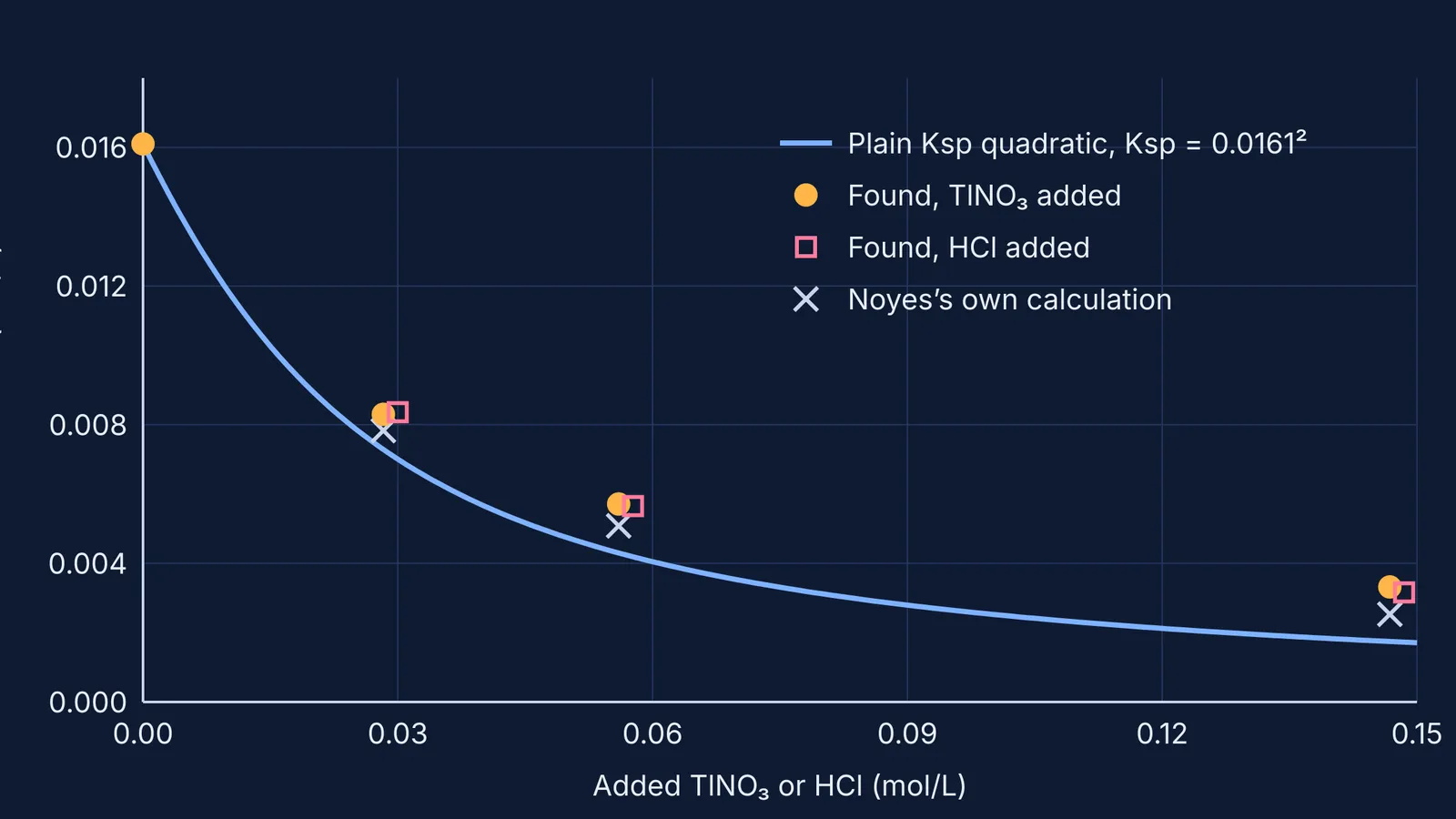
His Table VI, at 25 °C (all in mol/L):
Nothing added: 0.0161
0.0283 added: 0.00830 with TlNO₃, 0.00836 with HCl
0.0560 added: 0.00571 with TlNO₃, 0.00565 with HCl
0.1468 added: 0.00332 with TlNO₃, 0.00316 with HCl
1.000 M HCl: 0.00200
"The solubility is lowered equally by the addition of the thallous nitrate and of the hydrochloric acid," he wrote. That is exactly what a constant [Tl⁺][Cl⁻] predicts, because the product does not care which ion is in excess. Silver bromate behaved the same way: with 0.00850 M added, 0.00810 fell to 0.00510 with AgNO₃ and 0.00519 with KBrO₃.
No thallium salt's conductivity had been measured, so he measured TlNO₃. He was struck that "the thallium atom, despite its more than fivefold weight, migrates almost as fast as the potassium atom".
Worked example 1: Ksp and the common-ion quadratic
TlCl(s) ⇌ Tl⁺(aq) + Cl⁻(aq). In pure water [Tl⁺] = [Cl⁻] = s₀ = 0.0161 M, so Ksp = (0.0161)² = 2.59 × 10⁻⁴.
Add c = 0.0283 M TlNO₃. Now [Tl⁺] = s + 0.0283 and [Cl⁻] = s, so s(s + 0.0283) = 2.59 × 10⁻⁴.
Rearrange: s² + 0.0283s − 2.59 × 10⁻⁴ = 0. Solve: s = [−0.0283 + √(0.0283² + 4 × 2.59 × 10⁻⁴)] ÷ 2 = 0.00728 M.
The shortcut s ≈ Ksp/c gives 2.59 × 10⁻⁴ ÷ 0.0283 = 0.00916 M, 26% too high. It fails because c is not much larger than s.
With 0.1468 M added, the quadratic gives 0.00174 M and Ksp/c gives 0.00177 M. Now c ≫ s, so the shortcut works.
Why were his measured solubilities always too high?
At 0.0283 M added, TlNO₃ gave 0.00830 against the quadratic's 0.00728, 1.14 times higher. At 0.0560 M the ratio is 1.33, and at 0.1468 M it is 1.9. In 1 M HCl he found 0.00200, almost eight times the plain prediction of 0.00026.
Noyes did not use the plain quadratic. He corrected for incomplete dissociation, using degrees of dissociation from conductivity, and got 0.00783, 0.00508 and 0.00253. These were still too low, and the gap still grew with added salt. The same trend ran through Nernst's silver acetate and his own bromate data: "The phenomenon is therefore quite general."
He weighed two causes: mass action failing, "very unlikely" at 0.1 normal, or wrong degrees of dissociation from conductivity. He backed the second, concluding there was "no reason to doubt the strict validity of the law of mass action", only "the exact proportionality between conductivity and dissociation".
In 1 M HCl, he argued, almost only undissociated TlCl stays dissolved; he put that limit at 0.00151 M and found 0.00200.
Today the explanation is activity. In a solution crowded with ions, each ion is shielded by oppositely charged neighbours and behaves as if its concentration were lower. The true constant is the product of activities, so more TlCl dissolves than the simple formula says. NCERT's Ksp = [M⁺][X⁻] with plain molarities is an approximation that works for dilute solutions. Noyes also found the opposite of the common-ion effect: a salt with no common ion raises the solubility.
Where does the golden ratio come from?
Noyes gave a table for a fully dissociated salt. Add n times the original solubility as a common ion, and the solubility falls to these fractions: n = 1, 0.62; 2, 0.41; 3, 0.30; 4, 0.24; 10, 0.10; 40, 0.02; 100, 0.01.
Worked example 2: derive his table
Let r = s/s₀. Then s(s + ns₀) = s₀², so r² + nr − 1 = 0.
Solve: r = [−n + √(n² + 4)] ÷ 2.
For n = 1: r = (√5 − 1) ÷ 2 = 0.618, the golden ratio.
n = 2 gives 0.414, n = 3 gives 0.303, n = 10 gives 0.099, n = 100 gives 0.0100. His 0.02 for n = 40 is 0.025 rounded down.
His comment on the table: "almost as much is achieved by a small addition, say ten- or twentyfold, as by a much larger one." That is why a little dilute reagent in the wash water is enough. In the same paper he noted that when excess reagent redissolves a precipitate, a new compound is forming, the case in why too much chloride redissolves AgCl.
Where does this come up in JEE and NEET?
Class 11 Equilibrium: solubility product and the common-ion effect. Our guide to solubility product, Ksp and precipitation has the NCERT-style problems. Nernst's better-known 1889 work is in Walther Nernst and the heat theorem.
For exam-style practice on these problems, Fermi Test Prep covers JEE Main and Advanced preparation with an AI tutor. If your quadratic keeps going wrong, the Fermi Problem Library has a step-by-step solver that explains the reasoning.
Quick checklist
1889 Nernst, 1890 Noyes: TlCl's solubility falls equally with added Tl⁺ or Cl⁻.
s(s + c) = Ksp; the shortcut Ksp/c needs c ≫ s.
Adding a common ion equal to s₀ leaves 0.618 s₀, the golden ratio.
Measured solubilities run high because activities, not concentrations, set the constant.