On this page
In 1891 Max Le Blanc, working in the physical chemistry laboratory at Leipzig under Wilhelm Ostwald, whom he thanks as "my highly honoured teacher", measured the smallest voltage that starts electrolysis in dozens of solutions. Sulphuric, nitric and phosphoric acids, caustic soda and caustic potash all needed about 1.7 V; HCl, HBr and HI needed less. His explanation is the rule you now use in Class 12 electrochemistry: in these solutions it is water that gets electrolysed. We read his paper, "Die elektromotorischen Kräfte der Polarisation", Zeitschrift für physikalische Chemie volume 8 (1891), from page 299, on the scanned pages at the Internet Archive. The translations are ours.
What is a decomposition voltage?
It is the smallest applied voltage at which an electrolyte is decomposed steadily; below it, the current soon dies away.
Marcellin Berthelot had taken the decomposition point as the voltage at which he saw the first gas bubbles through a telescope. But Helmholtz had shown that even very small voltages decompose acidified water a little, so the first bubble marks when products become visible, not when decomposition starts.
Le Blanc watched the current instead:
Leclanché cells and a resistance box let him raise the voltage in steps of 0.02–0.03 V.
The electrodes were pure platinum wire, 0.7 mm thick and 6 mm long, in a U-tube of about 7 cm³ kept at 20 °C. The salt solutions were normal (1 N).
He compared each voltage with a Clark standard cell, which he took as 1.437 V at 15 °C.
Below the decomposition point, each step gave a small kick on a mirror galvanometer and the needle returned. About 0.3 V higher, the kick was roughly ten times larger and the needle did not come back.
For sulphuric acid he wrote that "the decomposition point lies at 1.67 volt". He put his error at ±0.05 V.
Why did so many acids and bases give the same 1.7 V?
His table for acids and bases:
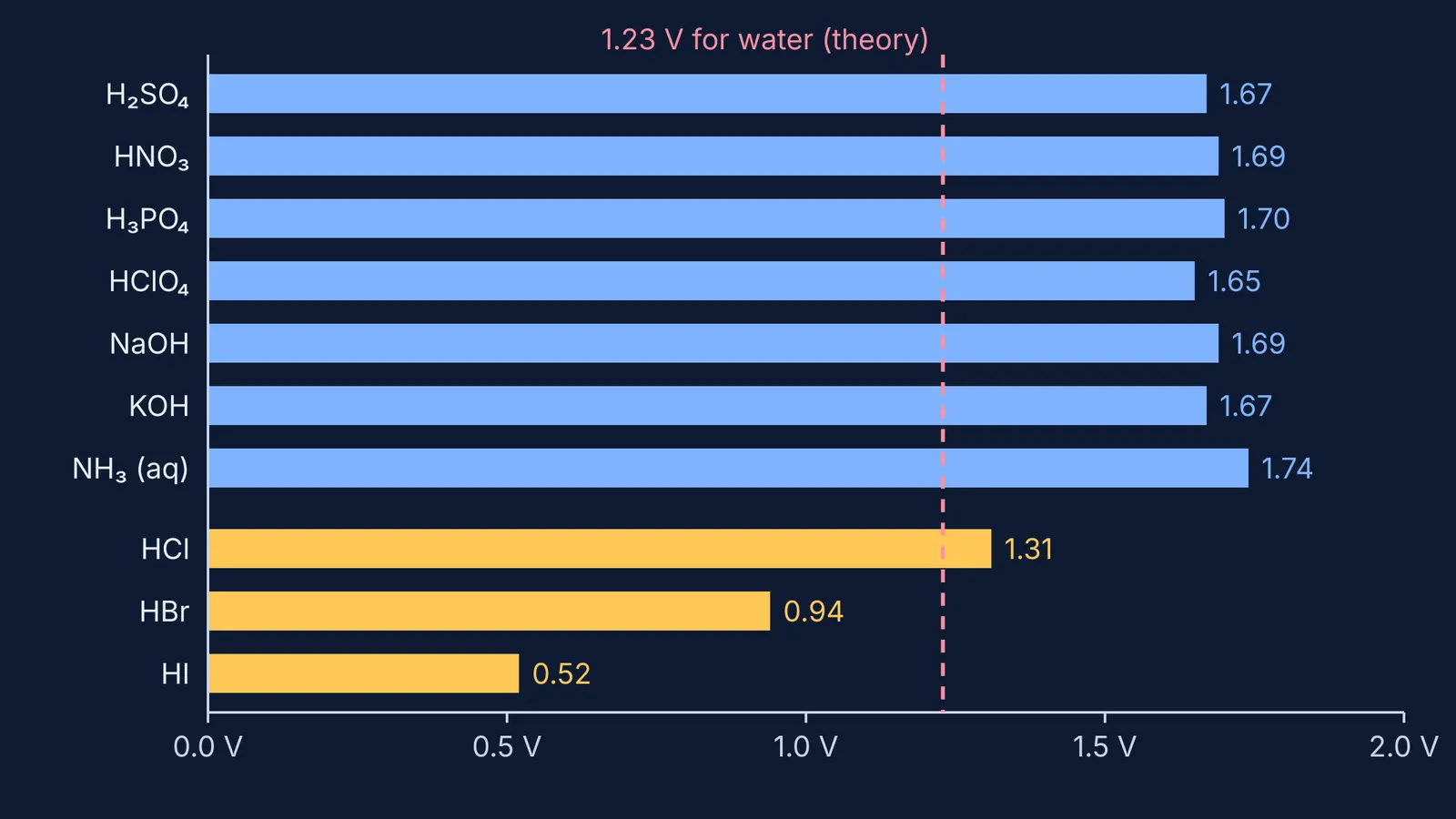
About 1.7 V: H₂SO₄ 1.67, HNO₃ 1.69, H₃PO₄ 1.70, HClO₄ 1.65, chloroacetic acid 1.72, dichloroacetic acid 1.66, malonic acid 1.69, NaOH 1.69, KOH 1.67, ammonia 1.74.
Lower: tartaric acid 1.62, pyruvic acid 1.57, trichloroacetic acid 1.51, HCl 1.31, oxalic acid 0.95, HBr 0.94, HI 0.52.
The clue came from salts. Sodium acetate, butyrate, malonate, succinate and benzoate all gave 2.00–2.10 V. Le Blanc called this "at first quite surprising and completely incomprehensible to me", because he had expected each anion to hold its charge with a different strength. Sulphates and nitrates gave the same high values, so there seemed to be a maximum. His conclusion: "It indicates that not different processes occur here, but always the same one, and this is possible in only one case: water takes part directly in the electrolysis. The maximum value is then nothing other than the value for the decomposition of water."
In acids, he said, the hydroxyl of water is discharged at the anode; in bases, the hydrogen of water at the cathode.
Which product forms at each electrode?
NCERT's rules: the species with the higher E° is reduced at the cathode, and the one with the lower E° is oxidised at the anode, unless overpotential changes the order.
Dilute H₂SO₄ (platinum): cathode 2H⁺ + 2e⁻ → H₂; anode 2H₂O → O₂ + 4H⁺ + 4e⁻. Overall 2H₂O → 2H₂ + O₂.
NaOH or KOH: cathode 2H₂O + 2e⁻ → H₂ + 2OH⁻; anode 4OH⁻ → O₂ + 2H₂O + 4e⁻. Overall again 2H₂O → 2H₂ + O₂.
HCl: anode 2Cl⁻ → Cl₂ + 2e⁻; cathode 2H⁺ + 2e⁻ → H₂. Overall 2HCl → H₂ + Cl₂. HBr gives Br₂ and HI gives I₂ in the same way.
Sulphate is not oxidised in dilute acid: the NCERT electrochemistry chapter gives 1.96 V for 2SO₄²⁻ → S₂O₈²⁻ + 2e⁻, and water splits first at about 1.7 V. Concentrated acid is different, as our post on what forms at the anode in sulphuric acid electrolysis explains.
Salt solutions needed more: Na₂SO₄ 2.21 V against 1.67 V for H₂SO₄. Le Blanc traced the extra half volt to alkali building up at the cathode and acid at the anode, a pair that opposes the applied voltage.
Worked example: how big was the overpotential?
Le Blanc did not compare his numbers with 1.23 V in this paper. We add that step.
Theoretical voltage. For H₂(g) + ½O₂(g) → H₂O(l), ΔG° = −237.1 kJ/mol and n = 2. From ΔG° = −nFE°, E° = 237,100 ÷ (2 × 96,485) = 1.229 V, the 1.23 V in NCERT.
Why acid and alkali agree. Both electrode potentials shift by 0.059 V per pH unit at 25 °C, in the same direction, so their difference stays 1.229 V at pH 0, 7 or 14. Every acid and base that splits water should need the same voltage, as Le Blanc found.
Overpotential. For H₂SO₄, 1.67 − 1.23 = 0.44 V. For NaOH, 1.69 − 1.23 = 0.46 V. The whole cluster lies 0.42–0.51 V above 1.23 V. On platinum, hydrogen is released easily, so most of this extra is usually put down to oxygen.
Energy cost. At 1.67 V, each mole of H₂ takes 2 × 96,485 × 1.67 = 322 kJ, about 36% more than 237 kJ at 1.23 V.
Why do HCl, HBr and HI need less?
From the NCERT table, E° is 1.36 V for Cl₂/Cl⁻, 1.09 V for Br₂/Br⁻ and 0.54 V for I₂/I⁻. With H₂ at the cathode, these are the theoretical voltages for electrolysing the three acids. Le Blanc measured 1.31, 0.94 and 0.52 V. Each sits at or below the table value. At the decomposition point only traces of halogen exist, and in the Nernst equation a low product concentration lowers the voltage needed.
He tied the numbers to how the acids behave on standing: HCl at 1.31 V "is very stable", HBr at 0.94 V "gradually separates bromine", and HI at 0.52 V "can hardly be kept colourless even for a short time".
The classic question: in HCl, would you expect Cl₂ or O₂ at a platinum anode from E° alone? O₂, because 1.23 V is less than 1.36 V. Le Blanc's numbers show what really happens: oxygen on platinum needed about 1.67 V, chlorine only 1.31 V, so chlorine wins. That is the "overpotential of oxygen" argument NCERT uses for brine, measured 135 years ago. See why chlorine, not oxygen, forms at the anode in brine for the effect of concentration.
In 1800 Nicholson and Carlisle split water with the steady current of a voltaic pile (who first split water); Le Blanc explained why so many different solutions give the same two gases. To see products change as you switch the electrolyte, the Simulation Lab has interactive simulations for ideas easier to see than read. For JEE questions on electrolysis, Fermi Test Prep covers JEE Main and Advanced preparation with an AI tutor.
Quick checklist
Dilute oxyacids and alkalis with platinum electrodes give H₂ and O₂: water is electrolysed.
Theory says 1.23 V at any pH; Le Blanc measured 1.65–1.74 V.
Measured minus theoretical is the overpotential: about 0.44 V for H₂SO₄.
HCl, HBr and HI give the halogen: 1.31, 0.94 and 0.52 V, below water's practical 1.7 V.
Salts such as Na₂SO₄ need more (2.21 V): acid and alkali build up at the electrodes.