On this page
Hang a pulley from one side of an Atwood machine. Hang another pulley from that one, and keep going forever, with a 1 kg block on the left of every string. One idea, that a light pulley and its load act like a single mass on the string above, gives the answer in a few lines: the top block rises at exactly g/2, and the ceiling carries only 3mg.
What is the infinite Atwood machine?
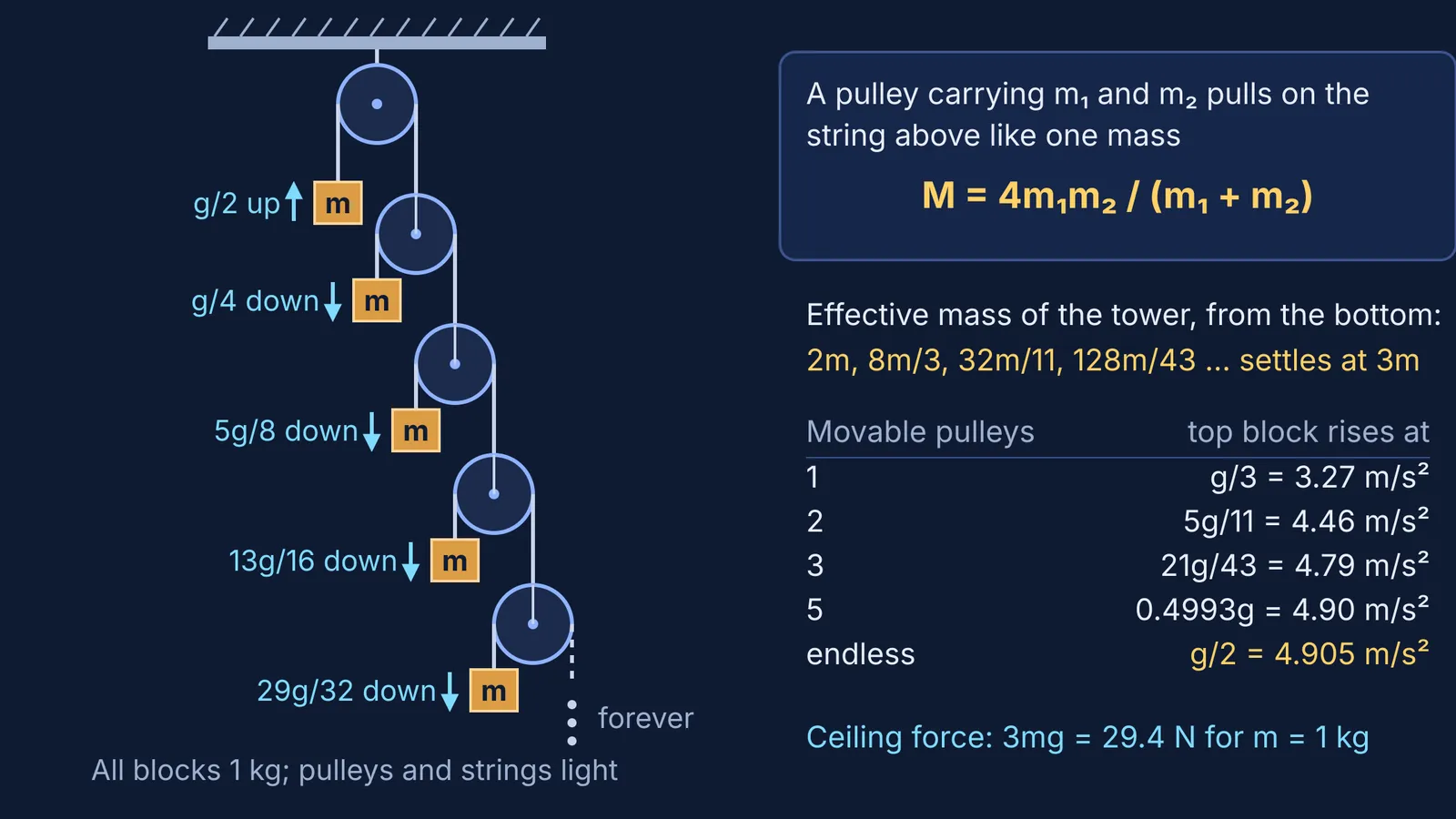
Start with an ordinary Atwood machine on a fixed pulley at the ceiling. On the left is a block of mass m. On the right, instead of a second block, hangs a light movable pulley. Over that pulley runs another string, with a block m on its left and the next movable pulley on its right. The pattern repeats without end. All blocks have the same mass m, and all pulleys and strings are light and frictionless.
The question is the acceleration of the top block. A version of it appears in David Morin's textbook Introduction to Classical Mechanics. Here we derive it from scratch. If the basic machine is rusty, start with our Atwood machine problems on tension and acceleration.
Why can a moving pulley be replaced by a single mass?
You may already know that a fixed pulley carrying m₁ and m₂ pulls on its support with a force 4m₁m₂g/(m₁ + m₂). That result is worked out in why a pulley on a spring balance reads 2T, not the total weight. Read it differently: the pulley and its two blocks pull on the support like one mass M = 4m₁m₂/(m₁ + m₂).
The step students doubt is whether this still holds when the pulley itself accelerates. It does. Suppose the pulley accelerates downward at A. Go into the pulley's frame. Each block feels its weight plus a pseudo force upward of mA, so the effective gravity is g − A. Inside that frame it is an ordinary Atwood machine, so the string tension is T = 2m₁m₂(g − A)/(m₁ + m₂). The light pulley needs no net force, so the string above it pulls up with 2T = M(g − A).
A real block of mass M accelerating down at A has exactly the same string tension, M(g − A). So the string above cannot tell the pulley and its load from a block of mass M. This needs light pulleys and strings. A pulley with mass of its own breaks the replacement.
How do you build the tower from the bottom up?
Cut the tower off after n movable pulleys and work upward.
The lowest pulley carries m and m. Its effective mass is 4m·m/(2m) = 2m.
The next pulley carries m and that 2m. Its effective mass is 4m(2m)/(3m) = 8m/3.
The next gives 4m(8m/3)/(11m/3) = 32m/11.
Then 128m/43, then 512m/171, and so on.
The numbers creep up towards 3m. For an endless tower the effective mass M must not change when you add one more pulley on top, because the tower below any pulley is again an endless tower. So M = 4mM/(m + M). Cancel M and you get m + M = 4m, so M = 3m.
Worked example: how fast does the top block rise?
Take every block as 1 kg and g = 9.81 m/s².
Replace the tower. Everything hanging on the right of the fixed pulley acts like one block of effective mass 3m = 3 kg.
Solve one Atwood machine. The fixed pulley now carries m on the left and 3m on the right. The acceleration is a = (3m − m)g/(3m + m) = g/2.
Put in numbers. a = 9.81/2 = 4.905 m/s², with the top block moving up.
Find the top tension. For the top block, T − mg = ma, so T = m(g + g/2) = 1.5mg = 14.7 N.
Find the ceiling force. The light fixed pulley has string on both sides, so the ceiling holds 2T = 3mg = 29.4 N.
The infinite tower is the limit of finite towers, so check it against them. With one movable pulley (the usual double Atwood machine with three equal blocks) the top block rises at g/3 = 3.27 m/s². With two, 5g/11 = 4.46 m/s². With three, 21g/43 = 4.79 m/s². With five, 0.4993g. In general, n movable pulleys give a = (4ⁿ − 1)g/(2·4ⁿ + 1), which tends to g/2. We also solved all the Newton's-law and string equations directly for a 20-pulley tower, with no effective-mass trick, and got the top acceleration as 0.49999999999932g. The answer is not an artefact of infinity.
How fast does each block further down move?
Go down one level at a time using the same trick. The first movable pulley moves down at g/2, because the string over the fixed pulley has fixed length. In its frame the effective gravity is g − g/2 = g/2. It carries m on the left and an effective 3m on the right, so the block m rises relative to the pulley at (3m − m)/(4m) × g/2 = g/4. Its acceleration in the ground frame is g/2 − g/4 = g/4 downward.
Repeating this gives the blocks' accelerations: g/2 up, then g/4, 5g/8, 13g/16 and 29g/32 downward. In numbers: 4.91 m/s² up, then 2.45, 6.13, 7.97 and 8.89 m/s² down. The movable pulleys fall at g/2, 3g/4, 7g/8 and 15g/16. Deep in the tower, everything is close to free fall. Our direct 20-pulley solve gives exactly these values.
Why does the ceiling hold only 3mg?
With n movable pulleys there are n + 2 blocks, so the total weight grows without limit. Yet the ceiling force only goes from 8mg/3 (26.2 N) with one movable pulley to 2.91mg (28.5 N) with two, and never passes 3mg (29.4 N).
This is not a contradiction. The support force equals the total weight only when nothing accelerates. Newton's second law for the whole hanging system says: total weight − ceiling force = sum of (mass × downward acceleration). Most of the blocks are nearly in free fall, so they put almost no load on the strings above them. The string holding a block that falls at 29g/32 carries only m(g − 29g/32) = 3mg/32. A tower of nearly weightless blocks adds almost nothing to the load.
To check your own constraint answers, use the three checks in how to tell if an AI's pulley answer is wrong. The Fermi Problem Library has laws-of-motion problems with a step-by-step solver that explains the reasoning. If you are preparing for JEE Main & Advanced, Fermi Test Prep offers personalised preparation with an AI tutor, live classes, adaptive mocks, mentorship and a study plan that updates based on mastery.
Quick checklist
A light pulley carrying m₁ and m₂ acts on the string above like one mass 4m₁m₂/(m₁ + m₂), even while it accelerates.
For equal masses the tower's effective mass runs 2m, 8m/3, 32m/11 and settles at 3m.
Top block: a = (3m − m)g/4m = g/2 upward; top tension 1.5mg.
Ceiling force 3mg, because most of the tower is nearly in free fall.
Finite towers: g/3, 5g/11, 21g/43, ... which tend to g/2.