On this page
You paste a pulley problem into an AI chatbot. It gives you a tidy answer, and you can't tell whether to trust it. Pulley problems are where this matters most, because the most common slip doesn't show in the algebra. The chatbot writes correct Newton's-law equations and then links the accelerations wrongly.
In a 2023 study in Physical Review Physics Education Research, Gerd Kortemeyer had ChatGPT work through representative assessment content from an actual calculus-based physics course, graded like a student's. It would narrowly pass the course while "exhibiting many of the preconceptions and errors of a beginning learner". Three quick checks catch those errors.
The problem we will check
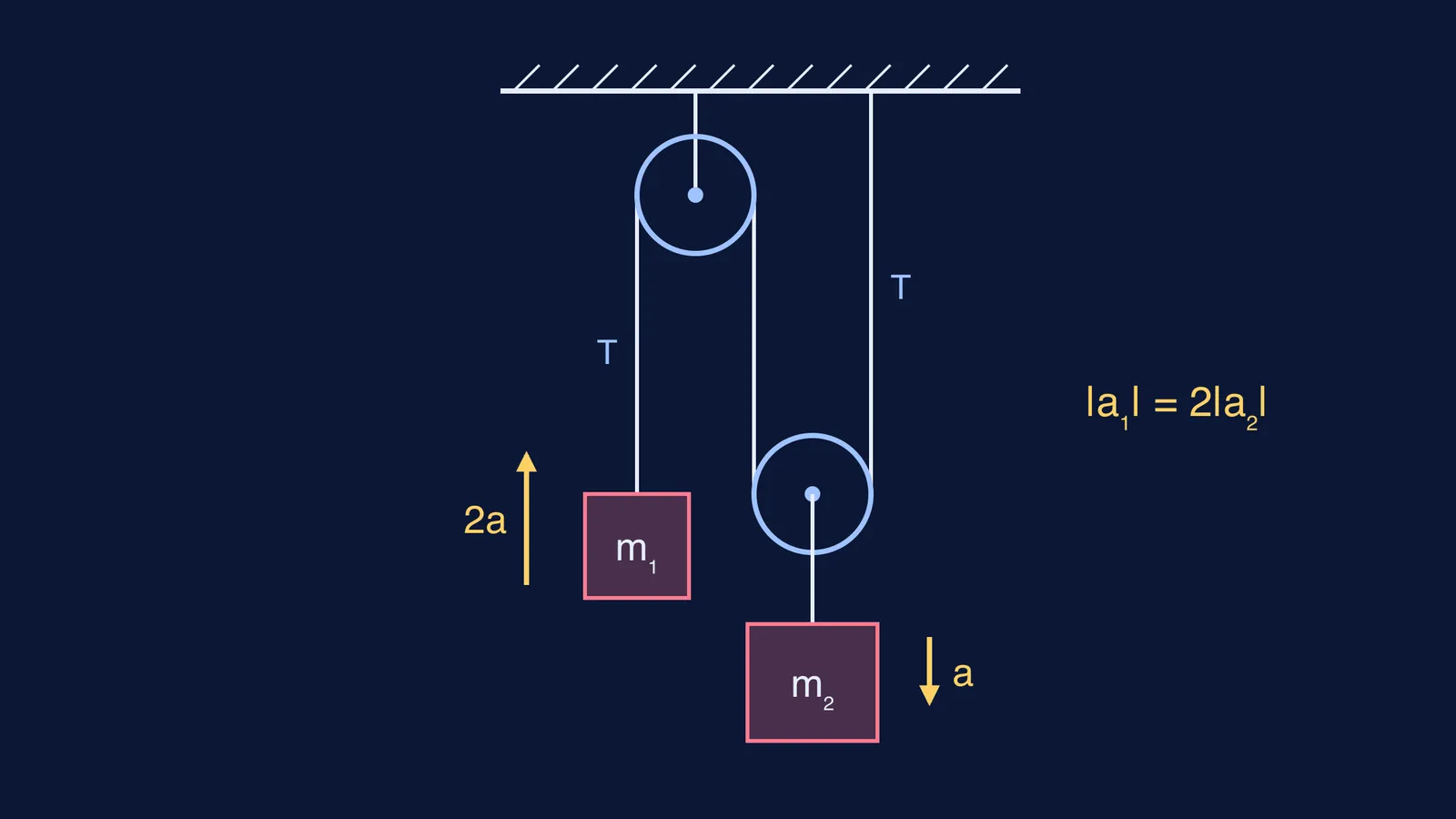
A light string is tied to block m₁ = 2 kg. It runs up over a fixed pulley, down under a movable pulley that carries block m₂ = 6 kg, and up to the ceiling. The pulleys and string have no mass and no friction, and g = 9.8 m/s². Find both accelerations and the tension.
Say a chatbot replies: "This is an Atwood machine, so a = (m₂ − m₁)g/(m₁ + m₂) = 4.9 m/s² for both blocks." That formula is right for a plain Atwood machine, where one string runs straight over one fixed pulley, as OpenStax University Physics, Example 6.5 derives. It is wrong here.
Check 1: does the answer obey the string-length constraint?
Measure positions downward from the fixed pulley: y₁ for m₁ and y_p for the movable pulley. One stretch of string hangs above m₁ and two stretches hold the movable pulley, so the length is L = y₁ + 2y_p + a constant.
L never changes, so differentiate twice: a₁ + 2a_p = 0. If the movable pulley (and m₂) drops with acceleration a, m₁ rises with acceleration 2a.
An answer that gives both blocks the same acceleration fails this check. The chatbot's answer fails it.
What is the correct answer?
Take down as positive for m₂ and up as positive for m₁, so m₂ accelerates at a and m₁ at 2a. The tension is T all along the string.
For m₁: T − m₁g = m₁(2a)
For m₂, held by two segments: m₂g − 2T = m₂a
Eliminate T: a = (m₂ − 2m₁)g / (m₂ + 4m₁)
Putting in the numbers: m₂ accelerates down at a = 2g/14 = 1.4 m/s², m₁ accelerates up at 2a = 2.8 m/s², and T = m₁(g + 2a) = 25.2 N.
Why test equal masses on a pulley problem?
A limiting case is a version of the problem whose answer you already know. Plug it into the AI's formula.
Equal masses. Here, unlike a plain Atwood machine, equal masses do not balance. m₂ is held up by 2T but m₁ only by T, so m₁ wins. The correct formula gives a = (m − 2m)g/(5m) = −g/5: m₂ rises at 1.96 m/s² and m₁ falls at 3.92 m/s². The chatbot's formula says a = 0, which shows it ignored the movable pulley.
Balance point. The blocks should stay still when m₂ = 2m₁. The correct formula gives zero. The chatbot's gives g/3.
One mass shrinks to zero. If m₁ goes to 0, m₂ should fall freely, and a goes to g. If m₂ goes to 0, a goes to −g/2, so m₁ falls at 2a = g. Both pass.
How do you confirm the directions are right?
Ask three questions.
Do the two blocks move in opposite directions? They must. When m₂ goes down, its pulley takes up string, and m₁ has to rise to supply it.
Does the tension fit each block's motion? m₁ accelerates up, so T must be more than m₁g = 19.6 N, and 25.2 N is. m₂ accelerates down, so 2T = 50.4 N must be less than m₂g = 58.8 N, and it is.
Do the sizes match the constraint? 2.8 is exactly twice 1.4.
A 60-second checklist for any AI pulley answer
Write the string length in terms of positions and differentiate twice. Do the AI's accelerations satisfy it?
Plug in equal masses, a balance case and a zero mass. Does each give the motion you expect?
Check that the blocks move in opposite directions, and that T is bigger or smaller than each weight as the motion demands.
If any check fails, ask: "Write the string-length constraint for this setup and redo the problem from it." Then rerun the checks; a different answer isn't automatically right.
Our guide on checking an AI's free-body diagram covers the other common weak spot. For practice on other setups, try these Atwood machine variations.
When the mistake is in the method rather than the arithmetic, the Fermi Problem Library has worked problems with a step-by-step solver that explains the reasoning rather than printing an answer, so you can follow each step of the method. If constraint relations still feel shaky, the Fermi Concept Library gives each concept its own lesson.