On this page
On a hot road, light from the sky bends up into your eye and the road looks wet. Turn the situation upside down, with cold water and warm air above it, and light bends the other way: down, towards the surface. Bend it enough and a ray can follow the curve of the Earth, so ships, islands and coastlines that should be hidden below the horizon rise into view. This is the superior mirage. NCERT covers only the hot-road mirage, so this goes beyond the syllabus, but it uses only refraction and the gas law.
Why does a temperature change bend light in air?
The refractive index of air is only slightly above 1, and the small excess, n − 1, is proportional to the air's density. The NIST Engineering Metrology Toolbox gives n = 1.000 271 8 for dry air at 20 °C and standard pressure, and states that n − 1 is proportional to density. Scaling to 15 °C by the gas law gives n − 1 ≈ 2.77 × 10⁻⁴.
Since ρ ∝ P/T, falling pressure with height lowers n, and rising temperature lowers it faster still.
A light ray always bends towards the region of higher refractive index. For a ray travelling horizontally, the radius of its curve is R = 1/|dn/dz|, where z is height. Andrew Young's atmospheric refraction notes at San Diego State University derive this: the slower, lower edge of a wavefront lags, so the front turns.
Putting the gas law in, the gradient is
dn/dz = −((n − 1)/T) × (g/R_air + dT/dz)
where g/R_air = 9.807/287.05 = 0.0342 K/m comes from the fall in pressure (R_air is the gas constant for one kilogram of dry air) and dT/dz is the temperature gradient. A positive dT/dz, warmer air above, is a temperature inversion.
How much does ordinary air bend light?
Take sea level at 15 °C (T = 288.15 K) and the standard atmosphere, which cools by 6.5 °C per kilometre, so dT/dz = −0.0065 K/m.
(n − 1)/T = 2.77 × 10⁻⁴ / 288.15 = 9.60 × 10⁻⁷ per kelvin.
g/R_air + dT/dz = 0.0342 − 0.0065 = 0.0277 K/m.
dn/dz = −9.60 × 10⁻⁷ × 0.0277 = −2.65 × 10⁻⁸ per metre.
Ray radius R = 1/(2.65 × 10⁻⁸) = 3.77 × 10⁷ m, about 37,700 km, or 5.9 times the Earth's radius of 6,371 km.
The ray curves about one-sixth as sharply as the Earth. Young's notes give 18% for the same atmosphere. So light skims a little way round the curve, and the Earth looks flatter by a factor 1/(1 − 1/5.9) = 1.20. For an eye 2 m above the sea, the horizon moves from √(2 × 6,371,000 × 2) = 5.05 km to √(2 × 1.20 × 6,371,000 × 2) = 5.54 km. Our post on the distance to the horizon quotes the surveyors' factor of about 7/6. Our 1.20 is a dry-air estimate.
What temperature gradient makes light follow the Earth's curve?
The ray hugs the Earth when its radius equals 6,371 km, which needs dn/dz = −1/6,371,000 = −1.57 × 10⁻⁷ per metre. Then
g/R_air + dT/dz = 1.57 × 10⁻⁷ / 9.60 × 10⁻⁷ = 0.164 K/m,
so dT/dz = 0.164 − 0.034 = +0.13 K/m. Temperature must rise by about 0.13 °C for every metre you go up.
The threshold depends on the air temperature. Since n − 1 grows as the air cools, colder air needs a gentler inversion: the same formula gives about 0.11 °C/m at 0 °C and 0.09 °C/m at −20 °C. Young's notes quote about 0.11 °C/m, using rounder values, and cite Alfred Wegener's 1918 figure of 0.114 °C/m. Steeper than this, rays bend more sharply than the Earth and can be trapped in the warm layer, which is called ducting.
Worked example: how much of a distant island can you see?
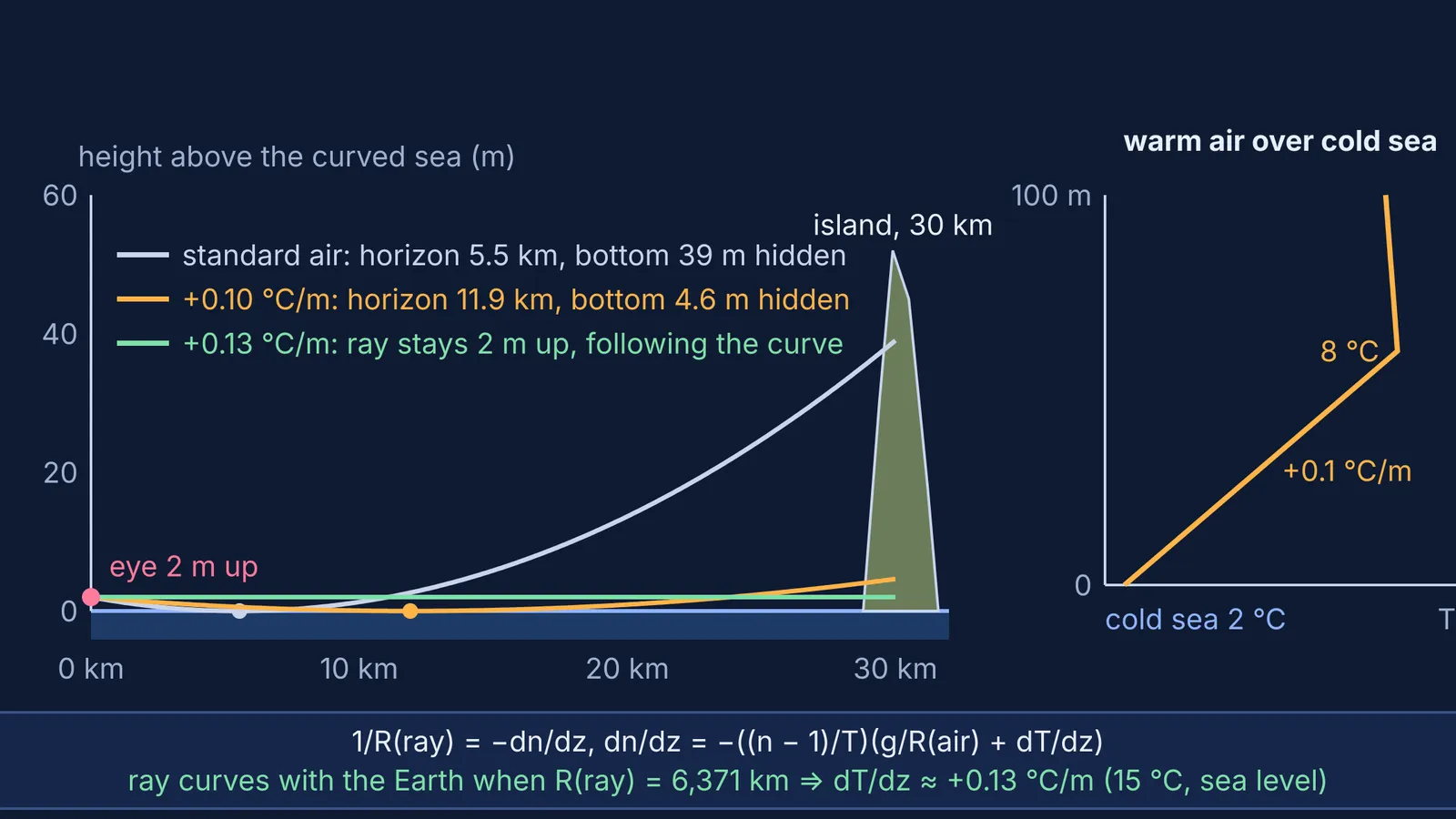
An island stands 30 km away. Your eye is 2 m above the sea. How much of the island's base is hidden?
No air (straight rays): horizon at 5.05 km. The line of sight then rises above the sea by (30 − 5.05)²/(2 × 6,371) km = 0.0489 km, so the bottom 49 m is hidden.
Standard air: use an effective Earth radius 1.20 × 6,371 = 7,670 km. Horizon at 5.54 km. Hidden part (30 − 5.54)²/(2 × 7,670) km = 39 m.
Inversion of +0.10 °C/m: g/R_air + dT/dz = 0.134 K/m, dn/dz = −1.29 × 10⁻⁷ per metre, and the ray radius is 7,770 km, only 1.22 times the Earth's. The effective radius becomes 6,371/(1 − 1/1.22) ≈ 35,400 km, about 5.6 times the real one. Horizon at √(2 × 35,400 × 0.002) = 11.9 km. Hidden part (30 − 11.9)²/(2 × 35,400) km = 4.6 m.
Inversion of +0.13 °C/m: the ray stays 2 m above the water all the way. Nothing above 2 m is hidden at any distance, as long as the warm layer lasts.
A modest inversion shrinks the hidden band from 39 m to under 5 m, and the island seems to lift out of the sea: looming.
What are superior mirages, looming and the Fata Morgana?
The World Meteorological Organization's International Cloud Atlas defines a superior mirage as one seen above a surface much colder than the air above it, with light bent downwards so that distant objects appear higher than their true positions. It notes that objects below the horizon may become visible, which is looming, and describes the Fata Morgana as a very complex superior mirage, usually seen in polar regions, with stretching, inversion and lifting of objects in changing patterns.
The stacked and upside-down images come from the shape of the inversion. When the gradient is strongest in a thin layer, rays from one point of an object can reach your eye along two or three different paths, each giving an image. Young's introduction to mirages shows how a strong duct produces an inverted image above an upright one.
The extreme case is the Novaya Zemlya effect, named after the Arctic islands where Willem Barents's crew saw the Sun in 1597 while it should still have been below the horizon. A 2003 paper in Applied Optics, Novaya Zemlya effect and sunsets, explains such sightings as light carried along a strong temperature inversion over very long distances.
How is this different from the hot-road mirage?
Same physics, opposite sign. The hot-road mirage needs a thin layer of very hot air at the ground, so rays bend upwards and you see an inverted image below the object. The superior mirage needs cold air at the bottom, so rays bend down and images appear above. Sound does the same thing in a night-time inversion, which is why distant trains sound clearer at night.
To revise refraction and the gas laws side by side, the Fermi Concept Library gives each concept its own lesson.
Quick checklist
n − 1 is proportional to air density, about 2.77 × 10⁻⁴ at 15 °C.
A horizontal ray curves with radius 1/|dn/dz|, towards the denser air.
Ordinary air: ray radius about 6 Earth radii, horizon about 1.1 times further.
Inversion of about 0.13 °C/m at 15 °C (0.11 °C/m at 0 °C): rays follow the Earth.
Superior mirage: cold surface, images lifted, sometimes stacked or inverted.