On this page
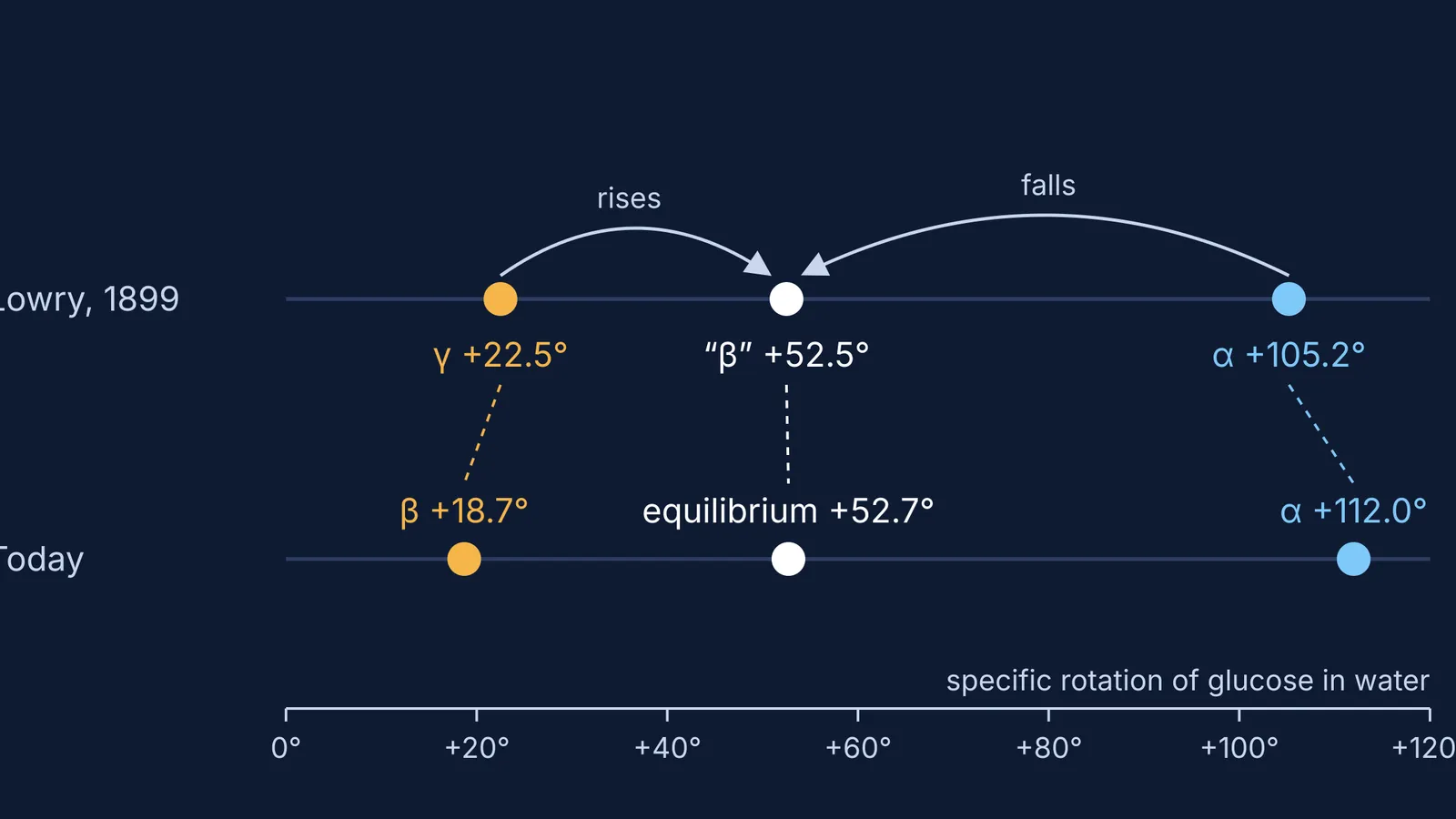
Open your Class 12 book and β-D-glucose has a specific rotation of +18.7°. Open an 1899 paper by T. Martin Lowry and "β-glucose" is +52.5°, which is the value glucose solutions settle at. Both are honest numbers. They use the same letter for different things. The same paper is where Lowry proposed the word mutarotation, and where he argued that a sugar's rotation drifts because two isomers turn into each other until they reach equilibrium.
The paper is T. M. Lowry, "Studies of the Terpenes and Allied Compounds. Nitrocamphor and its Derivatives. IV. Nitrocamphor as an Example of Dynamic Isomerism", J. Chem. Soc. Trans. 75 (1899) 211–244 (DOI 10.1039/CT8997500211; scan on the Internet Archive). Values and quotes below come from that scan, checked against the page images. The standard α/β percentage calculation with today's values is in mutarotation: calculate the alpha and beta glucose percentage; this post is about what the 1899 paper said.
What did Lowry see in nitrocamphor?
He was measuring the rotation of nitrocamphor in benzene when he noticed that a fresh solution was more strongly laevorotatory than one that had stood. A sample crystallised four times went from [α]D = −123° to −104° in a 5 per cent solution, and after four more crystallisations the limits were −124° and −104°. So the change belonged to the substance, not to an impurity.
The change happened in every solvent he tried, and only in compounds that kept the secondary nitro group and the hydrogen next to it. He concluded it was a chemical change, not a physical one: part of the normal, laevorotatory form turns into a dextrorotatory "pseudo" form until the two are in equilibrium. He could not isolate the pseudo form, but he guessed its rotation at about +180°, which put it at "about 7 per cent" at equilibrium. With the benzene figures, (−104 − (−123)) ÷ (180 − (−123)) = 19 ÷ 303 = 6.3%, in line with his estimate.
Why did Lowry say "mutarotation" and not "birotation"?
Sugars had shown the same kind of drift for decades. Lowry cites Dubrunfaut's 1846 paper in Comptes rendus, which named it "birotation" because the first rotation seemed to be twice the final one. Lowry's comment: "this is not so except in the case of glucose". Wheeler and Tollens had since used "multirotation" and "paucirotation" for ratios above and below 1. Lowry then wrote:
"The essential feature of the phenomenon, however, is the change of rotatory power which takes place in the freshly prepared solution, and the term 'mutarotation' may, therefore, be used with advantage to include all those cases in which such a change occurs without reference either to the sign or to the relative magnitude of the initial and final rotations."
His own Table I shows why one word was needed. Divide the initial rotation by the final one:
Glucose: 105.2 ÷ 52.5 = 2.00. "Birotation" fits.
α-Lactose hydrate: 82.9 ÷ 55.2 = 1.50.
Maltose: 119 ÷ 137 = 0.87. The rotation rises.
Rhamnose: −3.1° to +8.6°. The rotation changes sign.
What did Lowry think caused mutarotation in sugars?
The usual explanation then was Fischer's 1890 suggestion: in water the sugar's aldehyde or ketone group picks up water, as acetaldehyde does: CH₃CHO + H₂O ⇌ CH₃CH(OH)₂. Lowry pointed out that bromonitrocamphor mutarotates by isomeric change, not hydration. So, he argued, sugars probably do the same, and when the rotation becomes constant "two dynamic isomerides are present in equilibrium in the solution."
He did not know their structures. He wrote that the data "are not yet available", drew three candidate formulas for glucose (the open-chain aldehyde, a ring closed through an oxygen atom, and a third), and said two of them were probably the pair. Today the pair is the α and β ring forms, which interconvert through a trace of the open chain; see glucose structure: open chain, cyclic forms and anomers. Later in the paper he proposed the name dynamic isomerism for isomers that reach a reversible equilibrium once melted or dissolved.
What were Tanret's three glucoses?
Tanret had described three forms of glucose, called α, β and γ. Lowry's Table I lists:
α-glucose: +105.2° at first, then +52.5° (from Parcus and Tollens, 1890).
β-glucose: +52.5° at first, and +52.5° at the end (Tanret, Comptes rendus, 1895).
γ-glucose: +22.5° at first, rising to +52.5° (Tanret).
Tanret's "β" started at the final value and never changed. Lippmann and Tanret treated it as a third isomer. Lowry disagreed: α- and γ-glucose are the two isodynamic forms, "whilst β-glucose, β-lactose, &c., do not represent any new form of isomerism, but are merely mixtures of the isodynamic α- and γ-forms."
Put his numbers next to today's and the match is clear:
Tanret's α (+105.2°) lines up with today's α-anomer (+112°).
Tanret's γ (+22.5°) lines up with today's β-anomer (+18.7°).
Tanret's "β" (+52.5°) is today's equilibrium mixture (+52.7°).
The match is by rotation. The old and new values differ by a few degrees; we have not traced why.
Worked example: % α at equilibrium from 1899 numbers
Treat the solution as α plus γ (today's β). Let x be the fraction of α.
Rotations add by fraction: 105.2x + 22.5(1 − x) = 52.5.
Expand: 105.2x − 22.5x = 52.5 − 22.5, so 82.7x = 30.0.
x = 30.0 ÷ 82.7 = 0.363. That is 36.3% α and 63.7% of the other form.
K for α ⇌ β (today's names) = 63.7 ÷ 36.3 = 1.76.
Check: 0.363 × 105.2 + 0.637 × 22.5 = 38.2 + 14.3 = 52.5°.
With today's +112°, +18.7° and +52.7°, the same steps give 36.4% α. The 1899 numbers give the same answer to within a few tenths of a per cent.
Try it yourself on lactose. Lowry's table gives α-lactose hydrate +82.9°, γ-lactose +35° and a constant +55.2°. You should get about 42% of the α form. These are his 1899 values; we have not compared them with a modern table.
If you are revising Biomolecules for the exam, Fermi Test Prep offers JEE Main and Advanced preparation with an AI tutor, and the Concept Library covers anomers and optical activity one idea at a time.
Lowry's name may already be familiar from acid–base chemistry; see Brønsted, Lowry and the 1923 acid–base theory.
Quick checklist
1899: Lowry proposed "mutarotation" for any change of rotation in a fresh solution.
"Birotation" assumed the first rotation is twice the last, which holds only for glucose.
Lowry: two isomers reach equilibrium; Fischer had suggested hydration.
Tanret's α ≈ today's α; Tanret's γ ≈ today's β; Tanret's "β" = the equilibrium mixture.
From 1899 values: 36.3% α at equilibrium; from today's: 36.4%.