On this page
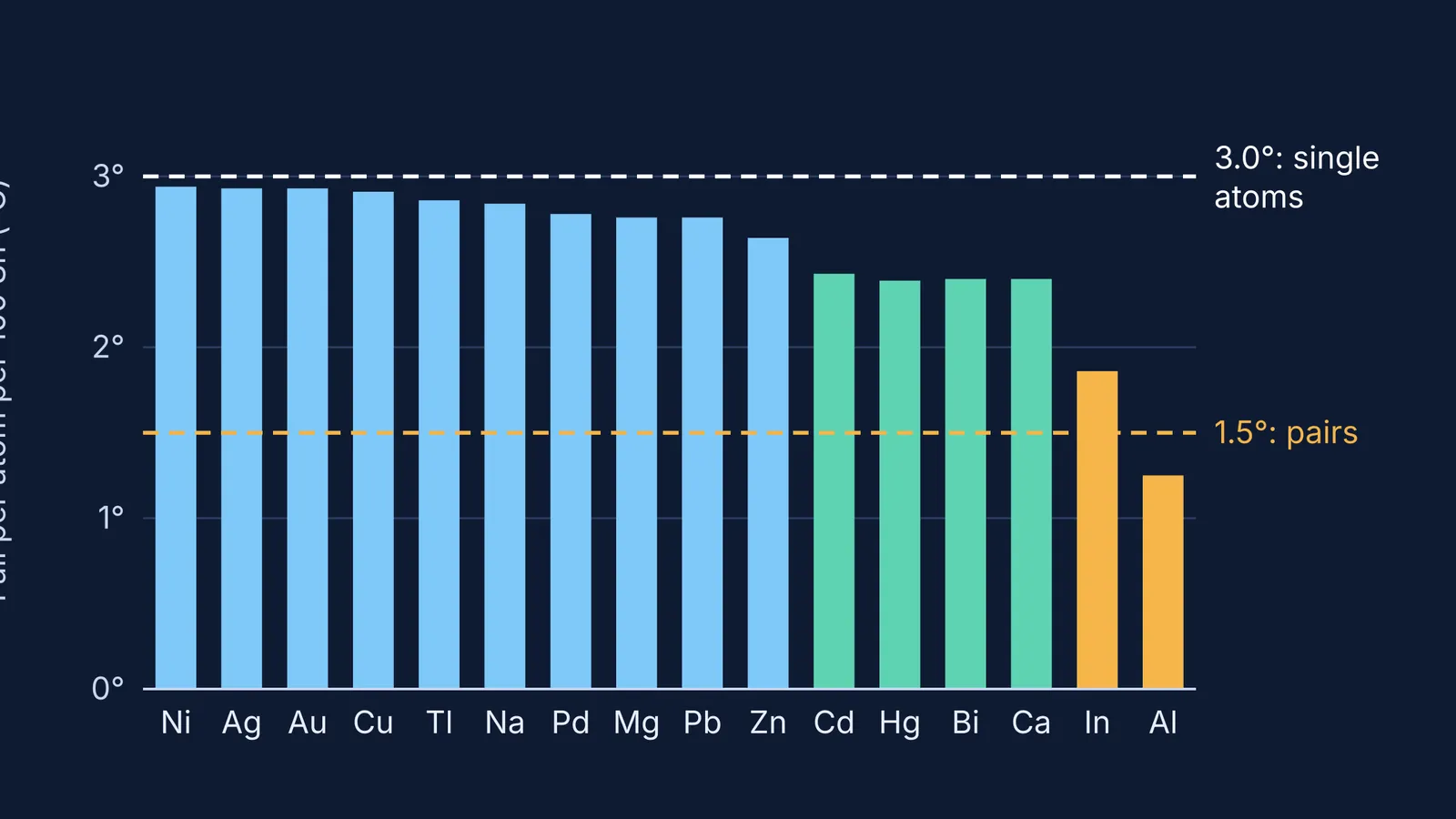
Is a metal dissolved in another metal present as single atoms or as clusters? In 1890 C. T. Heycock and F. H. Neville answered with a Class 12 tool: depression of freezing point. They dissolved weighed amounts of metals in molten tin and measured how far its freezing point fell. Most metals gave close to the 3° per atom that theory predicts for single atoms. Aluminium gave about half.
The paper is C. T. Heycock and F. H. Neville, "The Molecular Weights of Metals when in Solution", J. Chem. Soc. Trans. 57 (1890) 376–393 (DOI 10.1039/CT8905700376; scan on the Internet Archive). Numbers and quotes come from that scan, checked against the page images.
What were Heycock and Neville trying to find out?
They set three aims: to test Raoult's freezing-point laws for one metal dissolved in another, "to ascertain the atomicity (number of atoms) of the elementary molecules in solution", and to compare metallic solutions with salt solutions. The second works because a freezing-point depression counts particles: from the mass added and the fall, you get the number of atoms per particle.
How did they measure the freezing point of molten tin?
In principle, from a cooling curve near 230 °C. The tin sat in iron blocks under paraffin, a water motor stirred it, and calibrated thermometers read "differences of temperature of 0.01 °C".
They reported each result as the atomic fall: the depression caused by 1 atom of added metal per 100 atoms of tin. Their example on p. 377:
Worked example 1: the atomic fall of silver
Silver added: 4.3085 g in 400 g of tin. They used Ag = 108 and Sn = 118.
Atoms of silver per 100 atoms of tin = (4.3085 × 118 × 100) ÷ (108 × 400) = 1.177.
Fall = 231.68° (pure tin) − 228.29° (alloy) = 3.39°.
Atomic fall = 3.39 ÷ 1.177 = 2.88°. The paper prints 2.875, which matches the 228.295° in its Table I (3.385 ÷ 1.177 = 2.876).
Their p. 392 table, for solutions under 1 atom per 100, sorts the metals into three groups:
Group I, close to 3°: nickel 2.94, silver 2.93, gold 2.93, copper 2.91, thallium 2.86, sodium 2.84, palladium 2.78, magnesium 2.76, lead 2.76, zinc 2.64.
Group II, somewhat low: cadmium 2.43, mercury 2.39, bismuth 2.40, calcium 2.40.
Group III, well below: indium 1.86, aluminium 1.25.
Why did about 3° per atom mean single atoms?
Through Ramsay's translation of van 't Hoff's paper they knew the theory, which predicts the fall from the solvent's absolute freezing point and latent heat of fusion. For tin they used 504.5 K and Person's latent heat of 14.25 calories per gram, and found that "1 mol. of any metal dissolved in 100 atomic weights of tin ought to cause a depression of 3° Centigrade."
Worked example 2: Kf of tin and the fall for one atom
NCERT gives Kf = R × M₁ × Tf² ÷ (1000 × ΔfusH). The same formula is worked for water in Kb and Kf from enthalpy of vaporisation and fusion.
Convert the latent heat: 14.25 cal/g × 4.184 J/cal = 59.62 J/g. Per mole of tin (M₁ = 118 g/mol), ΔfusH = 59.62 × 118 = 7035 J/mol.
Tf² = 504.5² = 254,520 K².
Kf = 8.314 × 118 × 254,520 ÷ (1000 × 7035) = 35.5 K kg mol⁻¹.
One atom per 100 atoms of tin means 1 mol of solute in 100 × 118 g = 11.8 kg of tin. Molality = 1 ÷ 11.8 = 0.0847 mol kg⁻¹.
ΔTf = Kf × m = 35.5 × 0.0847 = 3.0°.
That is their 3°. Single atoms should give about 3° per atom; pairs about 1.5°. Their verdict on Group I: the number "is so nearly equal to the fall produced by 1 atomic weight of most of the metals examined as to make it very probable that their molecules, when in dilute solution in tin, are monatomic." They noted that Ramsay and Tammann, working with mercury as solvent, had reached the same result.
Two caveats: the 14.25 cal/g was their input from Person, not checked here against a modern table, and the formula "cannot be applied to more concentrated solutions."
Did aluminium really form Al₂ molecules?
That was their 1890 interpretation. They wrote that the falls for aluminium "are so nearly half the average atomic falls that it seems probable that the molecule of aluminium when in solution in tin consists of 2 atoms." Their Plate 1 shows a dotted line for aluminium at a molecular weight of 54, which is Al₂ with Al = 27.
The arithmetic is the van 't Hoff factor you already know:
Aluminium gave 1.25° dilute; in stronger solutions it "increases to 1.4°".
i = observed ÷ expected fall = 1.25 ÷ 3 = 0.42, or 1.4 ÷ 3 = 0.47.
Apparent molar mass = 27 × 3 ÷ 1.4 = 58 g/mol, near the 54 expected for Al₂.
It is the same algebra as acetic acid showing a molar mass of 120 in benzene. But a freezing point only shows fewer particles than atoms added; it does not prove what the particles are. We have not checked how aluminium in tin is explained today, so treat Al₂ as their proposal, not a modern fact.
Cadmium, mercury and zinc gave low falls "as if there were some condensation", although those metals are monatomic as vapours. Antimony did the opposite of every other metal: it raised the freezing point, by about 2.5° per atom, and they wrote, "we do not see how, on theoretical grounds, this rise can be explained." They also called Raoult's third law "probably incorrect": 1 atom of gold per 100 atoms of solvent gave about 4° in sodium, 3° in tin and 1.8° in potassium.
What did the paper say about eutectics and solder?
A footnote defines the eutectic, "as used by Guthrie", as the mixture "which solidifies at the lowest temperature." Their Table XIX gives copper at 0.915% and 226.76°, and zinc at 7.98% and 198.28°. As a dilute copper–tin alloy cools, pure tin crystallises first and the liquid gets richer in copper until it reaches 0.915%; the rest then solidifies at a constant 226.76°. It "behaves exactly like a dilute solution of common salt in water when cooled below zero." The same idea, they noted, is behind separating lead from silver (Pattinson's method) and the mouldable solder of "wiping" plumbers' joints. For the alloys in your syllabus, see common alloys and their uses: brass, bronze, solder and amalgams.
For practice turning a freezing-point reading into i or a molar mass, the Fermi Problem Library has worked problems with a step-by-step solver that explains the reasoning. The Concept Library covers colligative properties.
Quick checklist
Atomic fall = depression per 1 atom of solute per 100 atoms of solvent.
Kf of tin from their constants is about 35.5 K kg mol⁻¹, which gives 3.0° per atom per 100 Sn.
Most metals gave 2.6 to 2.9°, so they read them as single atoms in tin.
Aluminium gave 1.25 to 1.4°, so i ≈ 0.42 to 0.47; Al₂ was their 1890 proposal.
Antimony raised the freezing point; they could not explain it.