On this page
These eight questions run from easy to hard, all in JEE Main's numerical-value format. Each has a worked solution, the answer as a plain number, a quick check and the slip that most often gives a wrong one. Try each on paper first.
How are JEE Main numerical value questions marked?
NTA's Information Bulletin for JEE (Main) 2027 says each subject in Paper 1 has Section A (multiple-choice questions) and Section B, whose answers are filled in as a numerical value. Mathematics has 5 Section B questions. A correct answer earns +4, an incorrect one −1 and an unanswered one 0. You type an integer on an on-screen keypad, and the answer should be rounded off to the nearest integer.
All eight questions sit inside Unit 11 (Three Dimensional Geometry) and Unit 12 (Vector Algebra) of NTA's Syllabus for JEE (Main) 2027. Planes are not in Unit 11, so none appear here. For the theory and a study plan, read how to prepare vectors and 3D geometry for JEE Main.
Easy: can you get these right first time?
Q1 (easy). The vectors a = λi + 2j − 3k and b = 4i − j + 2k are perpendicular. What is λ?
Answer: 2. Perpendicular means a · b = 0, so 4λ − 2 − 6 = 0 and λ = 2.
Check: with λ = 2, a · b = 8 − 2 − 6 = 0. Slip: 0.5, from dropping the k-terms and solving 4λ − 2 = 0.
Q2 (easy). a = 3i + 4j + 5k and b = 2i − j + 2k. What is the scalar projection of a on b?
Answer: 4. The projection is (a · b)/|b|. Here a · b = 6 − 4 + 10 = 12 and |b| = √(4 + 1 + 4) = 3, so the projection is 12/3 = 4.
Check: 4 × |b| = 12 = a · b. Slip: 12, from forgetting to divide by |b|, or 1 (from 1.33) after dividing by |b|².
Q3 (easy). P divides the segment from A(1, 2, 3) to B(7, −4, 9) internally in the ratio 1 : 2. What is the sum of P's coordinates?
Answer: 8. P = (2A + B)/3 = ((2 + 7)/3, (4 − 4)/3, (6 + 9)/3) = (3, 0, 5), and 3 + 0 + 5 = 8.
Check: P is one third of the way from A, and A + (B − A)/3 = (1 + 2, 2 − 2, 3 + 2) = (3, 0, 5). Slip: 10, from weighting the wrong end, which gives the 2 : 1 point (5, −2, 7).
Medium: where do the steps pile up?
Q4 (medium). A line makes 60° with the x-axis, 45° with the y-axis and an acute angle γ with the z-axis. What is γ in degrees?
Answer: 60. Direction cosines satisfy cos²α + cos²β + cos²γ = 1, so cos²γ = 1 − 1/4 − 1/2 = 1/4. Since γ is acute, cos γ = 1/2 and γ = 60°.
Check: (1/2)² + (1/√2)² + (1/2)² = 1. Slip: 120, from taking cos γ = −1/2; the question fixes γ as acute.
Q5 (medium). |a| = 3, |b| = 5 and a · b = 9. What is |a × b|?
Answer: 12. Use |a × b|² + (a · b)² = |a|²|b|². So |a × b|² = 225 − 81 = 144 and |a × b| = 12.
Check: cos θ = 9/15 = 3/5, so sin θ = 4/5 and |a||b| sin θ = 15 × 4/5 = 12. Slip: 144, from stopping before the square root.
Q6 (medium). The triangle with vertices A(1, 0, 0), B(0, 2, 0) and C(0, 0, 3) has area Δ. What is 4Δ²?
Answer: 49. AB = −i + 2j and AC = −i + 3k, so AB × AC = 6i + 3j + 2k, whose length is √(36 + 9 + 4) = 7. So Δ = 7/2 and 4Δ² = 49.
Check: the squares of the areas of the triangle's shadows on the three coordinate planes add up to Δ², and 1² + 3² + 1.5² = 12.25 = (7/2)². Slip: 196, from forgetting the ½ in Δ = ½|AB × AC|.
Hard: can you handle vector sums and skew lines?
Q7 (hard). Vectors a, b and c satisfy a + b + c = 0, with |a| = 3, |b| = 4 and |c| = 5. What is a · b + b · c + c · a?
Answer: −25. Square the sum: |a + b + c|² = |a|² + |b|² + |c|² + 2(a · b + b · c + c · a) = 0. So 50 + 2S = 0 and S = −25.
Check: the sides 3, 4, 5 make a right triangle, so a · b = 0, b · c = −(a · b + |b|²) = −16 and c · a = −(|a|² + a · b) = −9, which add to −25. Slip: 25 from dropping the minus sign, or −50 from forgetting the 2.
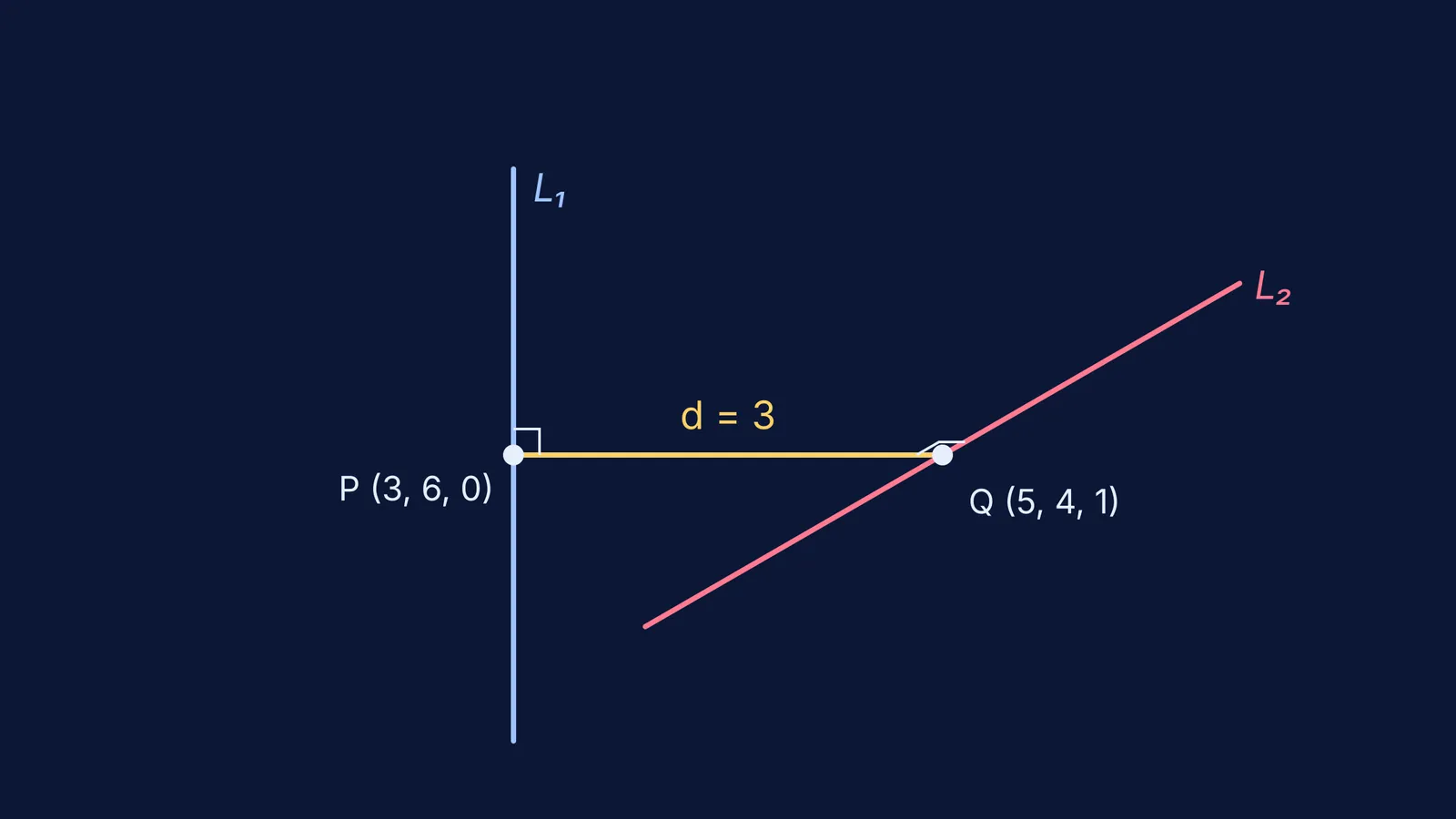
Q8 (hard). Find the shortest distance between the lines (x − 1)/1 = (y − 2)/2 = (z + 4)/2 and (x − 1)/2 = (y − 2)/1 = (z − 5)/(−2).
Answer: 3. Take A(1, 2, −4) and B(1, 2, 5) on the lines, with directions d₁ = (1, 2, 2) and d₂ = (2, 1, −2). Then d₁ × d₂ = (−6, 6, −3), of length 9, and AB = (0, 0, 9). The distance is |AB · (d₁ × d₂)| / |d₁ × d₂| = 27/9 = 3.
Check: the feet of the common perpendicular are P(3, 6, 0) on the first line and Q(5, 4, 1) on the second, and PQ = (2, −2, 1) has length 3. Slip: 0 (from 1/3), after dividing by |d₁ × d₂|² = 81 instead of its length.
How do you avoid wrong numbers in vectors and 3D geometry?
Write every vector in i, j, k components before you multiply.
Name the product you need: a dot product gives a number, and the length of a cross product gives a parallelogram's area.
Divide by a length, not a squared length, in projections and shortest distances.
Use the condition the question fixes: an acute angle, internal division, an absolute value.
Check by a route you did not use to solve: substitute back, use a second formula, or test a special case.
For multiple-choice practice, try our vectors and 3D geometry JEE Main practice questions with solutions.
Answer still won't match? The Fermi Problem Library has worked problems with a step-by-step solver that explains the reasoning rather than printing an answer. For the rest of your JEE preparation, start at Fermi Test Prep, our JEE Main and Advanced preparation.