On this page
Each question below is original and in JEE Main's multiple-choice style, with a full solution, the wrong option most likely to tempt you, and a quick way to check the answer.
What does the JEE Main syllabus cover in vectors and 3D geometry?
The JEE Main 2027 syllabus from NTA lists Three Dimensional Geometry as Unit 11 and Vector Algebra as Unit 12 of the Paper 1 mathematics syllabus. Unit 11 covers coordinates in space, distance, the section formula, direction ratios and cosines, the angle between intersecting lines, the equation of a line, and the shortest distance between skew lines. Unit 12 covers vectors and scalars, the addition of vectors, components in two and three dimensions, and the scalar and vector products.
Planes and the scalar triple product are not named in either unit, so this set leaves them out. Confirm on the NTA syllabus page before your exam. For a study plan, read how to prepare vectors and 3D geometry for JEE Main.
Questions 1-4: vector algebra
Q1 (easy). If a = 2i − j + 2k and b = i + 2j − 2k, the unit vector along a + b is (A) (3i + j)/√10 (B) (3i + j)/6 (C) (3i + j)/4 (D) (i + 3j)/√10.
Solution: a + b = 3i + j, of magnitude √10. Answer (A).
Trap: (B) divides by |a| + |b| = 3 + 3. Magnitudes add only when vectors point the same way.
Check: (3/√10)² + (1/√10)² = 1.
Q2 (easy). The projection of a = 2i + j + 2k on b = 3i + 4k is (A) 14/5 (B) 14/3 (C) 14 (D) 2.
Solution: a · b = 6 + 8 = 14 and |b| = 5, so the projection is 14/5. Answer (A).
Trap: (B) divides by |a| = 3, which gives the projection of b on a.
Check: 2.8 is less than |a| = 3; a projection is never longer than the vector.
Q3 (medium). The area of the triangle with vertices A(1, 0, 0), B(0, 2, 0) and C(0, 0, 3) is (A) 7/2 (B) 7 (C) 3 (D) √14.
Solution: AB = −i + 2j and AC = −i + 3k, so AB × AC = 6i + 3j + 2k, of magnitude 7. Area = 7/2. Answer (A).
Trap: (B) forgets the half; that is the parallelogram.
Check: for intercepts 1, 2 and 3, area = ½√(4 + 36 + 9) = 7/2.
Q4 (medium). If a = 2i + λj + k, b = i − 2j + 3k and |a + b| = |a − b|, then λ is (A) 5/2 (B) −4 (C) 2/5 (D) −5/2.
Solution: squaring both sides leaves 4(a · b) = 0, so 2 − 2λ + 3 = 0 and λ = 5/2. Answer (A).
Trap: (B) forces a and b to be parallel using two components. Equal diagonals make a rectangle, so they are perpendicular.
Check: with λ = 5/2, |a + b|² and |a − b|² both equal 25.25.
Questions 5-8: 3D geometry
Q5 (easy). A line makes 45° with the x-axis and 60° with the y-axis. Its angle with the z-axis is (A) 60° or 120° (B) 75° (C) 90° (D) 30°.
Solution: cos²γ = 1 − ½ − ¼ = ¼, so cos γ = ±½. Answer (A).
Trap: (B) assumes the angles add to 180°. It is the squared cosines that add to 1.
Check: ½ + ¼ + ¼ = 1.
Q6 (medium). The xy-plane divides the segment from A(2, 1, 4) to B(−1, 3, −2) (A) 2 : 1 internally, at (0, 7/3, 0) (B) 1 : 2 internally, at (1, 5/3, 2) (C) 2 : 1 externally (D) 1 : 1.
Solution: in the ratio k : 1, z = (−2k + 4)/(k + 1). Setting z = 0 gives k = 2, and the point is (0, 7/3, 0). Answer (A).
Trap: (B) swaps the weights. In k : 1, the k multiplies B's coordinates.
Check: A is 4 above the plane and B is 2 below, so the split is 4 : 2.
Q7 (medium). The lines (x − 1)/2 = (y + 2)/(−1) = (z − 3)/2 and x/1 = (y − 1)/2 = (z + 1)/(−2) meet at an angle of (A) cos⁻¹(4/9) (B) π − cos⁻¹(4/9) (C) cos⁻¹(1/9) (D) π/2.
Solution: the direction ratios (2, −1, 2) and (1, 2, −2) have dot product −4 and magnitudes 3 each, so cos θ = 4/9. Answer (A).
Trap: (B) keeps the minus sign. The angle between lines is taken as the acute one.
Check: both lines pass through (−1, −1, 1) at parameter −1, so they really intersect.
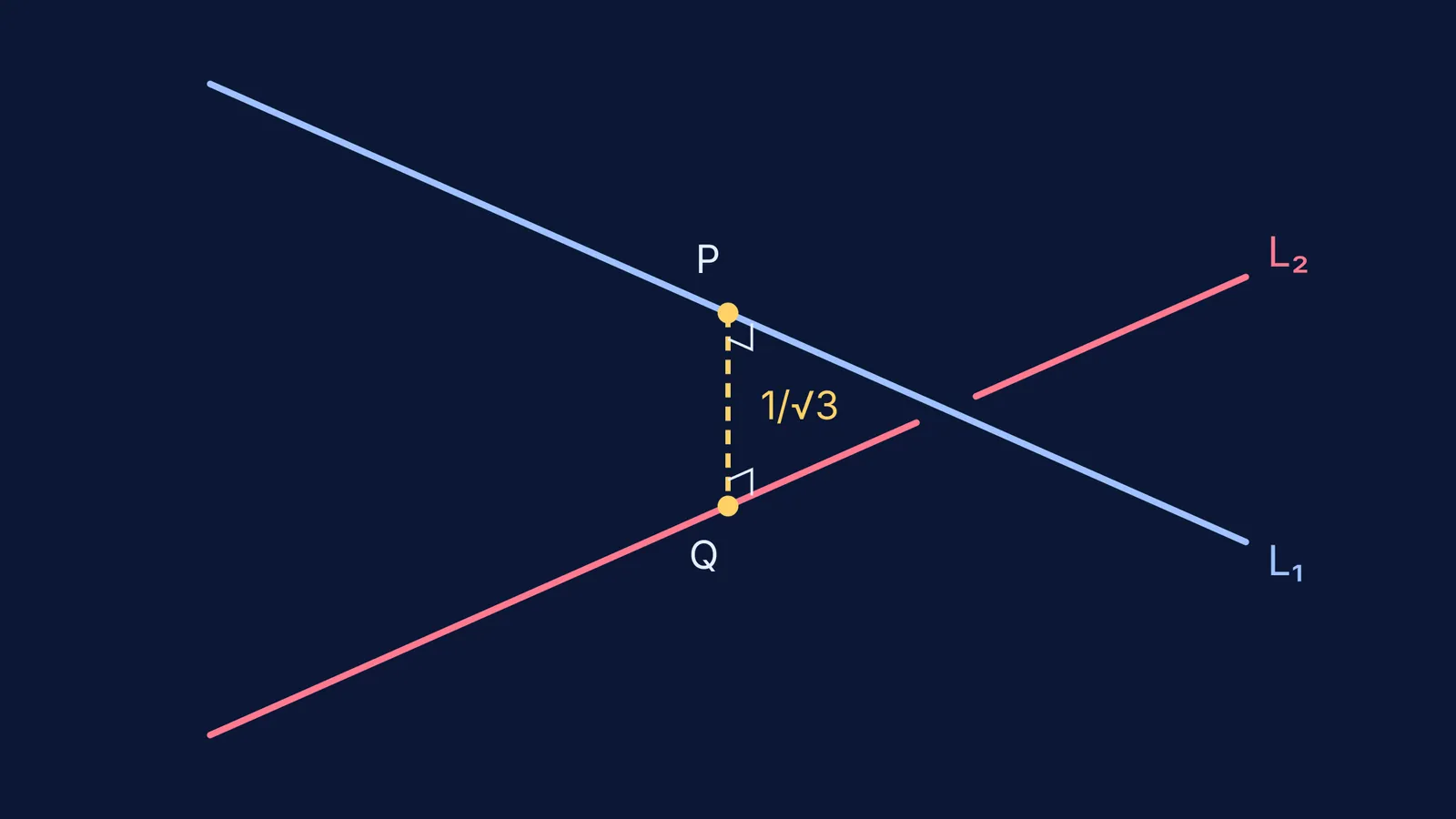
Q8 (hard). The shortest distance between r = (i − k) + λ(i + 2j + k) and r = (j + 2k) + μ(2i + j − k) is (A) 1/√3 (B) √11 (C) 0 (D) 1/9.
Solution: AB = −i + j + 3k and d₁ × d₂ = −3i + 3j − 3k, of magnitude 3√3. AB · (d₁ × d₂) = −3, so the distance is 3/(3√3) = 1/√3. Answer (A).
Trap: (B) is the distance between the two given points, which are not the closest pair.
Check: at λ = μ = 4/3 the feet are P(7/3, 8/3, 1/3) and Q(8/3, 7/3, 2/3). PQ = (1/3)(1, −1, 1) is perpendicular to both directions, with length 1/√3.
How should you use this practice set in revision?
Attempt all eight in one timed sitting before reading any solution. Mark each right, wrong or guessed.
For every miss or guess, write one line naming the trap that caught you.
A few days later, re-solve those questions from a blank page.
Change one number in a missed question and predict how the answer moves before working it.
Make the quick check your last step on every problem, in mock tests too.
If a solution skipped a step you needed, the Fermi Problem Library has worked problems with a step-by-step solver that explains the reasoning rather than printing an answer. To fit this chapter into a full JEE Main and Advanced plan, start at Fermi Test Prep. For the same format on another topic, try the complex numbers and quadratic equations practice set.