On this page
Every order below is NCERT's own, from Chapter 18 of NCERT Class 11 Biology (Reprint 2026-27). The NMC NEET (UG) 2026 syllabus places the chapter in Unit 5, Human Physiology. All 11 questions are original.
Which sequences in neural control does NCERT give in order?
Route of a signal (18.2): tissue or organ → afferent fibres → CNS → efferent fibres → peripheral tissue or organ.
Through one neuron (18.3): dendrites → cell body → axon → distal branches → synaptic knobs → synapse or neuro-muscular junction.
Resting potential (18.3.1): membrane more permeable to K+ than Na+ → axoplasm high K+, low Na+ → sodium-potassium pump (3 Na+ out per 2 K+ in) maintains the gradients → outside positive, inside negative → resting potential.
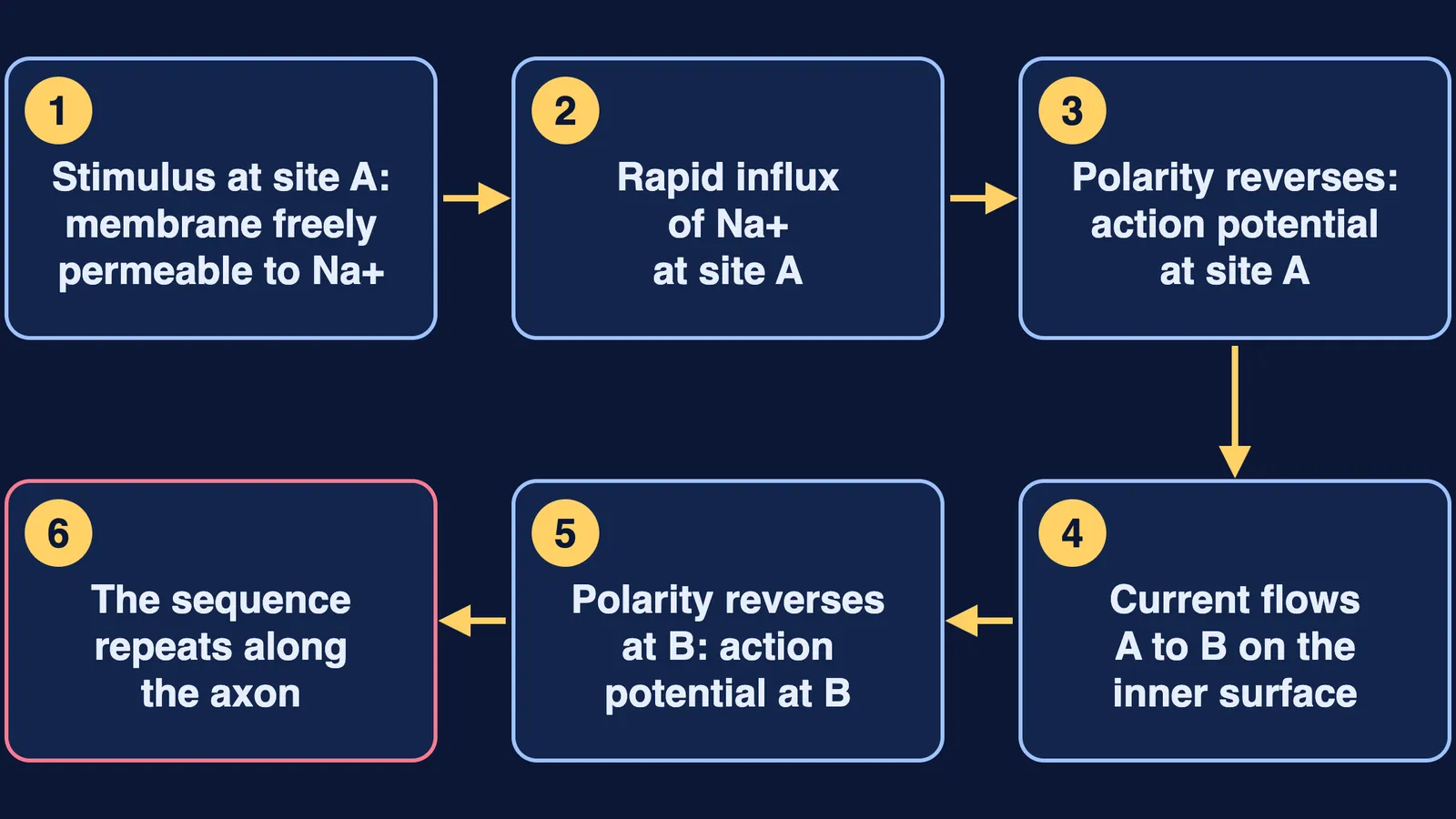
Nerve impulse, one chain in three stages (18.3.1): *generation:* stimulus at site A → membrane freely permeable to Na+ → Na+ influx → polarity reverses (action potential); *conduction:* current flows A to B inside → polarity reverses at B → repeats along the axon; *recovery at A:* brief Na+ permeability rise → K+ permeability rise → K+ out → resting potential → responsive again.
Chemical synapse (18.3.2): impulse at axon terminal → vesicles move to membrane → fusion → neurotransmitters into the cleft → post-synaptic receptor binding → channels open → ions enter → new potential (excitatory or inhibitory).
Brain to spinal cord (18.4.2, 18.4.3, Figure 18.4): thalamus and hypothalamus → midbrain → pons → medulla → spinal cord. Basis: the midbrain lies between thalamus/hypothalamus and pons; the medulla joins the spinal cord.
How can you crack an order question quickly?
Anchor both ends first: the step nothing causes starts the chain; the step nothing follows ends it. Then test one adjacent pair against NCERT.
Arrange-in-order questions (Q1 to Q6)
Q1. Signal route: A. CNS; B. Efferent fibres; C. Afferent fibres; D. Tissue sending impulses; E. Organ receiving regulatory impulses (1) C, D, A, B, E (2) D, B, A, C, E (3) D, C, A, B, E (4) D, C, B, A, E Answer: (3). Afferent fibres enter the CNS; efferent fibres leave it (18.2).
Q2. Path of an impulse through one neuron: A. Axon; B. Synaptic knob; C. Dendrites; D. Cell body; E. Distal axon branches (1) C, D, A, E, B (2) D, C, A, E, B (3) C, D, E, A, B (4) C, A, D, E, B Answer: (1). Dendrites feed the cell body; the axon's branches end in knobs (18.3).
Q3. Resting potential: A. Outside positive, inside negative; B. Pump moves 3 Na+ out for 2 K+ in; C. Resting potential; D. Axoplasm high in K+, low in Na+; E. At rest, K+ crosses the membrane far more easily than Na+ (1) D, E, B, A, C (2) E, D, A, B, C (3) E, D, B, C, A (4) E, D, B, A, C Answer: (4). Permeability builds the gradients, the pump keeps them, so the outside turns positive (18.3.1).
Q4. Along an axon: A. Site A becomes freely permeable to Na+; B. Current flows inside from A to B; C. Na+ influx reverses polarity at A; D. Action potential at B; E. Sequence repeats along the axon (1) A, B, C, D, E (2) A, C, B, D, E (3) C, A, B, D, E (4) A, C, D, B, E Answer: (2). A fires before current reaches B (18.3.1).
Q5. Recovery at the excited site: A. K+ diffuses out; B. Fibre responsive again; C. Brief rise in Na+ permeability; D. K+ permeability rises; E. Resting potential returns (1) C, A, D, E, B (2) C, D, A, E, B (3) D, C, A, E, B (4) C, D, A, B, E Answer: (2). K+ can leave only after its permeability rises (18.3.1).
Q6. From a stimulated axon to the next neuron: A. Impulse arrives at the axon terminal; B. Action potential at site B; C. Action potential at site A; D. New potential in the post-synaptic neuron; E. Neurotransmitters released into the cleft (1) C, A, B, E, D (2) B, C, A, E, D (3) C, B, E, A, D (4) C, B, A, E, D Answer: (4). The impulse runs A to B along the axon (18.3.1), then crosses the synapse (18.3.2).
Which step comes before, after or out of place? (Q7 to Q9)
Q7. Down the brain stem, which part comes immediately after the midbrain? (1) Medulla oblongata (2) Pons (3) Hypothalamus (4) Spinal cord Answer: (2). The midbrain lies between the thalamus/hypothalamus and the pons (18.4.2).
Q8. At an excited site, what happens immediately after the rise in K+ permeability? (1) Na+ rushes in (2) K+ diffuses out (3) Current flows from A to B (4) Vesicles fuse with the membrane Answer: (2). K+ then diffuses outside (18.3.1).
Q9. Top of the brain down: P. Medulla oblongata; Q. Thalamus and hypothalamus; R. Midbrain; S. Pons; T. Spinal cord. Which item is out of place? (1) P (2) Q (3) R (4) S Answer: (1). The medulla belongs after the pons, where it joins the spinal cord (18.4.2, 18.4.3).
Two-statement questions on order (Q10 and Q11)
Key: (1) Both true (2) Both false (3) Only I true (4) Only II true
Q10. I: Afferent fibres bring an impulse to the CNS before efferent fibres carry the regulatory impulse out. II: At site B, the action potential arises before current flows inside from A to B. Answer: (3). Afferent in, efferent out (18.2); the current reverses polarity at B (18.3.1).
Q11. I: At an excited site, the resting potential returns before K+ diffuses out. II: Within a neuron, an impulse passes the cell body before entering the axon. Answer: (4). K+ outflow restores the resting potential (18.3.1); the axon carries impulses away from the cell body (18.3).
How should you use this set?
Cover the answers, then rewrite each missed sequence from memory. Next, try the neural control diagram-based questions or the neural control statement and match-the-list questions, or revise with the Neural control Class 11 guide.
Not sure what to drill next? Fermi's AI tutor works out what you already know and builds a plan for the session.