On this page
Neural Control and Coordination is Chapter 18 of NCERT Class 11 Biology. This guide follows only the rationalised 2026-27 text, adds one worked example and ends with practice questions we wrote ourselves.
What does the 2026-27 syllabus include from this chapter?
In the CBSE Biology curriculum for 2026-27, Unit V, Human Physiology, carries 18 of the 70 Class XI theory marks. Those marks are shared across the unit's chapters, and CBSE prints no separate figure for this one. The syllabus lists neuron and nerves, the central, peripheral and visceral nervous systems, and the generation and conduction of the nerve impulse.
The NCERT chapter (Reprint 2026-27) also covers the synapse and the brain, so learn those too. NCERT's list of rationalised content, which uses the old chapter number 21, removed reflex action and the reflex arc, and sensory reception, including the eye and the ear. Skip them for the school exam.
How is a neuron built?
Cell body: cytoplasm, organelles and Nissl's granules.
Dendrites: short branched fibres, also with Nissl's granules, carrying impulses towards the cell body.
Axon: one long fibre carrying impulses away from the cell body. Its branches end in synaptic knobs holding vesicles of neurotransmitters.
Neurons are multipolar (cerebral cortex), bipolar (retina) or unipolar (mostly embryonic). In myelinated fibres, Schwann cells form a myelin sheath broken by nodes of Ranvier; our guide to myelinated and non-myelinated nerve fibres compares the two.
How is a nerve impulse generated and conducted?
At rest, the axon membrane lets K+ through far more easily than Na+ and holds back the negatively charged proteins inside. So the axoplasm is rich in K+ and poor in Na+, and the outside fluid is the reverse. According to the NCERT chapter, each cycle of the sodium-potassium pump carries 3 Na+ outward and 2 K+ inward. The outer surface ends up positive and the inner negative: the membrane is polarised, and this difference is the resting potential.
A stimulus at site A makes the membrane there freely permeable to Na+. Na+ rushes in and the polarity flips: inside positive, outside negative. This is the action potential, or nerve impulse. Current then flows on the inner surface from A to the next site, B, and on the outer surface from B to A, reversing the polarity at B. Soon K+ permeability rises, K+ diffuses out and A returns to its resting potential.
Worked example (our numbers). A pump runs 150 cycles. At 3 Na+ out and 2 K+ in per cycle, 450 Na+ leave and 300 K+ enter: 150 more positive ions out than in, keeping the outside positive.
How does a synapse pass the impulse on?
At an electrical synapse the membranes are very close and current passes straight across, faster than at a chemical synapse; NCERT notes these are rare in our body. At a chemical synapse, a fluid-filled synaptic cleft separates the membranes:
The impulse reaches the axon terminal.
Vesicles fuse with the membrane and release neurotransmitter into the cleft.
The neurotransmitter binds to specific receptors on the post-synaptic membrane.
Ion channels open, and the new potential may be excitatory or inhibitory.
What are the parts of the human brain?
Three meninges cover the brain: dura mater, arachnoid and pia mater (innermost).
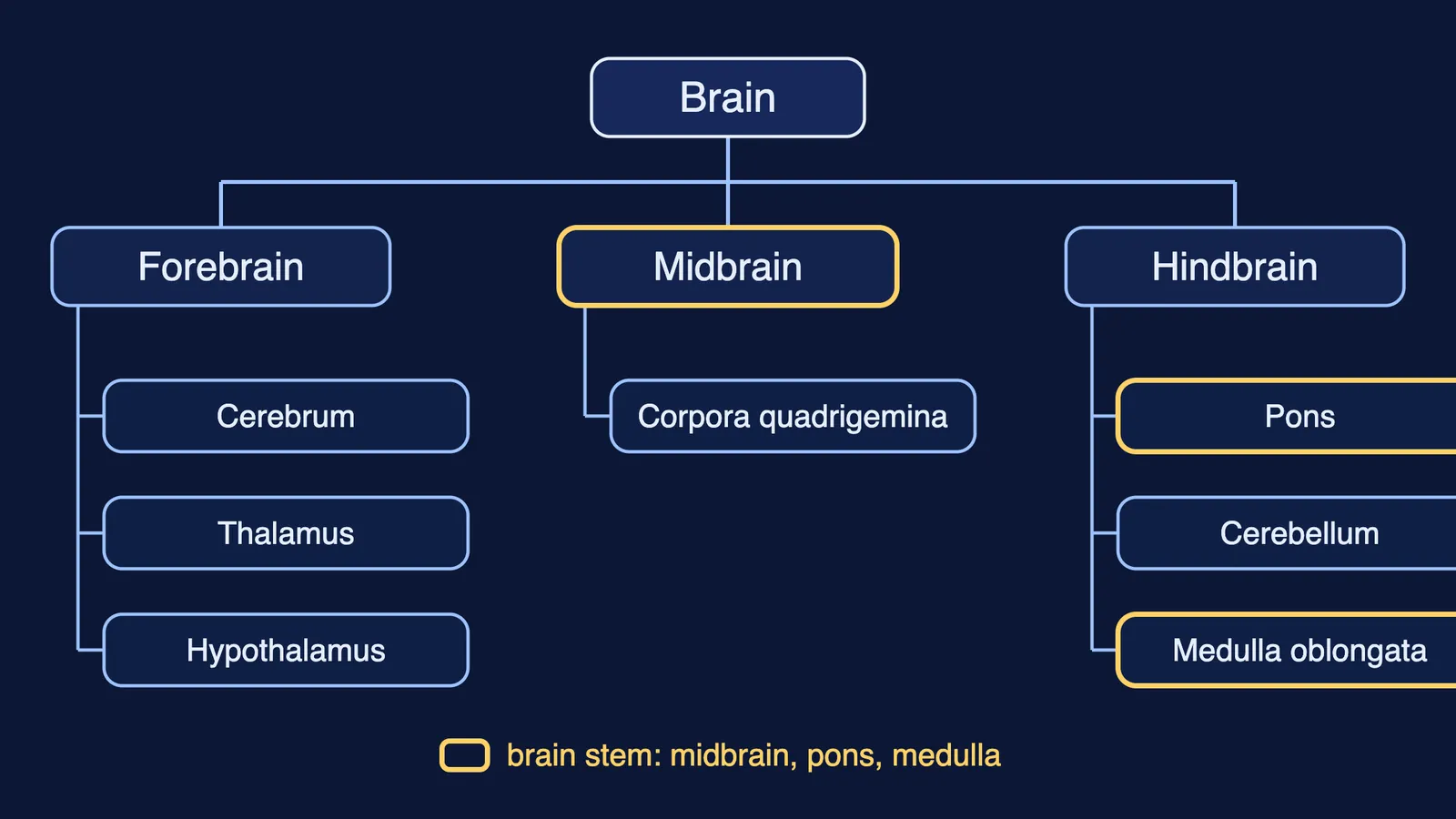
Forebrain: the cerebrum (two hemispheres joined by the corpus callosum; grey matter in the cortex, white matter beneath), the thalamus (a coordinating centre for sensory and motor signals) and the hypothalamus (body temperature, eating and drinking). The limbic system works with the hypothalamus on emotion and motivation.
Midbrain: between the forebrain and the pons, crossed by the cerebral aqueduct, with four dorsal swellings, the corpora quadrigemina.
Hindbrain: the pons (tracts linking brain regions), the cerebellum (highly folded) and the medulla (centres for respiration, cardiovascular reflexes and gastric secretions).
The midbrain, pons and medulla oblongata form the brain stem. For tissues and organ systems from Unit II, see our Structural Organisation in Animals Class 11 guide.
Which practice questions should you try?
Mark labels are our suggestion, not a CBSE allocation.
(1 mark) A stimulus reaches point A on an axon. Which surface of the membrane at A becomes negative?
(2 marks) A sodium-potassium pump completes 40 cycles. How many Na+ and K+ ions does it move, and what net charge leaves?
(3 marks) Name the part: (a) joins the cerebral hemispheres; (b) holds centres for gastric secretion; (c) bears the corpora quadrigemina.
(3 marks) Explain why a chemical synapse passes an impulse in one direction only.
Answers: 1. The outer surface. 2. 120 Na+ out, 80 K+ in; net 40 positive charges out. 3. Corpus callosum, medulla, midbrain. 4. The neurotransmitter vesicles are in the pre-synaptic axon terminal, and the receptors that bind it are on the post-synaptic membrane, so the signal crosses one way.
Preparing for NEET too? Our Human Physiology for NEET plan covers this chapter with its neighbours.
Not sure where to begin? Fermi's AI tutor works out what you already know, builds a plan for the session and checks understanding as it goes.