On this page
Caffeine has four nitrogen atoms, so you might expect it to take up four protons from a strong acid. The Indian Standard for food-grade caffeine, IS 11911:1986, says otherwise. Its purity test titrates caffeine with 0.1 N perchloric acid and states that each mL is equivalent to 19.42 mg of C₈H₁₀N₄O₂. That number tells you caffeine takes exactly one proton. Working out which nitrogen takes it is a good exercise in the basicity rules you already use for amides, pyrrole and pyridine.
What does IS 11911 say about caffeine?
The foreword gives the name 1,3,7-trimethylxanthine, the formula C₈H₁₀N₄O₂ and the molecular weight 194.19. There are two types, anhydrous and hydrous. The main points:
Description: white powder or needles. "Its solution shall be neutral to litmus." "The hydrate shall be efflorescent in air", meaning it loses water to the air. Melting range 235 to 237.5 °C.
Table 1: purity at least 98.5% (anhydrous basis); moisture at most 0.5% for anhydrous and 8.5% for hydrous caffeine; lead 10 mg/kg, arsenic 3 mg/kg, heavy metals 20 mg/kg; residue on ignition 0.1%.
Purity (Appendix A): dissolve about 800 mg in acetic anhydride and benzene, titrate with 0.1 N perchloric acid, and find the end point with an electrode (potentiometrically).
Moisture (Appendix B): loss on drying at 120 °C, or Karl Fischer in a dispute.
Why does 19.42 mg per mL mean one proton?
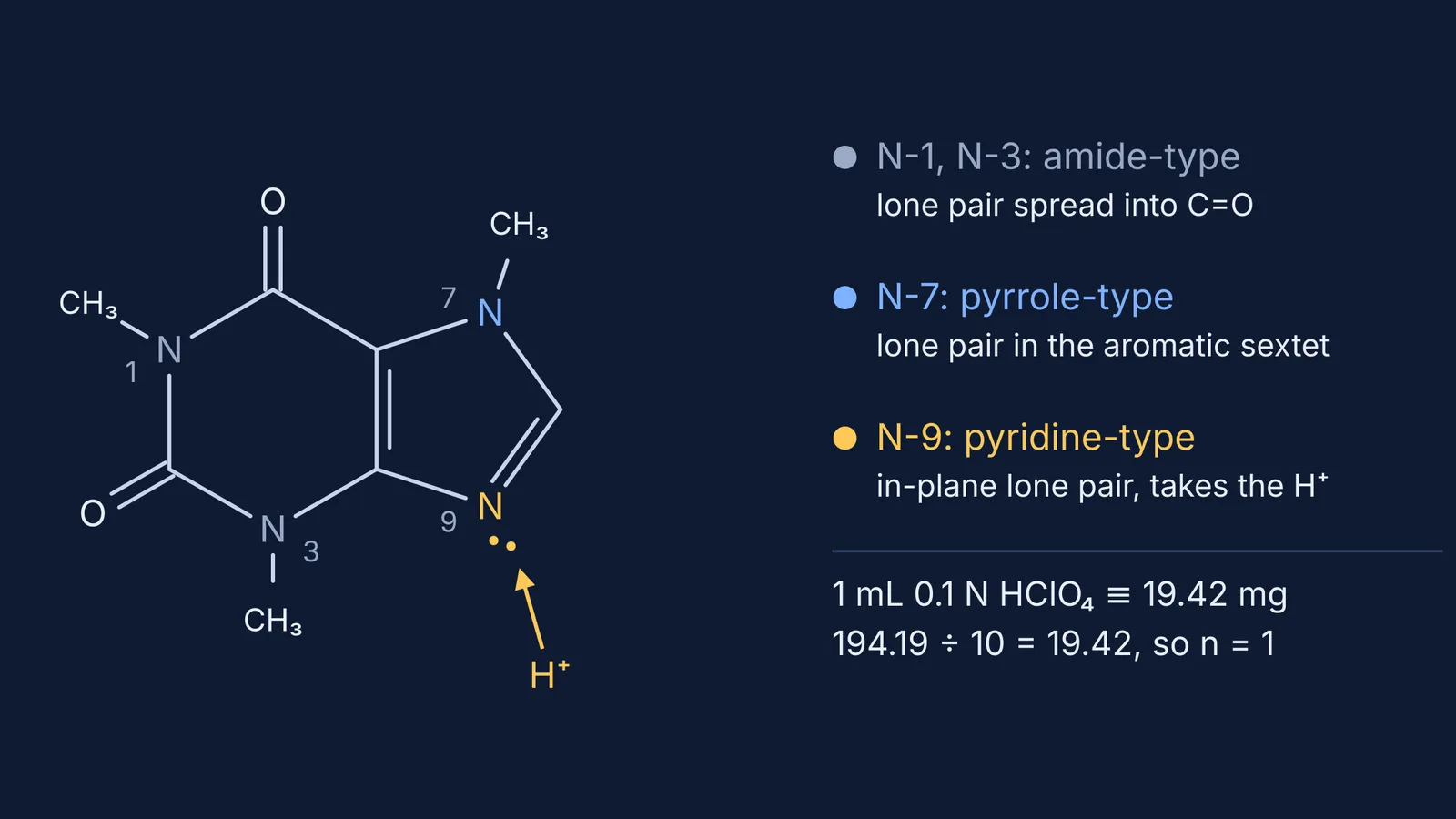
One mL of 0.1 N acid delivers 0.1 mmol of H⁺. If each caffeine takes n protons, that mL reacts with 0.1/n mmol of caffeine.
Mass of 0.1 mmol of caffeine: 0.1 × 194.19 = 19.42 mg.
BIS says 19.42 mg per mL.
So n = 194.19 / (10 × 19.42) = 1.
The reaction, with perchlorate as the counter-ion, is:
C₈H₁₀N₄O₂ + HClO₄ → [C₈H₁₁N₄O₂]⁺ClO₄⁻
Atoms balance (C 8, H 11, N 4, O 6, Cl 1 on each side) and the charge is zero on both sides. Compare monosodium glutamate, where BIS's figure is half the molar mass because each MSG takes two protons; see why MSG counts as two bases in the BIS perchloric acid titration. Caffeine is the n = 1 case.
Why is only one of caffeine's four nitrogens basic?
Use purine numbering. The six-membered ring holds N-1 and N-3; the five-membered ring holds N-7 and N-9. Methyls sit on N-1, N-3 and N-7; C=O groups on C-2 and C-6. For each nitrogen, ask where its lone pair is.
N-1 sits between the two C=O groups. Its lone pair is spread into both carbonyls, like the nitrogen of an imide. It is not available.
N-3 is bonded to the C-2 carbonyl. This is the amide case: the lone pair is delocalised onto oxygen, which is why amides are far less basic than amines.
N-7 is like the nitrogen of pyrrole. Its lone pair is part of the six π electrons of the aromatic imidazole ring. Protonating it would destroy that sextet.
N-9 has no methyl group and forms a C=N double bond with C-8. It is like the nitrogen of pyridine: its lone pair lies in the plane of the ring, outside the π system, so it can take a proton without disturbing the aromaticity.
This is the contrast in why pyridine is more basic than pyrrole, inside one molecule. Three lone pairs are tied up and one is free, which matches n = 1.
A word of caution: N-9 is where the lone-pair argument and most drawings put the proton, but we could not confirm the site from a primary structural study. Treat it as the textbook prediction. The measured fact is BIS's: one proton per molecule.
Why must caffeine be titrated in a non-aqueous solvent?
Even the free nitrogen is a very weak base. PubChem lists pKa = 0.7 for the caffeine cation (the conjugate acid). Published values differ a little, but all are close to or below 1. Compare pyridinium at about 5.2.
The fraction protonated is 1/(1 + 10^(pH − pKa)):
At pH 7: about 5 × 10⁻⁷, essentially nothing.
At pH 2: about 5%.
At pH 0, which is 1 M strong acid: only about 83%.
So in water there is no sharp jump to detect. It also explains "neutral to litmus": Kb = 10⁻¹³·³ ≈ 5 × 10⁻¹⁴, so even a 0.1 M caffeine solution would make only about 7 × 10⁻⁸ M OH⁻, less than pure water already holds.
In a weakly basic solvent, perchloric acid becomes a far stronger proton donor and protonates the weak base completely; the MSG post above explains this levelling idea. BIS uses acetic anhydride, which it does not explain. A likely reason is that acetic anhydride is an even weaker base and also removes traces of water: (CH₃CO)₂O + H₂O → 2CH₃COOH.
This is the principle only: perchloric acid in acetic anhydride is hazardous and benzene is a carcinogen, so this is not a school practical.
Why is the moisture limit for hydrous caffeine 8.5%?
Because it is almost exactly one molecule of water per caffeine. Caffeine monohydrate is C₈H₁₀N₄O₂·H₂O.
Molar mass: 194.19 + 18.02 = 212.21 g/mol.
Water fraction: 18.02 / 212.21 × 100 = 8.49%.
BIS limit for hydrous caffeine: 8.5% maximum.
So the hydrous grade may hold at most about one water per molecule.
Worked example: purity from a titre
Purity is reported on the anhydrous basis, so you must remove the water before you divide.
Anhydrous sample. You dissolve 800.0 mg and need 40.70 mL of exactly 0.1000 N HClO₄.
Caffeine found = 40.70 × 19.42 = 790.4 mg.
Purity = 790.4 / 800.0 × 100 = 98.8%. The minimum is 98.5%, so it passes.
Hydrous sample. You weigh 850.0 mg, the moisture test gives 8.20%, and the titre is 39.80 mL.
Dry mass = 850.0 × (1 − 0.0820) = 780.3 mg.
Caffeine found = 39.80 × 19.42 = 772.9 mg.
Purity (anhydrous basis) = 772.9 / 780.3 × 100 = 99.1%. It passes, and its moisture (8.20%) is under 8.5%.
If you forget step 1 you get 772.9 / 850.0 = 90.9%, and a good sample appears to fail.
Where does this fit in your syllabus?
Class 12, Amines: basicity from lone-pair availability; amide vs amine; pyrrole vs pyridine.
Class 11, Some Basic Concepts: water in a hydrate; equivalents with n = 1.
Class 11, Equilibrium: fraction protonated from pKa and pH.
One BIS identity test fits too: iodine solution gives no precipitate with caffeine until hydrochloric acid is added, then a red-brown one that redissolves in slight excess NaOH. One reading, ours not BIS's, is that the precipitate needs the protonated cation.
For basicity-order questions and n-factor traps in JEE Main and Advanced, Fermi Test Prep has an AI tutor you can practise with. To see the reasoning behind each step of a titration sum, try the Fermi Problem Library.
Quick checklist
19.42 mg per mL of 0.1 N = 194.19 / 10, so caffeine takes one proton.
N-1 and N-3: amide-type, lone pairs delocalised into C=O.
N-7: pyrrole-type, lone pair in the aromatic sextet.
N-9: pyridine-type, in-plane lone pair, the predicted site of protonation.
pKa of the caffeine cation is about 0.7, so water cannot give a sharp end point.
8.5% moisture limit ≈ 8.49% water in C₈H₁₀N₄O₂·H₂O.
Report purity on the anhydrous basis: subtract moisture first.