On this page
In the NEET (UG) 2026 syllabus, Evolution falls under Unit 7, Genetics and Evolution. Each order here comes from the NCERT Evolution chapter for Class 12 (Reprint 2026-27), sections in brackets. All 10 questions are original.
Which sequences does NCERT give in Evolution?
Universe to Earth (6.1): explosion → expansion and cooling → hydrogen and helium form → gases condense into galaxies → Earth forms, about 4.5 billion years ago.
Early Earth (6.1): gases from the molten mass cover the surface → UV rays split water → H2 escapes → oxygen combines with ammonia and methane → ozone layer → cooling, rain fills depressions as oceans.
Molecules to animals (6.1, 6.8): chemical evolution → non-cellular giant molecules (about 3 billion years ago) → first cells (about 2000 mya) → multicellular forms → invertebrates active by 500 mya.
Industrial melanism (6.3): white-winged moths outnumber dark (1850s) → soot darkens trunks → predators pick off white moths → dark moths outnumber white (1920).
Bacterial colony (6.5): built-in variation → medium changes → only a variant that copes survives → it outgrows the rest → it appears as a new species.
Thinkers (6.5, 6.6): Lamarck (even before Darwin) → Darwin, with Wallace around the same time → de Vries (first decade of the twentieth century) → population genetics (later).
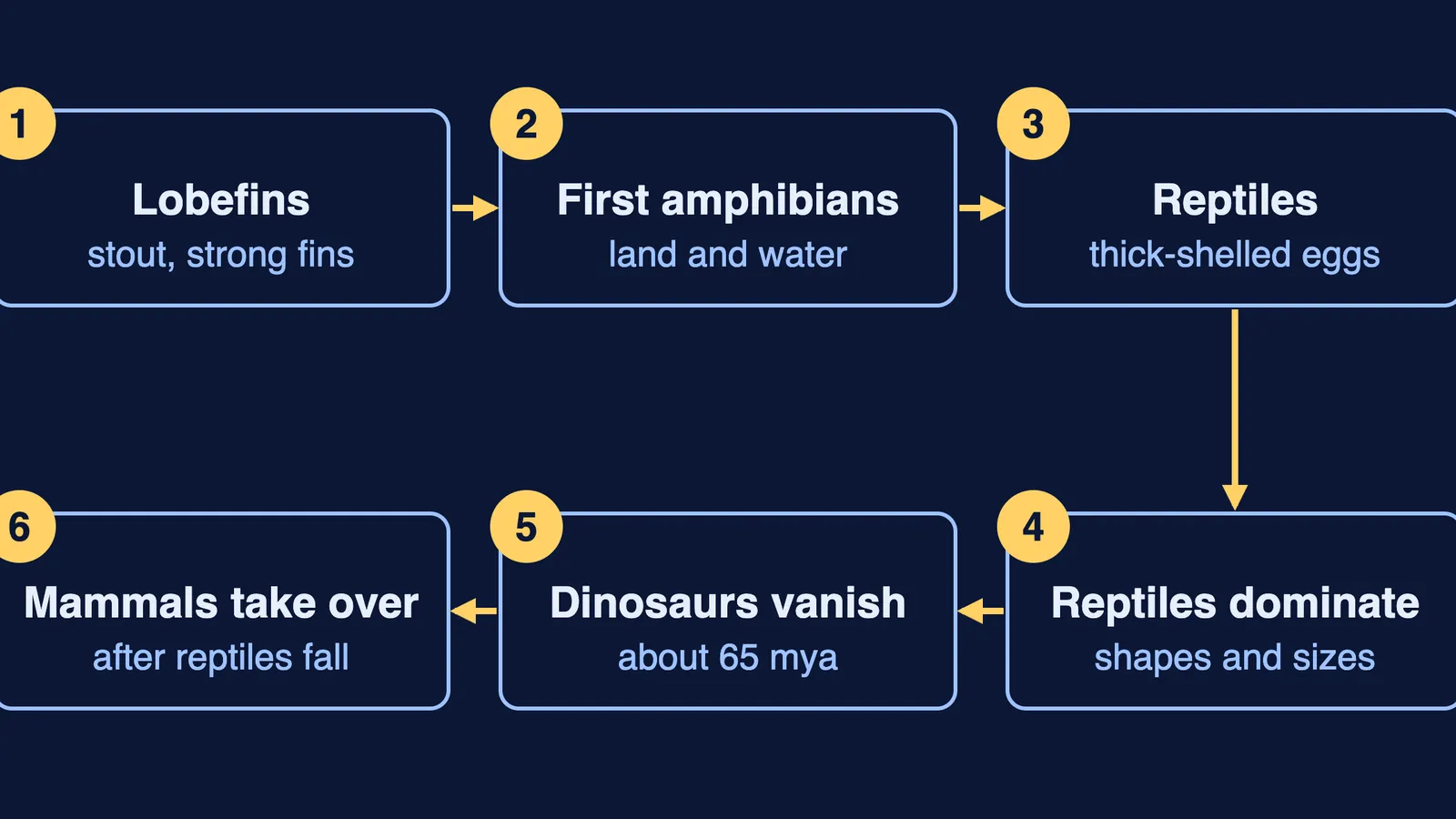
Vertebrates (6.8): lobefins → first amphibians → reptiles → reptiles dominate → dinosaurs vanish (about 65 mya) → mammals take over.
Humans (6.9): Dryopithecus and Ramapithecus (about 15 mya) → upright man-like primates (3-4 mya) → Australopithecines in East African grasslands (2 mya) → Homo habilis → Homo erectus, 1.5 mya (Java fossils) → Neanderthals (1,00,000-40,000 years ago). Modern Homo sapiens arose in the ice age (75,000-10,000 years ago); cave art dates to about 18,000 years ago and agriculture to about 10,000.
How should you tackle arrange-in-order items?
Decide which step opens the chain and which closes it, and strike out codes that break either; usually two go. Then check one adjacent pair you know cold.
Can you arrange these Evolution steps in order?
Q1. A. Hydrogen and helium form B. Gases condense into galaxies C. The universe expands and cools D. A single huge explosion E. Earth forms (1) D, A, C, B, E (2) D, C, A, B, E (3) D, C, B, A, E (4) C, D, A, B, E Answer: (2). Hydrogen and helium form only after cooling (6.1).
Q2. A. Gases from the molten mass cover the surface B. Rain fills the depressions C. UV rays split water D. The lighter H2 escapes (1) C, A, D, B (2) A, D, C, B (3) A, C, D, B (4) A, C, B, D Answer: (3). H2 escapes only after water is split; oceans come with cooling (6.1).
Q3. A. Non-cellular giant molecules B. Organic molecules form from inorganic ones C. Invertebrates formed and active D. First cellular forms (1) A, B, D, C (2) B, D, A, C (3) B, A, D, C (4) B, A, C, D Answer: (3). Chemical evolution first, then about 3 billion years ago, 2000 mya and 500 mya (6.1, 6.8).
Q4. A. Soot darkens trunks B. Dark moths outnumber white C. Predators pick off white moths D. White moths dominate lichen-covered trunks (1) A, D, C, B (2) D, A, C, B (3) D, C, A, B (4) D, A, B, C Answer: (2). The 1850s count came before industrialisation, the 1920 count after (6.3).
Q5. A. de Vries proposes saltation B. Lamarck proposes use and disuse C. Darwin proposes natural selection D. Population genetics brings some clarity (1) B, C, A, D (2) C, B, A, D (3) B, A, C, D (4) B, C, D, A Answer: (1). Lamarck came before Darwin; de Vries in the first decade of the twentieth century; population genetics later (6.5, 6.6).
Q6. A. Man-like primates walk upright in eastern Africa B. Invertebrates are formed and active C. Dryopithecus and Ramapithecus exist D. Dinosaurs suddenly disappear (1) B, D, A, C (2) D, B, C, A (3) B, D, C, A (4) B, C, D, A Answer: (3). About 500, 65, 15 and 3-4 mya (6.8, 6.9).
Which step comes next, or is out of place?
Q7. In NCERT's brief account of evolution, what comes immediately after the first cellular forms appear? (1) Invertebrates formed and active (2) Single-celled organisms slowly become multicellular (3) Non-cellular giant molecules arise (4) Jawless fish evolve Answer: (2). Multicellular forms arose before invertebrates were active by 500 mya (6.8).
Q8. Medium changes → only the variant survives → it outgrows the rest → it appears as a new species → the colony shows built-in variation. Which is out of place? (1) Built-in variation (2) Medium change (3) Survival of the variant (4) Outgrowth Answer: (1). Variation exists first; the new medium only brings it out (6.5).
Codes for Q9 and Q10: (1) I and II are both correct (2) Neither is correct (3) I alone is correct (4) II alone is correct
Q9. I: The 1850s moth collection was made before industrialisation. II: Australopithecines lived before the upright man-like primates of eastern Africa. Answer: (3). The man-like primates came first, 3-4 mya against 2 mya (6.3, 6.9).
Q10. I: Miller's 1953 experiment came before Hugo de Vries put forward mutations. II: The Java fossils of 1891 were found before de Vries put forward mutations. Answer: (4). De Vries wrote in the first decade of the twentieth century, after 1891 and before 1953 (6.1, 6.6, 6.9).
What should you do after this set?
Rewrite each missed sequence from memory, then try the Evolution statement and match-the-list set, the origin of life sequence of ideas and the Evolution exceptions and odd-one-out questions.
Which Evolution order keeps slipping? Fermi's AI tutor works out what you already know and builds a plan for the session.