

On this page
Origin of life is the first section of the NCERT Class 12 Evolution chapter, and it reads like a story. NEET questions on it do not test the story. They test order, names, and how strongly NCERT backs each idea.
Where does origin of life sit in the NEET syllabus?
The NEET (UG) syllabus notified by NMC lists origin of life as the first item under Evolution, in Unit 7: Genetics and Evolution. The NCERT source is section 6.1 of Class 12 Biology, Chapter 6.
What is the NCERT sequence of ideas, step by step?
All figures below are from section 6.1 of the NCERT Evolution chapter.
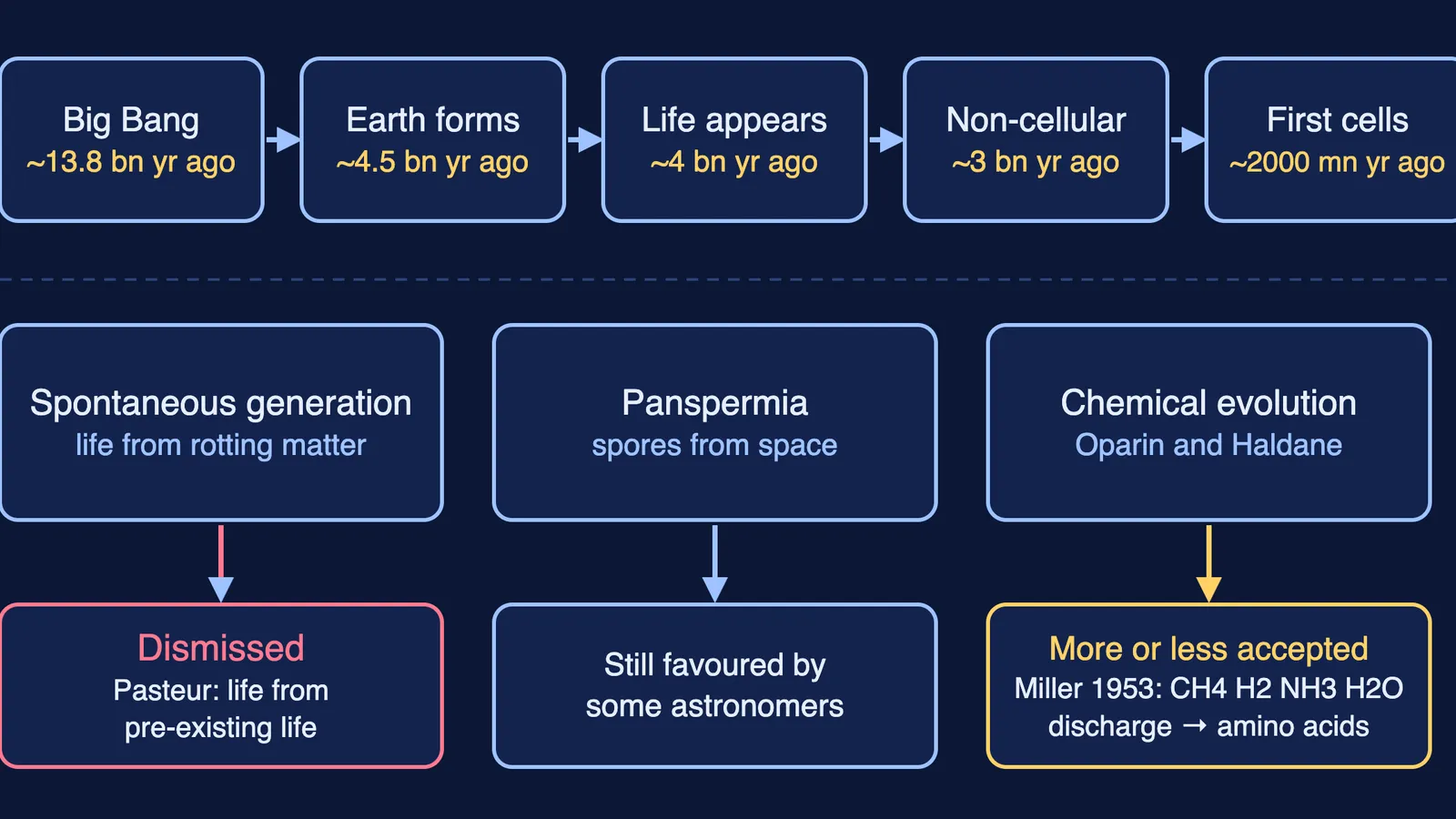
The universe. NCERT puts its age at almost 13.8 billion years. The Big Bang theory tries to explain its origin: one huge explosion, then expansion, cooling and galaxies.
Early Earth. Earth formed about 4.5 billion years ago with no atmosphere at first. Gases from the molten mass (water vapour, methane, carbon dioxide, ammonia) covered it; UV rays split water, an ozone layer formed, and rain filled hollows to make oceans.
Life appears. NCERT dates this to 500 million years after Earth formed, which it puts at almost four billion years ago.
Old ideas on where life came from. Panspermia says spores of life travelled between planets, an idea NCERT traces to early Greek thinkers. Spontaneous generation says life arises from decaying matter like mud or straw.
Pasteur. His flask experiments showed that living things arise only from earlier living things, and NCERT says this ended spontaneous generation. It did not explain where the first life came from.
Oparin and Haldane. They proposed that the first life could have come from non-living organic molecules such as RNA and protein, and that chemical evolution came first. NCERT lists the early-Earth conditions as high temperature, volcanic storms and a reducing atmosphere with CH4 and NH3.
Miller, 1953. In a closed flask at 800 °C he passed an electric discharge through CH4, H2, NH3 and water vapour; amino acids formed.
First life forms. Non-cellular forms, giant molecules such as RNA, protein and polysaccharides, may have arisen about 3 billion years ago. Cells probably came only around 2000 million years ago, as single cells in water.
Chemical evolution is the formation of varied organic molecules from inorganic constituents, the step that NCERT says came before life (NCERT).
Our Miller-Urey experiment explainer covers the apparatus, and our profile of Alexander Oparin and the primordial soup covers the idea's origins.
How sure is NCERT about each idea?
Each idea carries a different weight in section 6.1 of the NCERT chapter, and an option that shifts it is wrong:
Spontaneous generation: dismissed for good after Pasteur.
Panspermia: NCERT notes that some scientists believe life came from outside, and calls panspermia still a favourite idea of some astronomers.
Chemical evolution: more or less accepted, on what NCERT itself calls limited evidence (Miller's results, similar experiments that gave sugars, nitrogen bases, pigment and fats, and compounds found in meteorites).
The first self-replicating, metabolic capsule: NCERT says plainly that we have no idea how it arose.
Abiogenesis, the slow rise of first life from non-living molecules: accepted by the majority, in NCERT's words.
How do NEET statement questions twist this section?
How to attack this format: judge each statement alone against NCERT, checking the number, the name and the strength of the claim. Then pick the option matching your two verdicts.
Our own questions, all with these options:
(1) Both I and II are correct
(2) Both I and II are incorrect
(3) I is correct, II is incorrect
(4) I is incorrect, II is correct
Q1. I: Earth formed about 4.5 billion years ago. II: Life appeared about 500 million years after Earth formed. Answer: (1). Both figures match section 6.1.
Q2. I: Spontaneous generation held that spores of life were carried to Earth from other planets. II: Pasteur's work explained how the first life form arose. Answer: (2). Spores from other planets is panspermia, not spontaneous generation, and Pasteur left the first-life question open.
Q3. I: Miller's 1953 experiment used an electric discharge inside a closed flask. II: Miller himself reported sugars and fats forming in his flask. Answer: (3). Miller observed amino acids; NCERT credits sugars, nitrogen bases, pigment and fats to similar experiments by others.
Q4. I: NCERT describes the early-Earth atmosphere behind chemical evolution as oxidising. II: Chemical evolution builds organic molecules from inorganic ones. Answer: (4). NCERT describes a reducing atmosphere containing CH4 and NH3.
Q5. I: The first cellular life arose about 4 billion years ago. II: Early non-cellular forms may have been giant molecules such as RNA and protein. Answer: (4). NCERT places the first cells around 2000 million years ago.
Q6. I: Meteorite analysis found compounds like those made in Miller-type experiments. II: NCERT treats panspermia as disproved. Answer: (3). NCERT keeps panspermia as an idea some astronomers still favour.
For the rest of the chapter, read our Evolution for NEET guide.
Not sure which part of Evolution to revise next? Fermi's AI tutor works out what you already know and builds a plan for the session.


