On this page
In 1953, Stanley Miller, a graduate student working under Harold Urey at the University of Chicago, filled a sealed glass loop with simple gases, sent sparks through it and found amino acids in the water (Schopf, Life, 2024). His two-page report appeared in Science on 15 May 1953 (Miller, Science, 1953). It sits in the NCERT Class 12 Biology chapter on evolution (NCERT, Chapter 6), and it is still the clearest example of testing an origin-of-life idea with glassware instead of argument.
What did Oparin and Haldane propose?
Aleksandr Oparin in 1924 and J.B.S. Haldane in 1929 independently argued that life began with chemistry: simple gases on the young Earth reacted to form organic molecules, long before any cell existed (Schopf, 2024). Oparin pictured a strongly reducing atmosphere of methane, ammonia, hydrogen gas and water vapour as the starting material, according to the same review.
Chemical evolution is the formation of diverse organic molecules from inorganic constituents, a step that came before life itself (NCERT).
The idea made a testable prediction. If it was right, mixing those gases and adding energy should give you the molecules of life. Urey had proposed that the early atmosphere was made of reducing gases such as hydrogen, methane and ammonia, so those were the gases in the first experiments (Bada, Mètode).
How did the Miller-Urey apparatus work?
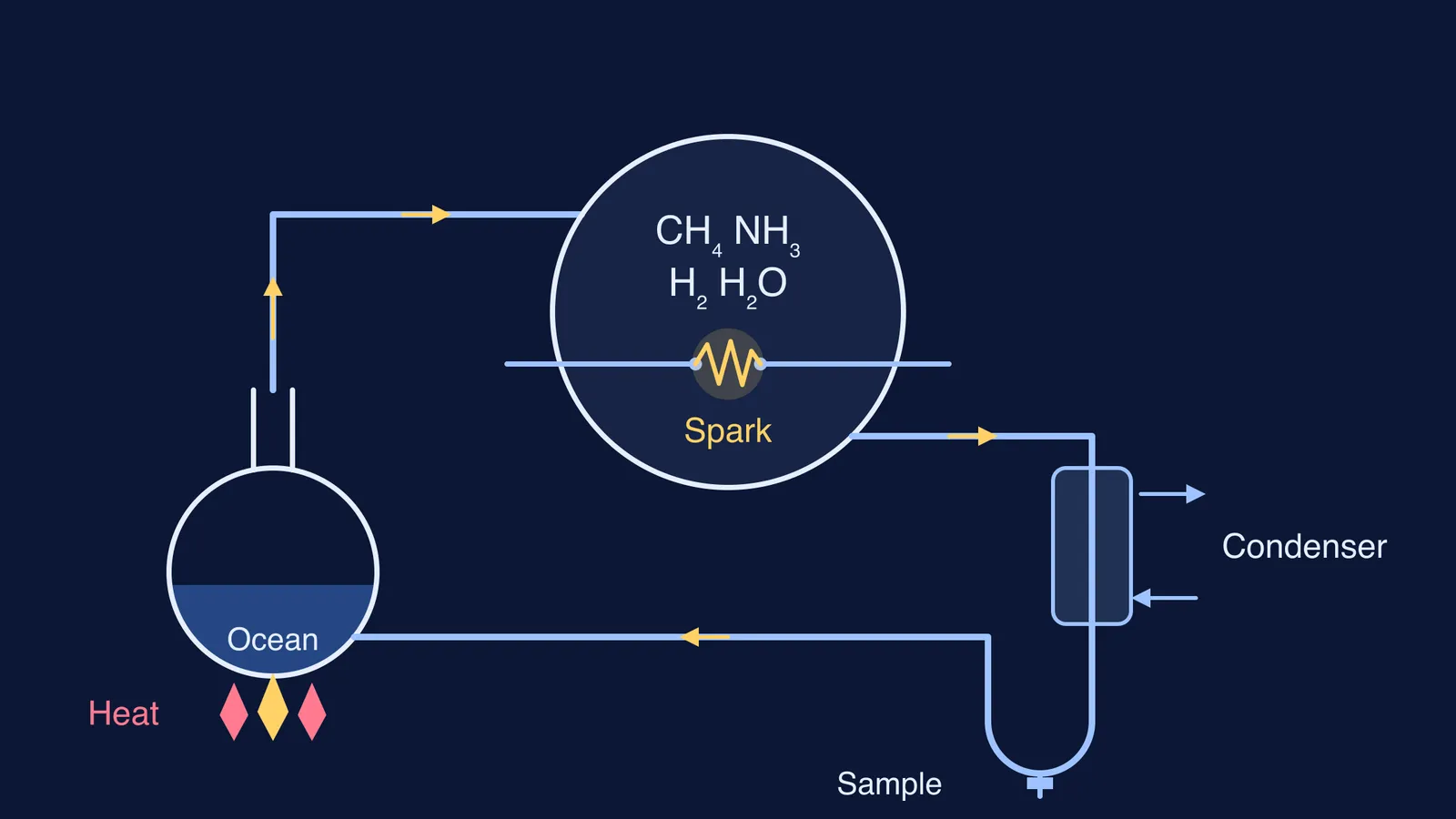
Jeffrey Bada, whose PhD thesis Miller supervised, describes a glass apparatus with a water flask joined to a larger flask fitted with electrodes; the air was pumped out before the gases went in (Bada, Mètode). Follow the loop in the diagram above:
Ocean: water in the small flask is heated, so vapour rises.
Atmosphere: the vapour joins hydrogen, methane and ammonia in the large flask.
Lightning: a Tesla coil drives a spark between two electrodes.
Rain: a condenser cools the gas, and water drips back carrying any new molecules.
Sampling: the liquid that collects is drawn off and analysed.
Bada writes that soon after the spark started, the water and the glass surfaces turned brown (Bada, Mètode). The run lasted about a week (The Scientist).
What amino acids did the Miller-Urey experiment make?
Miller detected glycine, alanine, aspartic acid and aminobutyric acid in 1953, notes a review by J. William Schopf (Schopf, 2024).
The story did not end there. After Miller's lab was cleared out in 2005, boxes of his old sample vials turned up, and a team later re-analysed them with modern methods (Bada, Mètode). The classic apparatus had made 13 amino acids and 5 amines, more than Miller could detect at the time, according to the same article.
A second design that produced a hot water mist in the spark flask, like a volcanic eruption with lightning, made a wider variety of amino acids than the classic one (Johnson et al., Science, 2008): 21 amino acids and 5 amines, Bada reports. A 1958 run that added hydrogen sulphide gave 23 amino acids and 4 amines, 7 of them containing sulphur (Parker et al., PNAS, 2011).
Did it prove Oparin and Haldane right?
It showed their first step was chemically possible. It did not show how life began.
The biggest objection is the gas mix. It is now generally held that the early atmosphere was likely not reducing but dominated by nitrogen and carbon dioxide, and sparks in such neutral mixtures had been shown to make organic compounds much less efficiently (Cleaves et al., 2008). That study found that neutral mixtures do produce significant amounts of amino acids, and that the yield rises sharply when an oxidation inhibitor such as ferrous iron is added before analysis.
The second gap is bigger. Amino acids are bricks, not a building. NCERT itself says we have no idea how the first self-replicating metabolic capsule of life arose (NCERT).
How do you write this as an exam answer?
For a 3 to 5 mark Class 12 answer, use this five-part frame:
Hypothesis: Oparin and Haldane, chemical evolution in a reducing atmosphere.
Setup: closed flask, CH4, H2, NH3 and water vapour, electric discharge. Draw the loop.
Observation: amino acids formed.
Conclusion: experimental support for chemical evolution.
Limit: the real early atmosphere was probably different, and amino acids are not life.
Write the conditions as your NCERT textbook states them, and ask your teacher if another source you read gives different details.
Then close the book and explain the loop out loud to someone at home, from ocean to sample. If you stall at reducing atmosphere or amino acid, look the idea up in the Fermi Concept Library, which gives each concept in chemistry and biology its own lesson and its place in the map. If you would rather be taught it, Fermi's AI tutor can draw the figure with you and check your understanding as it goes.