On this page
Chlorine is a stronger oxidising agent than iodine, so iodine should never push chlorine out of anything. Yet you will meet this equation: I₂ + 2KClO₃ → 2KIO₃ + Cl₂. It looks like iodine "displacing" chlorine from potassium chlorate. In 1890 Henry Bassett took the old method behind that equation and found something odd. The iodine dissolved, but chlorine gas did not come off. The chlorine ended up as chloride.
The paper is Henry Bassett, "The Interaction of Iodine, Water, and Potassium Chlorate", J. Chem. Soc. Trans. 57 (1890) 760–766 (DOI 10.1039/CT8905700760; scan on the Internet Archive). Quotes and numbers below come from that scan, checked against the page images. The paper prints his name only, with no institution, so this post says nothing more about his life.
Chlorate mixed with iodine and acid is hazardous; Bassett himself saw "a violent action" in one version. This post covers the history and the equations only.
Is iodine with potassium chlorate a displacement reaction?
No. In a real halogen displacement, a halogen takes electrons from a halide ion: Cl₂ + 2I⁻ → 2Cl⁻ + I₂. That is the series in why chlorine displaces bromine and iodine.
Here the iodine is not a halide. It starts as I₂ (oxidation state 0) and ends in iodate, IO₃⁻ (+5). Iodine is oxidised, so it acts as the reducing agent. Chlorate is the oxidising agent. Even the textbook equation says so: two I atoms lose 5 electrons each (10 lost) and two Cl atoms go from +5 to 0 (10 gained). It balances, but it is a redox reaction between an element and an oxoanion, not a displacement.
What did Bassett see when he repeated Millon's method?
The method came from the French chemist Millon (1843), whose directions said to heat the mixture and remove it from the flame "as soon as the chlorine begins to be abundantly liberated." Bassett wrote that the usual accounts "represent the action as a direct displacement of the chlorine by an equivalent of iodine".
When he tried it, the iodine dissolved "without any evolution of chlorine beyond a very slight indication at the last". On cooling, crystals of "biniodate of potassium" came out. That old name means an acid salt, KH(IO₃)₂: one KIO₃ and one HIO₃ in one crystal.
He also tested another textbook claim, from Schützenberger, that the reaction works in the cold. He found "no action whatever happened in the cold even after several weeks."
What equation did Bassett write, and how do you balance it?
His equation:
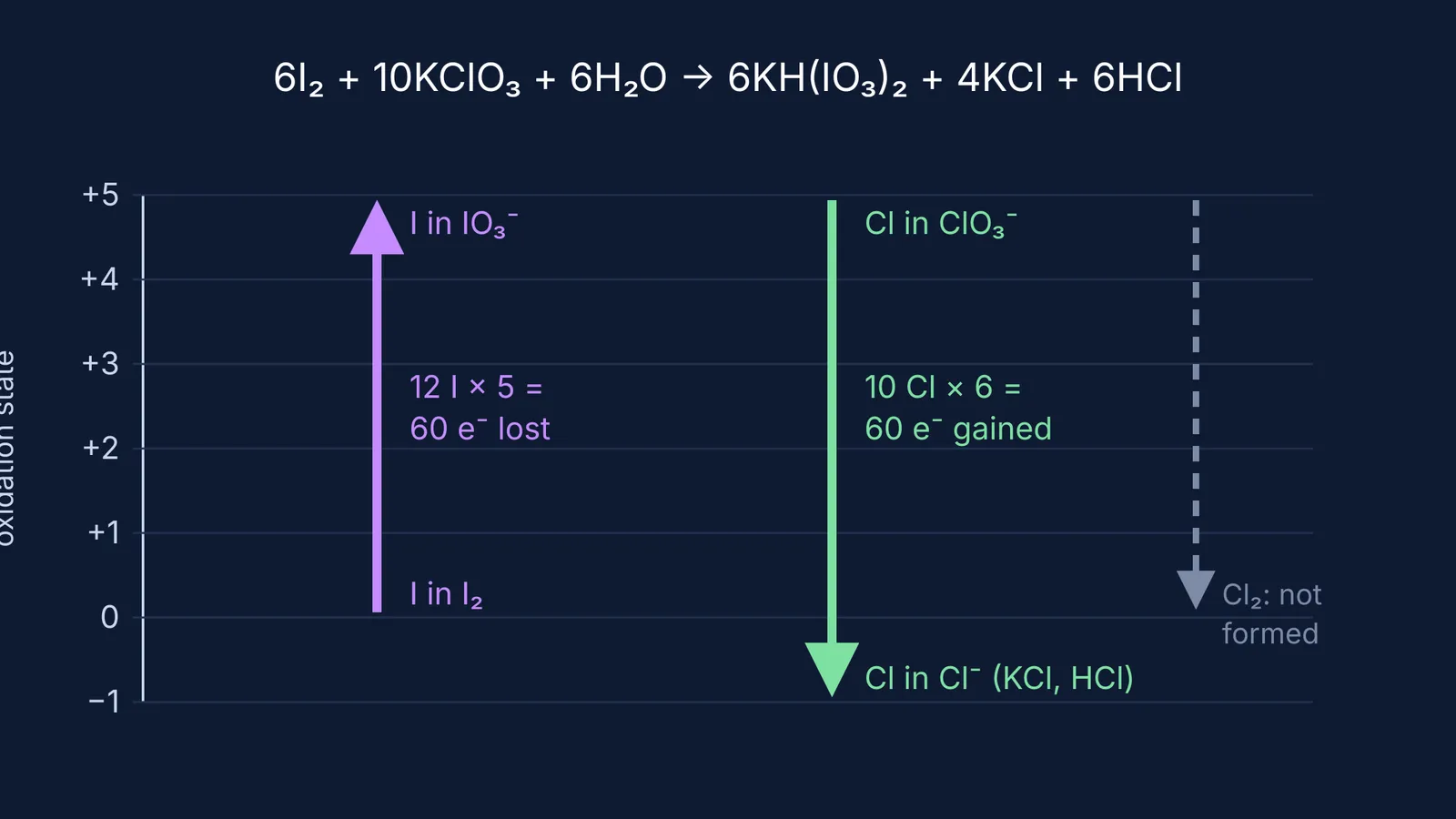
6I₂ + 10KClO₃ + 6H₂O → 6KH(IO₃)₂ + 4KCl + 6HCl
Worked example: balancing by electrons
Skeleton, as ions: I₂ + ClO₃⁻ → IO₃⁻ + Cl⁻.
Iodine: 0 to +5. Each I₂ has two atoms, so each I₂ loses 10 electrons.
Chlorine: +5 to −1. Each ClO₃⁻ gains 6 electrons.
Lowest common multiple of 10 and 6 is 30: take 3I₂ (30 lost) and 5ClO₃⁻ (30 gained).
So 3I₂ + 5ClO₃⁻ → 6IO₃⁻ + 5Cl⁻.
Oxygen: 15 on the left, 18 on the right. Add 3H₂O on the left.
Hydrogen: 6 on the left, so 6H⁺ on the right: 3I₂ + 5ClO₃⁻ + 3H₂O → 6IO₃⁻ + 5Cl⁻ + 6H⁺.
Charge: −5 on the left; −6 − 5 + 6 = −5 on the right. Balanced.
Double it and add 10 K⁺ to each side. Six K⁺, six H⁺ and twelve IO₃⁻ make 6KH(IO₃)₂. The other 4 K⁺ and 6 H⁺ pair with the 10 Cl⁻ as 4KCl and 6HCl.
Atom check: K 10 = 6 + 4; I 12 = 12; Cl 10 = 4 + 6; H 12 = 6 + 6; O 30 + 6 = 36 = 36. Electrons: 12 I × 5 = 60 lost; 10 Cl × 6 = 60 gained.
Why chloride and not Cl₂? Schützenberger's own account gives the clue: free chlorine oxidises iodine in water, 5Cl₂ + 5H₂O + I₂ → 10HCl + I₂O₅ (10 electrons each way). With iodine still present, any chlorine formed is used up.
How did Bassett check his equation with masses and titration?
Worked example: three checks
Mass ratio. 6I₂ = 6 × 253.81 = 1522.8 and 10KClO₃ = 10 × 122.55 = 1225.5. Scaled to 49 parts of chlorate, that is 60.9 parts of iodine. Bassett: "61 parts iodine to 49 parts potassium chlorate". In his first run he had found, by trial, 110 of iodine to 89 of chlorate, and 61 : 49 = 110 : 88.4.
Total acid. For 4.9 g of KClO₃ (0.0400 mol), the equation gives 12 acidic H per 10 KClO₃: six in HCl and six in the acid salt. That is 0.0480 mol H⁺. With methyl orange, each CO₃²⁻ takes 2H⁺, so you need 0.0240 mol Na₂CO₃ = 2.543 g. Bassett's equation "requires 2·544 grams"; his titrations gave 2.548, 2.536, 2.533 and 2.538.
Silver chloride. In a run with extra chlorate, the chloride gave 0.475 g AgCl. After heating to turn all the chlorine into chloride, it gave 0.566 g. Then (0.566 − 0.475) ÷ 0.566 = 0.16, about one-sixth of the chlorate unused. Bassett: "566 : 475 :: 6 : 5·04".
A last check: had the dried residue been pure KIO₃, 4.9 g of chlorate would give 8.56 g. He got 9.919 g, which was acid and contained chlorine. That led him to a residue of acid iodate plus KCl, calculated 9.921 g.
Then where did Millon's chlorine come from?
Bassett mixed everything at once and heated to boiling, as Millon said. With a large mass of iodine, at a certain point "a violent action was set up, with evolution of some quantity of chlorine". He blamed a side reaction between the iodic acid and hydrochloric acid that had built up:
HIO₃ + 5HCl → 3H₂O + ICl + 2Cl₂
Check it: I goes +5 to +1 (4 gained); four Cl go −1 to 0 (4 lost). Cooling the flask stopped the chlorine, while the iodine kept dissolving. His argument: if chlorine came from direct displacement, "it would begin and continue concurrently" with the dissolving of iodine. It did not.
He also saw an odd delay. Without acid, the brown iodine sometimes sat for over an hour, then "the liquid became suddenly colourless". A trace of acid "always caused instantaneous decolorisation", so acid speeds up the start.
Where does this fit in your syllabus?
Class 11 Redox: oxidation numbers, n-factors and balancing by electrons. Class 11 Some Basic Concepts: mass ratios and titration from an equation. Class 12 p-block: oxoacids of halogens and the +5 state of iodine. Iodate also turns up in iodised salt and the thiosulphate titration. For another chlorate puzzle of the same years, see Herbert McLeod on KClO₃ and MnO₂.
To practise n-factor and redox traps like this one, Fermi Test Prep is JEE Main and Advanced test prep with an AI tutor.
Quick checklist
I₂ + KClO₃ is iodine being oxidised (0 to +5), not halogen displacement.
Bassett, 1890: iodine dissolved with no chlorine given off.
6I₂ + 10KClO₃ + 6H₂O → 6KH(IO₃)₂ + 4KCl + 6HCl; 60 electrons each way.
Checks: 61 : 49 by mass; 2.543 g Na₂CO₃ per 4.9 g KClO₃; AgCl before and after heating.
Millon's chlorine came from HIO₃ + 5HCl → 3H₂O + ICl + 2Cl₂.
Biniodate of potassium is KH(IO₃)₂.