On this page
Your textbook says chlorine water loses its colour in sunlight and gives off oxygen. In 1890 Alexander Pedler, working in Calcutta, tested that sentence for months under the Indian sun and found it was only half the story. In full sun, chlorine water does give oxygen. In weak light, it gives almost none: the chlorine ends up as hypochlorous acid, then as chloric acid. The same two elements, chlorine and water, follow two redox routes, and the light decides which.
The paper is A. Pedler, F.I.C., "The Action of Chlorine on Water in the Light, and the Action of Light on Certain Chlorine Acids", J. Chem. Soc. Trans. 57 (1890) 613–625 (DOI 10.1039/CT8905700613; scan on the Internet Archive). Quotes and numbers below come from that scan, checked against the page images.
What did chemists think chlorine water did in light?
Two equations were in use. The textbook one was:
2Cl₂ + 2H₂O → 4HCl + O₂
The rival came from the chemist Popper, who said chlorine water in sunlight gives chloric acid too:
5Cl₂ + 5H₂O → HClO₃ + 9HCl + O₂
Pedler pointed out an easy test. In the first equation, every 10 volumes of chlorine that react should give 5 volumes of oxygen. By Popper's, 10 volumes give only 2. His verdict on the two equations: "neither equation is wholly right, or wholly wrong."
What happened in full tropical sun?
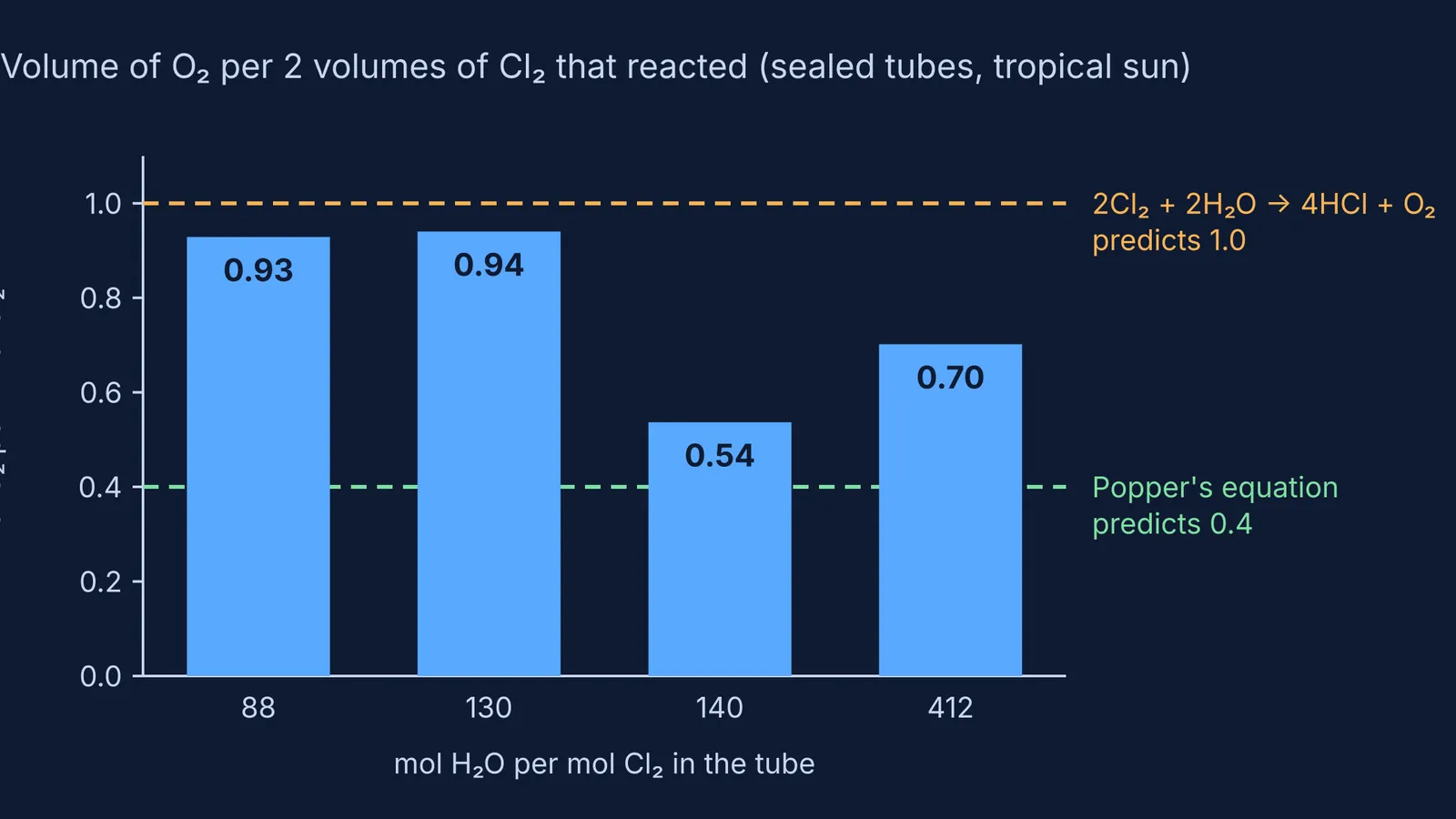
His first tests used sealed tubes of chlorine gas over a little water, left in direct sun for up to two months. At about 64 mol of water per mol of Cl₂, nothing measurable happened. Even at 412 mol of water, only about 78% of the chlorine reacted.
The oxygen was always a little short of the simple equation. In his Experiment 2, 14.0 mL of chlorine reacted, so the simple equation needs 7.0 mL of O₂. He found 6.5 mL. His table, plotted above, shows 0.93, 0.94, 0.54 and 0.70 volumes of O₂ per 2 volumes of chlorine used, against 1.0 for the simple equation and 0.4 for Popper's. The missing oxygen had gone into "oxidised chlorine acids".
Ordinary chlorine water is far more dilute than his tubes. Pedler worked it out: about 0.5566 g of chlorine in 100 mL of water near 30–32 °C, or 1 mol of chlorine to about 708 mol of water. In the full blaze of the sun, he wrote, such a solution "is actually seen to effervesce very decidedly", and there the main reaction is the simple one. He found only "exceedingly small" amounts of chloric acid in those runs.
What changed when the light was weak?
He then compared three kinds of light: direct sun, strong daylight in a south-facing verandah, and the feeble light opposite a north window. At the north window the result flipped. In one run lasting 37 days, "not a single bubble of oxygen gas escaped from the apparatus." The liquid smelt of hypochlorous acid. In another, chlorine water that should have given about 74 mL of oxygen by the simple equation gave only 5 mL in 46 days, and held "moderate amounts of hypochlorous and chloric acids".
His explanation has two steps.
Chlorine first reacts with water: Cl₂ + H₂O → HCl + HOCl.
Light then turns HOCl into chloric acid, HClO₃, with HCl and some oxygen.
He also showed that the chain stops at chlorate. Dilute chloric acid left in strong sun for 15 days gave only 2.1 to 3.2 chlorine atoms as chloride per 100 as chlorate.
How do you balance these equations by electron bookkeeping?
Every one of Pedler's equations is a disproportionation: chlorine is both oxidised and reduced. For the method in general, see disproportionation and comproportionation reactions. Here is the count for each.
2Cl₂ + 2H₂O → 4HCl + O₂. Four Cl atoms go from 0 to −1: 4 electrons gained. Two O atoms go from −2 to 0: 4 electrons lost. Balanced.
Popper: 5Cl₂ + 5H₂O → HClO₃ + 9HCl + O₂. Nine Cl go 0 to −1: 9 gained. One Cl goes 0 to +5 (5 lost) and two O go −2 to 0 (4 lost): 9 lost. Balanced.
Cl₂ + H₂O → HCl + HOCl. One Cl to −1, one to +1: 1 gained, 1 lost.
5HOCl → 4HCl + HClO₃ + O₂. Four Cl go +1 to −1: 8 gained. One Cl goes +1 to +5 (4 lost) and two O go −2 to 0 (4 lost): 8 lost. Atoms: Cl 5 = 5, H 5 = 5, O 5 = 3 + 2.
Worked example: from Pedler's analysis to an equation
Pedler left dilute HOCl in strong daylight. In 10 mL of the result he measured chloride with silver nitrate, then total chlorine after reducing everything to chloride with a zinc–copper couple.
Run 1: chloride 0.0224 g Cl, total 0.0292 g Cl.
Ratio: 0.0224 ÷ 0.0292 = 0.77, close to 3 : 4.
So 3 of every 4 chlorine atoms ended as Cl⁻ and 1 as ClO₃⁻.
Start from 4HOCl → 3HCl + HClO₃. Hydrogen: 4 = 4. Chlorine: 4 = 4. Oxygen: 4 on the left, 3 on the right.
One O atom is left over. Pedler wrote 4HClO = HClO₃ + 3HCl + O, with a single O.
As real oxygen gas, double it: 8HOCl → 2HClO₃ + 6HCl + O₂.
Check the oxygen. His solution held 0.0316 g Cl per 10 mL as HOCl, so 60 mL contained 0.0316 × 6 ÷ 35.45 = 5.35 × 10⁻³ mol HOCl. If all its oxygen came off, that is 2.67 × 10⁻³ mol O₂, about 60 mL at STP. Pedler says "roughly about 60 c.c." The 8HOCl equation predicts 5.35 × 10⁻³ ÷ 8 mol, about 15 mL. He collected 18 mL. Part of the gas stays dissolved, so the volumes are rough checks only.
Run 2, in strong sun: chloride 0.0234 g, total 0.0289 g. Ratio 0.81, close to 4 : 5. Now 4 Cl go to chloride and 1 to chlorate, which gives 5HOCl → 4HCl + HClO₃ + O₂. This one balances with O₂ as written.
Where does this fit in your syllabus?
Class 11 Redox asks you to identify disproportionation and balance by oxidation number. Pedler's four equations are good practice because each one balances. Class 12 p-block gives Cl₂ + H₂O → HCl + HOCl and the bleaching action of HOCl. For why fluorine behaves differently, read fluorine vs chlorine with water.
Pedler made the alkali link himself. The first step, he wrote, is "quite similar" to chlorine with dilute, cold alkali, and the second "very similar" to chlorine with more concentrated, hot alkali. Those are the two NCERT equations in chlorine with cold vs hot NaOH: hypochlorite first, chlorate later.
So "chlorine water gives O₂ in sunlight" is not wrong; Pedler found it right in strong sun. His point is that the light and the amount of water change the products.
To practise balancing redox equations like these one step at a time, the Fermi Problem Library has a step-by-step solver that explains the reasoning.
Quick checklist
1890, Calcutta: chlorine water tested in full sun, strong daylight and north-window light.
Full sun: mainly 2Cl₂ + 2H₂O → 4HCl + O₂, slightly short of oxygen.
Weak light: no oxygen at all; HOCl, then HClO₃.
First step: Cl₂ + H₂O → HCl + HOCl. Second: HOCl → HClO₃ + HCl (+ some O₂).
Pedler's single-O equation doubles to 8HOCl → 2HClO₃ + 6HCl + O₂.
Chloric acid barely changes in sun, so the chain stops at chlorate.