On this page
Every order here is NCERT's own, from Chapter 19 of NCERT Class 11 Biology, Chemical Coordination and Integration (Reprint 2026-27). The NMC NEET (UG) 2026 syllabus places "Chemical coordination and regulation" in Unit 5, Human Physiology. All 12 questions are original.
Which sequences in chemical coordination does NCERT give in order?
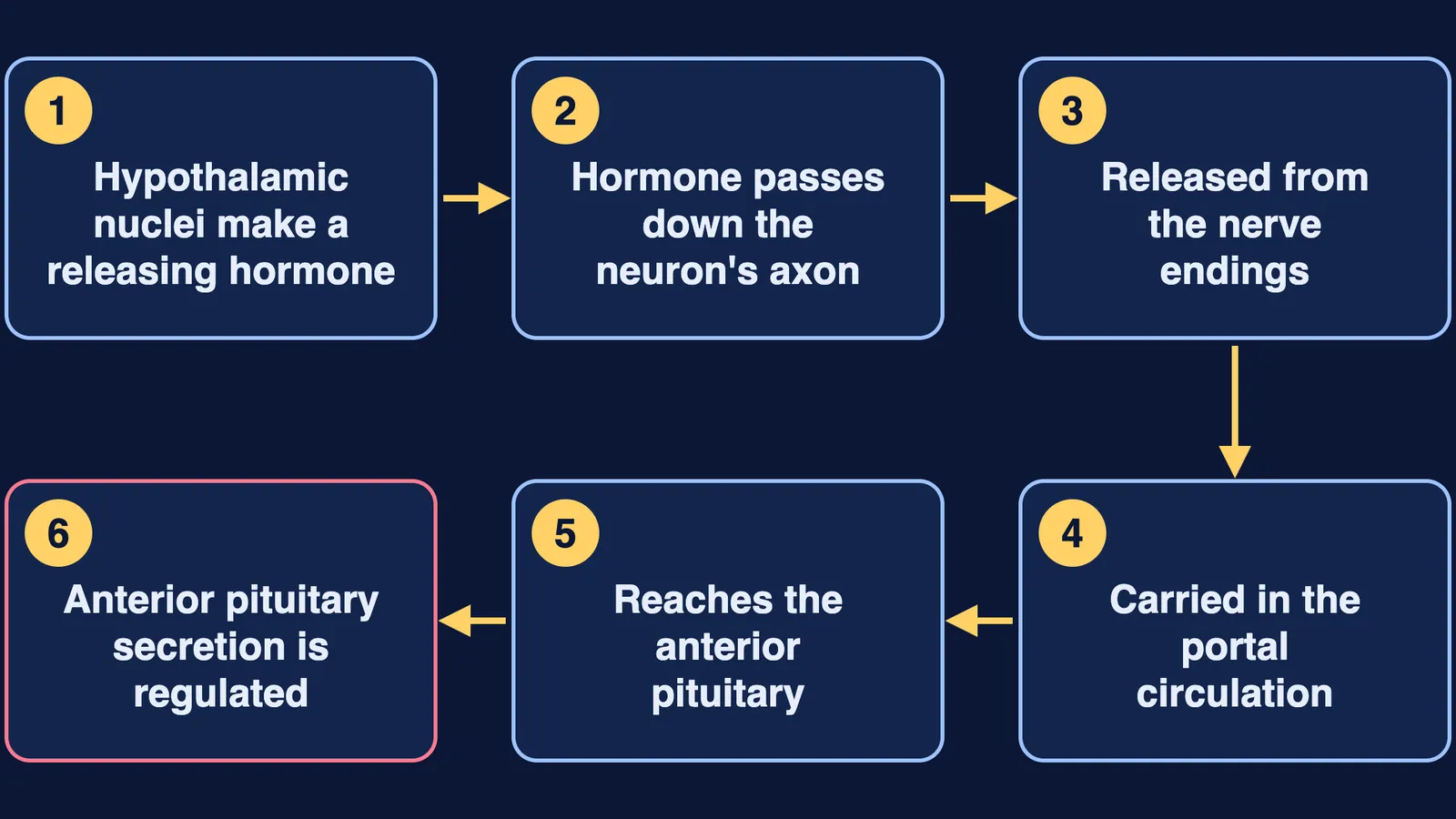
Hypothalamus to anterior pituitary (19.2.1): nuclei make a releasing or inhibiting hormone → axons → nerve endings → portal circulation → anterior pituitary regulated.
Posterior pituitary hormones (19.2.2): hypothalamus synthesises oxytocin or vasopressin → axonal transport → stored in the neurohypophysis → released.
ADH failure (19.2.2): impaired ADH synthesis or release → kidney conserves less water → water loss → dehydration (diabetes insipidus).
Excess growth hormone in adults (19.2.2): too much GH, often in middle age → severe disfigurement, mainly of the face (acromegaly) → serious complications → premature death if unchecked.
Adrenal cortex underproduction (19.2.7): too little cortical hormone → altered carbohydrate metabolism → acute weakness and fatigue → Addison's disease.
Overactive thyroid (19.2.4): cancer or nodules of the thyroid → hormone synthesis and secretion rise to abnormally high levels → hyperthyroidism → body physiology adversely affected.
ANF (19.3): blood pressure rises → atrial wall secretes ANF → blood vessels dilate → blood pressure falls.
Hormone action in general (19.4): hormone binds its specific receptor → hormone-receptor complex forms → biochemical changes in the target → its metabolism and functions regulated.
How do you attack sequence questions on hormones?
Find the trigger (a hypothalamic signal, a hormone meeting its receptor, rising blood pressure, a faulty gland): that is step one. Then find the end effect. With both ends fixed, check one middle pair; one swap usually splits the last two options.
Arrange-in-order questions (Q1 to Q7)
Q1. Thyroid and the unborn baby: A. Defective development and maturation of the growing baby; B. Iodine deficiency in the mother's diet; C. Stunted growth (cretinism); D. Hypothyroidism during pregnancy (1) B, D, A, C (2) D, B, A, C (3) B, A, D, C (4) B, D, C, A Answer: (1). Low iodine causes hypothyroidism, which in pregnancy impairs the baby's development (19.2.4).
Q2. Oxytocin: A. Stored in the neurohypophysis; B. Synthesised in the hypothalamus; C. Released by the posterior pituitary; D. Transported along axons; E. Smooth muscles are stimulated to contract (1) B, A, D, C, E (2) B, D, A, C, E (3) D, B, A, C, E (4) B, D, C, A, E Answer: (2). It is carried axonally to the neurohypophysis, which stores and then releases it (19.2.2).
Q3. Adrenal cortex: A. Acute weakness and fatigue; B. The adrenal cortex underproduces its hormones; C. Addison's disease; D. Carbohydrate metabolism is altered (1) B, A, D, C (2) D, B, A, C (3) B, D, C, A (4) B, D, A, C Answer: (4). The metabolic change causes the weakness, which leads to the disease (19.2.7).
Q4. Growth hormone in an adult: A. Severe disfigurement, especially of the face; B. Premature death if unchecked; C. Excess GH secretion in middle age; D. Serious complications (1) C, D, A, B (2) C, A, D, B (3) A, C, D, B (4) C, A, B, D Answer: (2). Disfigurement (acromegaly) comes first; complications and death follow if it goes unchecked (19.2.2).
Q5. General route of hormone action: A. Hormone binds its specific receptor; B. Hormone-receptor complex forms; C. Biochemical changes occur in the target; D. Its metabolism and functions are regulated (1) A, B, C, D (2) A, C, B, D (3) B, A, C, D (4) A, B, D, C Answer: (1). Binding makes the complex, and the complex brings the biochemical changes (19.4).
Q6. Thyroid overactivity: A. Hyperthyroidism results; B. Nodules develop in the thyroid; C. Body physiology is adversely affected; D. Thyroid hormone output rises to abnormally high levels (1) D, B, A, C (2) B, A, D, C (3) B, D, A, C (4) B, D, C, A Answer: (3). The raised output is what produces hyperthyroidism (19.2.4).
Q7. ANF: A. Blood vessels dilate; B. Blood pressure rises; C. Atrial wall secretes ANF; D. Blood pressure falls (1) C, B, A, D (2) B, C, A, D (3) B, A, C, D (4) B, C, D, A Answer: (2). Raised pressure triggers ANF, which dilates vessels (19.3).
Which step comes before, after or out of place? (Q8 to Q10)
Q8. With ADH impaired, what immediately follows reduced water conservation by the kidney? (1) Impaired ADH release (2) Water loss (3) More water resorbed (4) ANF secretion Answer: (2). Then dehydration (19.2.2).
Q9. In old age, what immediately precedes weaker immune responses? (1) Thymus enlarges (2) Fewer thymosins (3) More T-lymphocytes differentiate (4) More antibodies Answer: (2). The degenerating thymus makes fewer thymosins (19.2.6).
Q10. Insulin action: P. Insulin acts on hepatocytes and adipocytes; Q. Blood glucose falls; R. Cellular glucose uptake rises; S. Glucose moves rapidly from blood into these cells. Which item is out of place in P, Q, R, S? (1) P (2) Q (3) R (4) S Answer: (2). The fall in blood glucose is the end result (19.2.8).
Two-statement questions on order (Q11 and Q12)
Key: (1) Both true (2) Both false (3) Only I true (4) Only II true
Q11. I: The adrenal cortex secretes glucocorticoids first, and ACTH is then released in response. II: Acromegaly often goes unnoticed for years, until changes in external features show. Answer: (4). ACTH acts first and drives glucocorticoid secretion; NCERT says acromegaly is hard to spot early (19.2.2).
Q12. I: The anterior pituitary releases TSH, which then stimulates the thyroid to make and secrete its hormones. II: In old age, thymosin output falls first, and the thymus then degenerates. Answer: (3). TSH acts on the thyroid (19.2.2); degeneration comes first and lowers thymosin output (19.2.6).
How should you use this set?
Redo all 12 with answers covered and rewrite each missed chain from memory. Then try a new format: the chemical coordination statement and match-the-list questions, the diagram-based questions on chapter 19 figures or the NCERT exceptions and odd-one-out set.
Which hormone chain keeps slipping? Fermi's AI tutor works out what you already know and builds a plan for the session.