

On this page
Chemical coordination is a chapter of pairs, and these formats punish one swapped word. Here are 12 original questions built only from NCERT Class 11 Biology, Chapter 19 (Reprint 2026-27), which falls under Unit 5: Human Physiology of the NEET (UG) 2026 syllabus. The NEET (UG) 2026 bulletin awards four marks for a right answer and deducts one for a wrong one.
How do you attack Statement I/II questions?
Judge each statement alone, noting the deciding word, such as "cortex" or "medulla", then strike options containing a False line.
Options for Q1 to Q4: (1) Both correct (2) Both incorrect (3) I correct, II incorrect (4) I incorrect, II correct
Q1. Statement I: Hormones are non-nutrient intercellular messengers made in trace amounts. Statement II: In humans, only organised ductless glands make hormones.
Answer: (3). The heart, kidney and gut also make hormones.
Q2. Statement I: Melatonin helps maintain the daily rhythm of body temperature. Statement II: Melatonin influences pigmentation and the menstrual cycle.
Answer: (1). NCERT lists both roles.
Q3. Statement I: Thymosins drive the differentiation of T-lymphocytes, which give humoral immunity. Statement II: The thymus degenerates in old individuals.
Answer: (4). T-lymphocytes give cell-mediated immunity.
Q4. Statement I: Glucocorticoids stimulate gluconeogenesis and suppress the immune response. Statement II: Cortisol lowers the production of red blood cells.
Answer: (3). Cortisol stimulates RBC production.
Q5. Which are correct about adrenaline and noradrenaline? A. They come from the adrenal cortex. B. They raise alertness and cause piloerection. C. They raise blood glucose via glycogen breakdown. D. They slow the rate of respiration. E. They promote lipid and protein breakdown.
(1) B, C and E only (2) A, B and C only (3) B, D and E only (4) A, C and E only
Answer: (1). They come from the medulla and increase breathing rate.
Q6. Which are correct about hormone action? A. Each receptor is specific to one hormone. B. Intracellular receptors are mostly nuclear. C. Epinephrine is a steroid hormone. D. Membrane-receptor hormones usually act through second messengers such as IP3. E. Estradiol is an amino-acid derivative.
(1) A, B and D only (2) A, C and D only (3) B, D and E only (4) A, B, C and D only
Answer: (1). Epinephrine is an amino-acid derivative; estradiol is a steroid.
How do you attack match-the-list questions?
Read the options first. Fix your surest pair, strike options that disagree, then settle only where survivors differ.
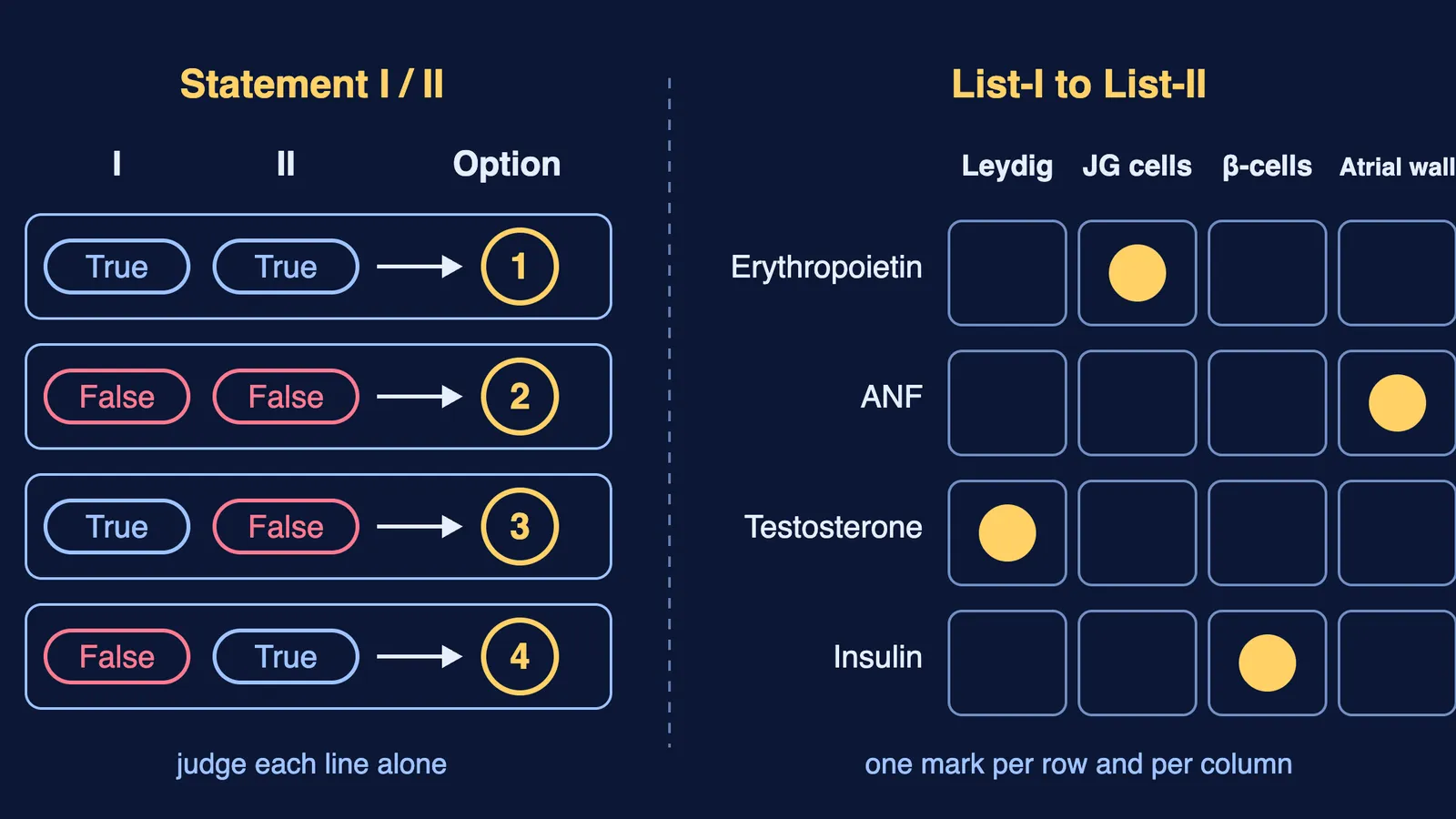
Q7. Match each hormone with its source. List-I: A. Erythropoietin; B. Atrial natriuretic factor; C. Testosterone; D. Insulin List-II: I. Leydig cells; II. Juxtaglomerular cells; III. β-cells of islets; IV. Atrial wall
(1) A-II, B-IV, C-I, D-III (2) A-IV, B-II, C-I, D-III (3) A-II, B-IV, C-III, D-I (4) A-I, B-IV, C-II, D-III
Answer: (1). D-III keeps 1, 2 and 4; A-II then leaves only 1.
Q8. Match each gut hormone with its action. List-I: A. Gastrin; B. Secretin; C. Cholecystokinin; D. Gastric inhibitory peptide List-II: I. Pancreatic water and bicarbonate; II. Inhibits gastric secretion and motility; III. HCl and pepsinogen; IV. Pancreatic enzymes and bile
(1) A-III, B-IV, C-I, D-II (2) A-III, B-I, C-IV, D-II (3) A-I, B-III, C-IV, D-II (4) A-III, B-I, C-II, D-IV
Answer: (2). CCK acts on pancreas and gall bladder.
Q9. Match each pituitary hormone with its effect. List-I: A. Prolactin; B. Oxytocin; C. MSH; D. ACTH List-II: I. Skin pigmentation; II. Glucocorticoid secretion; III. Milk ejection; IV. Mammary growth and milk formation
(1) A-III, B-IV, C-I, D-II (2) A-IV, B-III, C-II, D-I (3) A-IV, B-III, C-I, D-II (4) A-IV, B-I, C-III, D-II
Answer: (3). Prolactin makes milk; oxytocin ejects it.
Q10. Match each condition with its NCERT cause. List-I: A. Acromegaly; B. Cretinism; C. Diabetes insipidus; D. Exophthalmic goitre List-II: I. Hypothyroidism during pregnancy; II. Impaired ADH synthesis or release; III. Hyperthyroidism with protruding eyeballs; IV. Excess growth hormone in adults
(1) A-IV, B-I, C-II, D-III (2) A-IV, B-III, C-II, D-I (3) A-I, B-IV, C-II, D-III (4) A-IV, B-I, C-III, D-II
Answer: (1). Exophthalmic goitre is a hyperthyroid state.
Q11. Match each source with an action. List-I: A. Testicular androgens; B. Adrenal androgenic steroids; C. Estrogen; D. Progesterone List-II: I. Milk-storing alveoli; II. Axial and pubic hair at puberty; III. Anabolic effects on protein metabolism; IV. High-pitched voice
(1) A-II, B-III, C-IV, D-I (2) A-III, B-II, C-I, D-IV (3) A-III, B-II, C-IV, D-I (4) A-III, B-IV, C-II, D-I
Answer: (3). NCERT credits pubertal axial and pubic hair to adrenal androgens.
Q12. Match each gland with its position. List-I: A. Pituitary; B. Pineal; C. Parathyroid; D. Thymus List-II: I. Behind the sternum; II. Dorsal side of forebrain; III. Sella tursica; IV. Back of the thyroid
(1) A-III, B-II, C-IV, D-I (2) A-II, B-III, C-IV, D-I (3) A-III, B-II, C-I, D-IV (4) A-III, B-IV, C-II, D-I
Answer: (1). The pituitary sits in the sella tursica; the pineal, on the forebrain.
How should you practise with this set?
Attempt all 12 without notes. For each miss, ask whether you lacked the fact or mispaired it, then reread that NCERT subsection. For method, see our guides to statement-based questions in NEET and match-the-list questions, and revise with chemical coordination for NEET.
Not sure which gland to revise first? Fermi's AI tutor works out what you already know and builds a plan for the session.


