On this page
Every Class 12 student learns that benzaldehyde and concentrated NaOH give benzyl alcohol and sodium benzoate. In 1899 two chemists in Liverpool took the water out and got a third product, benzyl benzoate. They used the ester as evidence that the Cannizzaro reaction passes through an intermediate.
The paper is C. A. Kohn and W. Trantom, "The Interaction of Sodium Hydroxide and Benzaldehyde", J. Chem. Soc. Trans. 75 (1899) 1155–1162 (DOI 10.1039/CT8997501155; scan on the Internet Archive). It lists both authors as Ph.D., B.Sc., at University College, Liverpool, and says nothing else about them. Their dry runs used benzene, a carcinogen, so this post is history and calculation only. Tables were read from the page images.
What did Kohn and Trantom notice?
Concentrated caustic soda added to benzaldehyde gave "an immediate flocculent and bulky precipitate", with "a distinct rise in temperature". That suggested "the possibility of an intermediate stage in the reaction". They never isolated it, but claimed "satisfactory indirect evidence" for it, modelled on Ludwig Claisen's 1887 proposal for sodium methoxide and benzaldehyde.
How much benzyl alcohol does the ordinary reaction give?
First they ran the textbook version: 53 g of benzaldehyde with 10 g of NaOH dissolved in 15 g of water. The only products were benzyl alcohol and sodium benzoate, with benzyl alcohol at "90 per cent. of the theoretical yield". With 20 g of NaOH they got 98%, "a better, as well as a cheaper, method" for benzyl alcohol.
Worked example 1: limiting reagent and yield
The equation is 2C₆H₅CHO + NaOH → C₆H₅CH₂OH + C₆H₅COONa.
Moles of benzaldehyde (M = 106.12): 53 ÷ 106.12 = 0.4994 mol.
Moles of NaOH (M = 40.00): 10 ÷ 40.00 = 0.2500 mol. The ratio is 2.00 : 1, exactly the equation's ratio.
Theoretical benzyl alcohol: 0.4994 ÷ 2 = 0.2497 mol. With M = 108.14, that is 27.0 g.
At 90%: 0.90 × 27.0 = 24.3 g.
Theoretical sodium benzoate (M = 144.10): 0.2497 × 144.10 = 36.0 g.
"Theoretical" already means half the aldehyde; why is explained in our post on which aldehydes undergo the Cannizzaro reaction and what forms.
When does benzyl benzoate appear?
The paper's finding: "in the absence of water, or in the presence of an excess of benzaldehyde, benzylic benzoate is a product". Drying had to be thorough because, on their scheme, "a molecular proportion of water is regenerated in the action", so a trace keeps working. Their tables give:
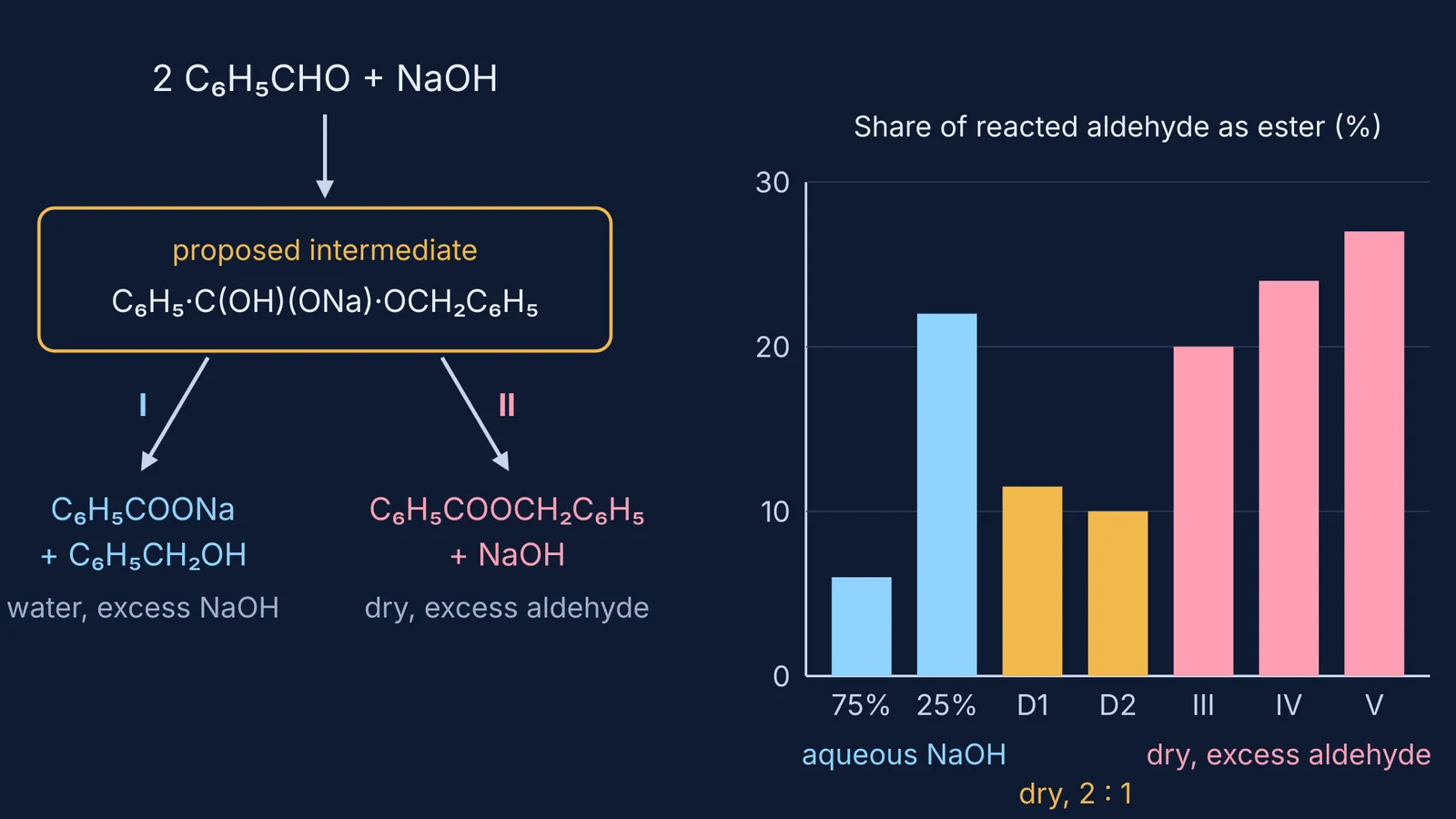
Dry NaOH, 2 : 1 ratio (106 g aldehyde, 20 g NaOH): 8 g of ester and 84 g of sodium benzoate plus benzyl alcohol. A second run (122 g, 23 g) gave 10 g of ester.
Aqueous NaOH at 75% of the theoretical amount: 4.5 g of ester.
Aqueous NaOH at 25% of the theoretical amount: 5 g of ester, against 21 g of the usual products.
Dry NaOH with excess aldehyde (three runs): 1.5 to 5.5 g of ester.
Worked example 2: rebuild their "proportional decomposition" column
Their last column is the share of reacted aldehyde that became ester. The paper gives no method; this reproduces it.
One pair of products, C₆H₅COONa + C₆H₅CH₂OH, weighs 144.10 + 108.14 = 252.24 g and comes from 2 × 106.12 = 212.25 g of aldehyde.
So 84 g of the pair came from 84 × 212.25 ÷ 252.24 = 70.7 g of aldehyde.
Benzyl benzoate, C₁₄H₁₂O₂, has M = 212.25, the same as two aldehyde molecules. So 8 g of ester came from 8 g of aldehyde.
Share as ester: 8 ÷ (8 + 70.7) = 10.2%. The paper gives 10.0.
The same method gives 11.6% for the 122 g run (paper 11.5), 6.2% at 75% NaOH (paper 6), and 22.1% at 25% NaOH (paper 22).
Less alkali per aldehyde, more ester. That trend is what their intermediate predicts.
How did they rule out the simple explanations?
Was the ester made during work-up in acetic acid? Sodium benzoate and benzyl alcohol heated in glacial acetic acid for 4 hours gave no ester.
Is the ester simply the first product? 26 g of benzyl benzoate with 5 g of dry NaOH gave 20 g of sodium benzoate and benzyl alcohol, with 10 g of ester unchanged. The ester is hydrolysed only partly, while benzaldehyde is "completely converted" by the theoretical NaOH. And a first product should appear whatever the conditions, "and this is not the case".
That left, as they put it, "the remaining possibility": an intermediate "ortho-compound".
What intermediate did they propose?
They wrote 2C₆H₅CHO + NaOH → C₆H₅·C(OH)(ONa)·O·CH₂C₆H₅. Check the atoms: C₁₄H₁₃O₃Na on both sides. Without water it can break up two ways:
I: → C₆H₅COONa + C₆H₅CH₂OH (the Cannizzaro products)
II: → C₆H₅COOCH₂C₆H₅ + NaOH (the ester)
"The first decomposition takes place far more readily than the second; it is favoured by an excess of alkali, whilst an excess of aldehyde favours the latter." Route II hands back NaOH, which can attack more aldehyde. Overall, 2C₆H₅CHO → C₆H₅COOCH₂C₆H₅ consumes no alkali at all.
Their scheme shows where the atoms end up, not how hydrogen moves, so do not credit them with the modern mechanism. Today the Cannizzaro step is described as hydride transfer from the hydroxide–aldehyde adduct to a second aldehyde. The ester route is the Tishchenko-type path in our post on how the Tishchenko reaction converts aldehydes to esters, which credits Claisen with benzyl benzoate from sodium benzylate. Kohn and Trantom add that plain NaOH gets there too, once water is removed or aldehyde is in excess.
How did they prove the ester was pure?
They fractionated it, collected the part boiling at 310–320 °C, and burned it.
Worked example 3: %C and %H from combustion
0.2089 g gave 0.6074 g of CO₂ and 0.1132 g of H₂O.
Mass of C: 0.6074 × 12.011 ÷ 44.009 = 0.1658 g, so C = 79.35%.
Mass of H: 0.1132 × 2.016 ÷ 18.015 = 0.01267 g, so H = 6.06%.
Theory for C₁₄H₁₂O₂: C 79.23%, H 5.70%.
The paper prints 79.30 and 6.02 found, against 79.25 and 5.66 required (older atomic weights). Hydrogen is about 0.3 high. Leftover benzyl alcohol (C 77.75%, H 7.46%) would raise H but also lower C, and C is not low, so we read the excess as analytical error. For how the CO₂ was caught, see Liebig's Kaliapparat. Hydrolysis gave back benzyl alcohol and benzoate, and pure ester boiled at 316.8 °C (Claisen gave 323–324 °C).
For more limiting-reagent and combustion problems, the Fermi Problem Library has a step-by-step solver that explains the reasoning.
Where is this in your syllabus?
Class 12 Aldehydes, Ketones and Carboxylic Acids: the Cannizzaro reaction needs no α-hydrogen.
Class 11 Some Basic Concepts: limiting reagent and percentage yield.
Class 11 Organic Chemistry, quantitative analysis: carbon and hydrogen by combustion.
Quick checklist
2C₆H₅CHO + NaOH → C₆H₅CH₂OH + C₆H₅COONa; theoretical alcohol is half the aldehyde in moles.
53 g aldehyde with 10 g NaOH: 27.0 g alcohol at 100%, 24.3 g at 90%.
Dry NaOH or excess aldehyde also gives benzyl benzoate, the same mass as two aldehyde molecules.
Ester share rose from 6% to 22% as NaOH fell from 75% to 25% of theory.
Kohn and Trantom proposed an intermediate; the hydride-transfer mechanism is the modern view, not theirs.