On this page
Hydrazoic acid, HN₃, has a fearsome name. Its salts, the azides, are known for decomposing violently, and the acid itself is highly toxic and explosive. So you might expect it to be a strong acid, a sort of nitrogen version of HCl. It is not. In 1900 Charles Alfred West, at the Royal College of Science in London, measured how far it ionises in water and found it only a little stronger than the acid in vinegar. His two-page paper uses exactly the method NCERT teaches: Kohlrausch's law for Λ∞, then α, then Ka.
Who measured the strength of hydrazoic acid first?
West's paper, "The dissociation constant of azoimide (hydrazoic acid)", appeared in the Journal of the Chemical Society, Transactions, volume 77 (1900), pages 705 to 707. Read the scanned pages on the Internet Archive. Azoimide was an old name for HN₃.
He explains that Wilhelm Ostwald had already measured the acid's conductivity and found it "a somewhat stronger acid than acetic acid". But Ostwald told West that the details "were never published and that they have not been preserved". So West put his own numbers on record. He thanks Professor Tilden, who suggested the work.
This post uses only his conductance and sugar-inversion numbers. The acid is dangerous, and nothing here describes making or handling it. Our post on the Schmidt reaction with hydrazoic acid explains why.
How did West find Λ∞ for a weak acid?
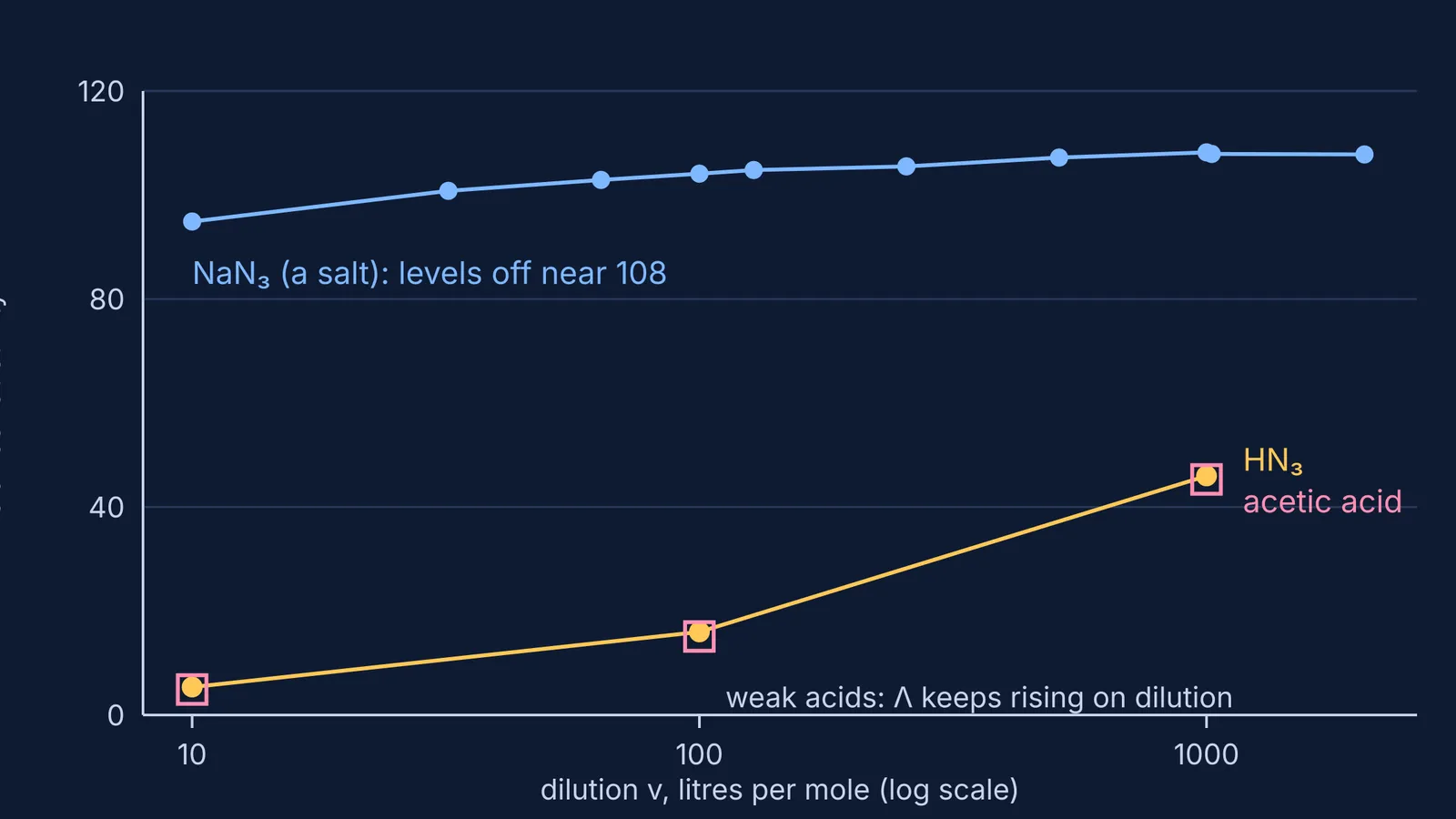
You cannot get Λ∞ for a weak acid by extrapolating its own data. Its molar conductivity keeps climbing steeply as you dilute, because more molecules ionise. West measured the sodium salt instead. A salt is a strong electrolyte, so its Λ flattens out:
NaN₃ at v = 32 L/mol: Λ = 100.8
at v = 1024: 107.9
at v = 2048: 107.8
From this he took Λ∞(NaN₃) as "about 109". Then he applied Kohlrausch's law of independent migration of ions, in the paper's own words "subtracting from this 44.5 for the velocity of the sodium ion, and adding 320.5 for hydrogen":
Λ∞(HN₃) = Λ∞(NaN₃) − λ∞(Na⁺) + λ∞(H⁺) = 109 − 44.5 + 320.5 = 385
NCERT does the same for acetic acid, using HCl, NaCl and CH₃COONa. West's ion values are 1900 figures in old "Siemens' units", so they differ from NCERT's table. That does not spoil the result: α is a ratio of two conductivities in the same units, so the units cancel.
He first checked his apparatus on acetic acid: 4.89, 15.10 and 45.3 at v = 10, 100 and 1000, against Ostwald's 4.86, 15.15 and 45.6, all within 0.7%.
How do you get α and Ka from molar conductivity?
Here is West's data for HN₃ at 25 °C, worked step by step. In his table, v is the volume in litres holding one mole, so c = 1/v.
Write the formulas. α = Λ/Λ∞. Ostwald's dilution law gives K = α²c/(1 − α).
v = 10 L/mol, so c = 0.1 mol/L. Λ = 5.38. α = 5.38/385 = 0.01397. K = (0.01397)² × 0.1/(1 − 0.01397) = 1.98 × 10⁻⁵.
v = 100, c = 0.01 mol/L. Λ = 15.98. α = 15.98/385 = 0.0415. K = (0.0415)² × 0.01/0.9585 = 1.80 × 10⁻⁵.
v = 1000, c = 0.001 mol/L. Λ = 45.97. α = 45.97/385 = 0.1194. K = (0.1194)² × 0.001/0.8806 = 1.62 × 10⁻⁵.
Compare with the paper. West printed α = 0.01397, 0.0415 and 0.1194, and k = 0.0000198, 0.0000180 and 0.0000166. The first two k values match the arithmetic. The third does not: his own α gives 1.62 × 10⁻⁵, not 1.66 × 10⁻⁵. A small slip; the conclusion stands.
Read the result. α rises about 8.5 times over a 100-fold dilution, while K stays near 2 × 10⁻⁵, drifting down by about a fifth.
In step 4, α is about 0.12. Dropping (1 − α) would give 1.43 × 10⁻⁵, about 12% too low.
How does sugar inversion measure acid strength?
Cane sugar (sucrose) reacts with water to give glucose and fructose, and H⁺ catalyses the reaction. At a fixed temperature the rate depends on how much H⁺ is present, so an acid that ionises more inverts sugar faster. Comparing rates gives the H⁺ concentration, and from that the dissociation constant. West calls an acid's strength its "avidity".
West used it as a completely independent check. In his words, the value of k "was also deduced from the rate of inversion of cane-sugar induced by the acid, and was found to be 0.0000186". That is 1.86 × 10⁻⁵, right inside the range his conductance data gave. An electrical and a chemical measurement agree. How the rate constant of this reaction is followed with a polarimeter is worked through in our post on the rate constant of sucrose inversion from optical rotation.
Is hydrazoic acid stronger than acetic acid?
Only just. West quotes, for N/10 solutions at 25 °C:
acetic acid: α = 0.0133, and k from Ostwald's measurements = 0.0000180
hydrazoic acid: α = 0.01397, k = 0.0000198 at the same strength
Working out K for acetic acid from its α the same way gives 1.79 × 10⁻⁵. So HN₃ comes out about 10% higher at 0.1 mol/L. At v = 100 the two K values are identical, 1.80 × 10⁻⁵ each. West's own verdict: the avidity of hydrazoic acid "is therefore a little greater than that of acetic acid, and only about one-seventieth of that of hydrochloric acid". His HCl figure was α = 0.914 at N/10 and 18 °C. Dividing, 0.914/0.01397 = 65, which he rounded to about seventy. Note that this compares degrees of dissociation at two temperatures, not Ka values.
A modern value agrees. PubChem's record for hydrazoic acid lists pKa = 4.72, citing the Merck Index. That is Ka = 1.9 × 10⁻⁵. West's inversion value, 1.86 × 10⁻⁵, gives pKa = 4.73. Acetic acid's pKa is about 4.76 in standard tables. So the two acids differ by less than 0.05 pKa units.
What should you take from this for JEE and NEET?
The chemistry lesson: how dramatic a compound is says nothing about its acid strength.
The exam lesson is the method. Class 12 Electrochemistry: Λ∞ of a weak electrolyte by Kohlrausch's law, then α and Ka. Class 11 Equilibrium: Ostwald's dilution law. Class 12 Kinetics: sucrose inversion, the standard pseudo-first-order reaction. West's paper touches all three. For the definitions and the factor of 1000 that students drop, see our guide to molar conductivity and Kohlrausch's law.
To practise more Λ-to-Ka problems, the Fermi Problem Library has a step-by-step solver that explains the reasoning. If you are preparing for the exam itself, Fermi Test Prep covers JEE Main and Advanced preparation with an AI tutor.
Quick checklist
Weak acid Λ∞ comes from strong electrolytes: Λ∞(HA) = Λ∞(NaA) − λ∞(Na⁺) + λ∞(H⁺).
α = Λ/Λ∞; units cancel, so old units still work.
Ka = cα²/(1 − α), with c = 1/v.
West's HN₃ at 25 °C: K from 1.98 to 1.62 × 10⁻⁵ by conductance, 1.86 × 10⁻⁵ by sugar inversion.
Acetic acid on the same footing: about 1.8 × 10⁻⁵. HN₃ is only a little stronger.
Recheck printed numbers; even a 1900 table can carry a slip.