On this page
Each summer, someone in the family picks up a watermelon at the thela, knocks on it twice and nods. The knock sets the whole fruit vibrating, and the note it rings at depends mainly on how firm the flesh is and how heavy the fruit is. Here is what that note means and how to check it with a free phone app.
Why does a ripe watermelon sound hollow when tapped?
A tapped fruit behaves a little like a mass on a spring: the flesh and rind are the spring, the weight is the mass. For a mass on a spring, the natural frequency is f = (1/2π)√(k/m), where k is the stiffness and m is the mass, as set out in OpenStax University Physics. A stiffer spring vibrates faster, and a heavier mass vibrates more slowly.
Ripening softens the flesh, which lowers k and so lowers the natural frequency. Our ears hear that lower, rounder note as "hollow". A ripe fruit is usually not empty inside; it is just less stiff.
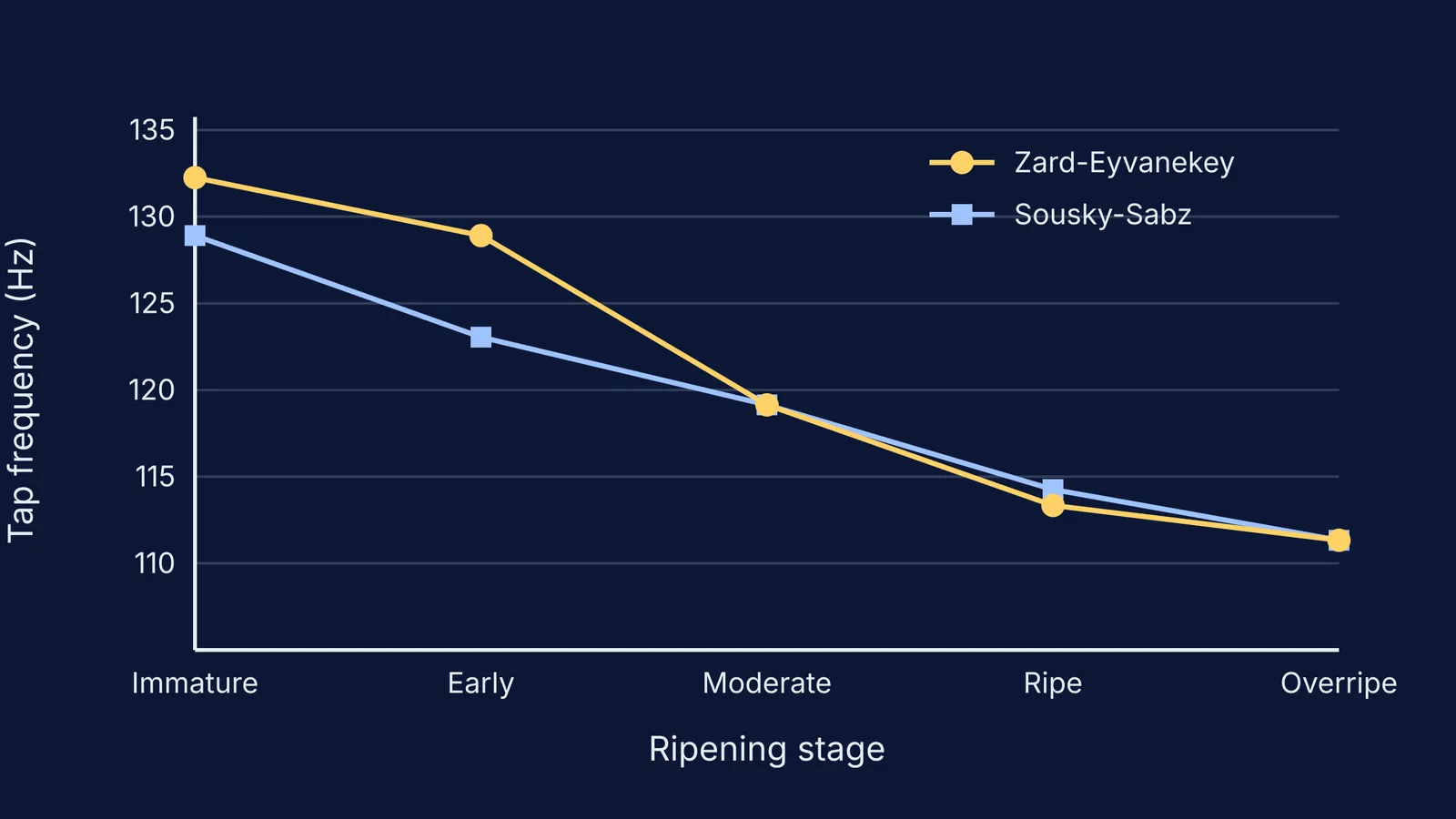
A 2015 study in Agriculturae Conspectus Scientificus measured this directly. Khoshnam, Namjoo and Golbakhshi tapped 65 melons from each of two varieties with a pendulum impactor tipped with a steel ball at five stages, from immature to overripe (open PDF). In one variety, the resonant frequency fell from 132.25 Hz to 111.33 Hz, a drop of about 15.8%. Over the same stages, the flesh's elastic modulus fell from 0.466 MPa to 0.149 MPa. The fruit also grew over six times heavier, so softening was not the only change. These were melons, cousins of the watermelon, but the physics is the same.
What does a deeper or duller sound tell you?
Use the note as a clue, not a verdict:
A high, sharp "tock" suggests firm flesh. The fruit is likely underripe.
A lower, ringing "tunk" suggests the flesh has softened.
A very low, flat thud can mean soft, overripe flesh or damage inside. A 2004 Biosystems Engineering study used tapping sounds to try to detect overripeness, voids in the flesh, creases and bruises in seedless watermelons (Diezma-Iglesias and colleagues).
There is a catch: size changes the note too. A big watermelon sounds deeper than a small one even when both are equally firm, because its mass is larger. To compare fruits of different sizes, researchers have used a stiffness index, S = f² × m^(2/3), where f is the frequency and m the mass (Abbaszadeh and colleagues, Australian Journal of Crop Science, 2011).
How can you test watermelon ripeness with a phone app?
The free app phyphox, made at RWTH Aachen University, has an Audio Spectrum experiment that "calculates and displays the FFT of audio from the microphone" and shows the strongest frequency.
Weigh each fruit and note the mass in kg.
Rest it on a folded towel so the table does not damp the vibration.
Open Audio Spectrum and hold the phone a few centimetres from the rind.
Knock once with a knuckle and read the peak frequency. Repeat at three spots and average.
Work out S = f² × m^(2/3) for each fruit and compare.
Worked example. Fruit A weighs 3.0 kg and peaks at 160 Hz. Fruit B weighs 5.0 kg and peaks at 140 Hz. B sounds deeper, so the ear says B is riper. Now the index: for A, 160² × 3.0^(2/3) = 25,600 × 2.08 ≈ 53,300. For B, 140² × 5.0^(2/3) = 19,600 × 2.92 ≈ 57,300. B is stiffer for its size, so A is more likely riper; B sounded deeper only because it is heavier.
The index only compares fruits measured the same way. Your phone, your knuckle and the towel all change the numbers, so there is no single "ripe" value to aim for.
If the mass-on-a-spring idea feels abstract, the Fermi Simulation Lab has interactive simulations for ideas that are easier to see than to read.
Is the thump test reliable?
Partly. In 1981, Yamamoto, Iwamoto and Haginuma reported that acoustic indices from tapping were correlated with firmness in apples and watermelons (J-STAGE abstract). But a 1996 field study of three watermelon varieties found that the links between sound and maturity were "too weak to be of value for maturity sorting" (Stone and colleagues, AGRIS record).
Lab equipment has done better. A 2013 study of 43 Crimson Sweet watermelons used a laser vibrometer and correctly sorted about 95% of its test fruits (18 of 19) as ripe or unripe (Journal of Food Science and Technology, PMC). The same paper notes that judging by the slap sound is "subject to errors" and needs experience.
The same idea explains why steel plates ring when tapped and plastic ones thud, and you can try a similar predict-then-test with tapping glasses of water. For the textbook terms, see our guide to forced vibration and resonance, or look up natural frequency in the Fermi Concept Library.