On this page
Chilli oleoresin is the deep red liquid left when dried chillies are extracted with a food-grade solvent and the solvent is distilled off. The Bureau of Indian Standards sets its quality in IS 13663:1993, Chilli oleoresin – Specification, reaffirmed in 2012. Two of its numbers look like magic constants: a minimum of 240,000 Scoville heat units, and an instruction to "multiply by 2" when measuring capsaicin. Both are school chemistry: a dilution and a molar-mass ratio.
What does IS 13663 require of chilli oleoresin?
Table 1 of the standard sets four requirements:
Colour value: 4,000 to 20,000.
Scoville heat units: at least 240,000.
Capsaicin content: at least 1.5% by mass.
Residual solvent: at most 25 mg/kg for hexane, and 30 mg/kg for the other listed solvents.
Colour value is the absorbance of a 0.01% acetone solution at 458 nm × 61,000, so the window is an absorbance of 0.066 to 0.33. The red is from carotenoids; the heat, our topic, is from capsaicin.
How is a Scoville heat unit just a dilution?
Annex B of the standard is a tasting test. Its outline says the oleoresin is diluted with sugar solution and "the highest dilution when a pungency is just detected is taken as a measure of the heat value." Three of a five-person panel must find it pungent.
The recipe:
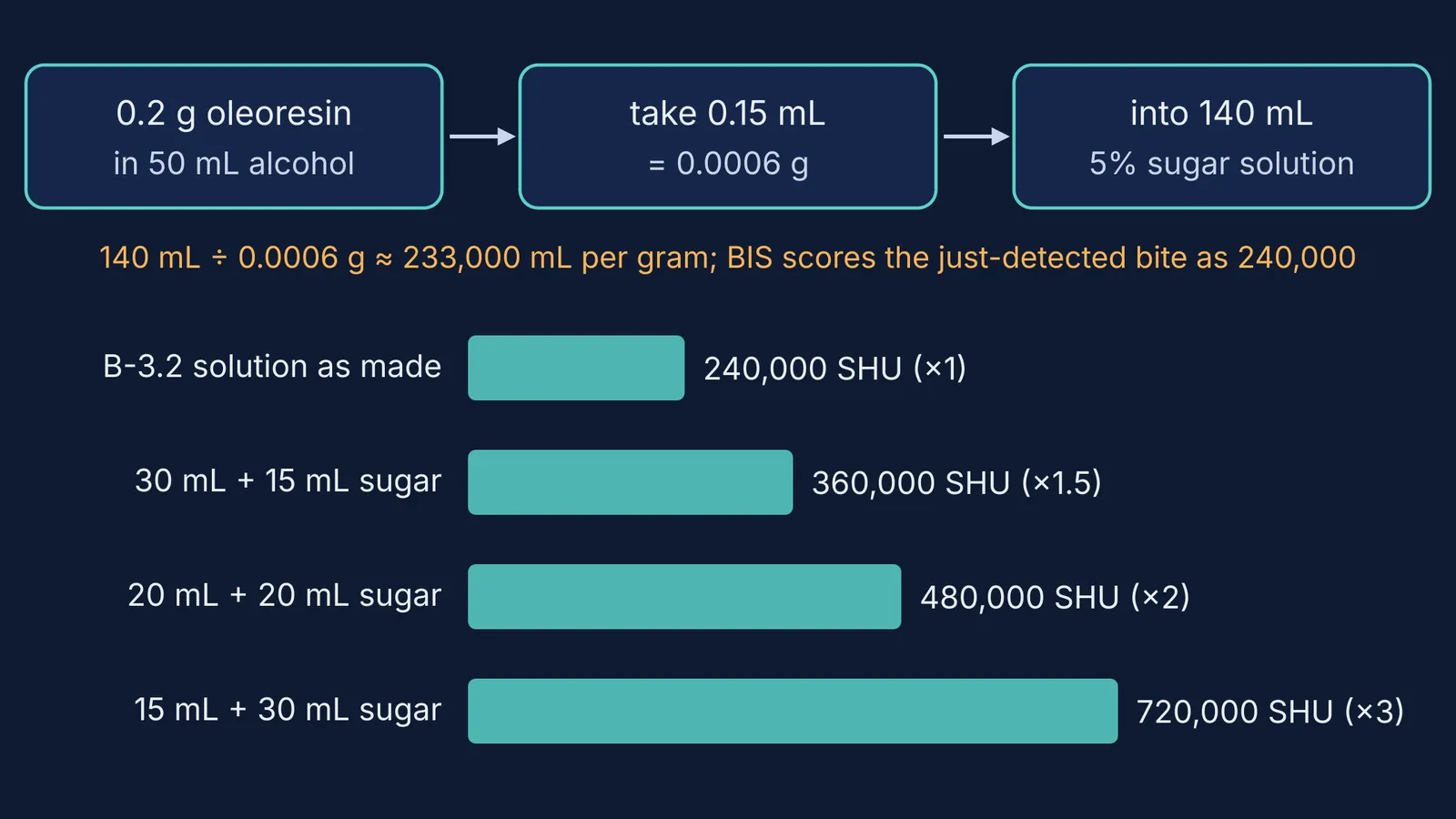
Dissolve 0.2 g of oleoresin in alcohol and make it up to 50 mL.
Add 0.15 mL of that solution to 140 mL of 5% sugar solution.
If a bite in the throat is "just perceptible at this dilution", the sample is "equal to 240 000 scoville units".
Concentration of step 1: 0.2 g ÷ 50 mL = 0.004 g per mL.
Oleoresin in 0.15 mL: 0.15 × 0.004 = 0.0006 g.
Dilution: 140 mL ÷ 0.0006 g = 233,333 mL per gram. Counting the 0.15 mL as well gives 233,583.
So a Scoville number is roughly how many millilitres of sugar water one gram can be spread through and still just be tasted. The standard states the result as 240,000, a rounded figure, not an error to correct.
Why does a hotter sample score 360,000, 480,000 or 720,000?
If the bite is too strong, the standard dilutes the step-2 solution further and gives a score for each mix. In every case the score is 240,000 multiplied by the extra dilution factor, total volume ÷ volume of step-2 solution:
30 mL solution + 15 mL sugar solution: 45 ÷ 30 = 1.5, so 240,000 × 1.5 = 360,000.
20 mL solution + 20 mL sugar solution: 40 ÷ 20 = 2, so 480,000.
15 mL solution + 30 mL sugar solution: 45 ÷ 15 = 3, so 720,000.
It is the C₁V₁ = C₂V₂ rule: needing 1.5 times more dilution means the sample is 1.5 times as strong. The scale is built on 240,000; from 233,333 the scores would be 350,000, about 466,700 and 700,000.
Why does BIS multiply the vanillin reading by 2?
Annex C measures capsaicin chemically. Oleoresin is spotted on a silica TLC plate and run in benzene–methanol (80 : 5), a 1993 solvent choice. The capsaicin spot sits at Rf 0.16. It is sprayed with Folin–Dennis reagent, a phosphomolybdic–phosphotungstic acid, which gives "a blue complex" read at 725 nm. Phenols reduce this kind of reagent to a blue product, and capsaicin is a phenol.
The calibration standard is vanillin, not capsaicin. The standard says to read the amount from a vanillin curve and "multiply by 2 ( a factor ) to correct for the difference in the molecular mass of capsaicin and vanillin."
Here is why that works, with molar masses from PubChem's capsaicin entry and PubChem's vanillin entry:
Same colour-forming group. Both molecules carry one 4-hydroxy-3-methoxyphenyl ring, so one phenol OH each. If the colour depends on moles of phenol, equal moles give equal colour.
Capsaicin, C₁₈H₂₇NO₃: 18(12.011) + 27(1.008) + 14.007 + 3(15.999) = 305.42 g/mol.
Vanillin, C₈H₈O₃: 8(12.011) + 8(1.008) + 3(15.999) = 152.15 g/mol.
Ratio: 305.42 ÷ 152.15 = 2.007. One mole of each gives the same blue, but a mole of capsaicin weighs 2.007 times as much.
Rounding to 2 changes the answer by under 0.4%. For dihydrocapsaicin, C₁₈H₂₉NO₃ (307.43 g/mol), the factor would be 2.021. Equal colour per mole is the assumption; the standard gives the molar-mass reason but not a test of it.
Worked example: from a TLC spot to percent capsaicin
The standard dissolves 5 g of oleoresin in acetone to 10 mL (0.5 g per mL) and gives: capsaicin % = X × 1000 × 200 ÷ r, where X is grams of capsaicin in the spot (vanillin × 2) and r is microlitres spotted.
Where the formula comes from. r µL holds r × 0.5 mg = r × 5 × 10⁻⁴ g of oleoresin. So % = X ÷ (r × 5 × 10⁻⁴) × 100 = X × 200,000 ÷ r.
Spot 5 µL. That is 2.5 mg of oleoresin.
Read the curve. Suppose the blue matches 20 µg of vanillin.
Convert. X = 2 × 20 µg = 40 µg = 4.0 × 10⁻⁵ g.
Percent: 4.0 × 10⁻⁵ × 200,000 ÷ 5 = 1.6%. That passes the 1.5% minimum. With 2.007 instead of 2 you get 1.61%.
The vanillin standard is 0.01 mg per mL, used in 1 to 3.5 mL portions, so the curve covers 10 to 35 µg. Hence the 5 to 20 µL spotting range: choose a volume that lands inside the curve. For more practice on dilution and percentage numericals, the Fermi Problem Library has a step-by-step solver that explains the reasoning.
What functional groups does capsaicin have?
PubChem names capsaicin (E)-N-[(4-hydroxy-3-methoxyphenyl)methyl]-8-methylnon-6-enamide. Read it piece by piece:
Secondary amide: "-amide" on a nine-carbon chain, joined through N–H to a CH₂ on the ring.
Phenol: the 4-hydroxy group on the benzene ring. This is the group the colour test uses.
Aryl methyl ether: the 3-methoxy group, –OCH₃ on the ring.
Alkene: "6-en", a C=C between C6 and C7 of the chain. Each end carries an H and a different carbon group, so E/Z isomers exist; capsaicin is the E isomer.
No stereocentre: C8 carries two identical CH₃ groups (C9 and the 8-methyl), so it is not chiral.
Vanillin shares the ring but has CHO where capsaicin has CH₂–NH–CO–. The same drill is in how to identify functional groups in a complex molecule, and a related spice amide with more double bonds is in piperine and its four geometric isomers. Why capsaicin tastes hot is covered in why chillies burn and milk helps.
Where does this show up in JEE and NEET?
Class 11 Some Basic Concepts: dilution, C₁V₁ = C₂V₂ and percentage by mass.
Class 12 Alcohols, Phenols and Ethers; Amines: spotting phenol, ether and amide groups.
Class 11 Organic: E/Z isomerism and chirality checks; Rf in chromatography.
For exam questions like these, try Fermi's AI tutor for JEE prep, part of Fermi Test Prep for JEE Main and Advanced.
Quick checklist
IS 13663: colour 4,000–20,000, at least 240,000 SHU, at least 1.5% capsaicin.
0.2 g in 50 mL, 0.15 mL into 140 mL: about 233,000 mL per gram, stated as 240,000.
Further dilution by 1.5, 2 or 3 gives 360,000, 480,000 or 720,000.
Vanillin factor: 305.42 ÷ 152.15 = 2.007.
Capsaicin: phenol, aryl methyl ether, secondary amide, one E C=C, no stereocentre.