On this page
Your textbook says a halogen in cold dilute alkali gives a hypohalite, and in hot alkali a halate. Our post on chlorine with cold and hot NaOH adds that iodine follows the same pattern. That is true, but for iodine "cold gives hypoiodite" lasts only minutes. Two papers in the Journal of the Chemical Society, Transactions, volume 77 (1900), timed it. Robert Llewellyn Taylor, of the Central School, Manchester, wrote "Action of Iodine on Alkalis" (pages 725 to 729). K. J. P. Orton and W. L. Blackman, of the Chemical Laboratory, St Bartholomew's Hospital and College, wrote "Estimation of Hypoiodites and Iodates" (from page 830). Both are in the scanned volume on the Internet Archive.
Why did Taylor doubt that iodine gives iodate straight away?
In 1899 E. Péchard had reported that the iodate formed could reach 92 per cent of the iodine used. Taylor found these conclusions "so remarkably at variance with the results of other experimenters" that he repeated the work. His objection was timing: Péchard's analyses "must have taken a considerable time (and with such unstable solutions this is of great importance)".
The two reactions, with oxidation states of iodine in brackets:
I₂ + 2OH⁻ → I⁻ + IO⁻ + H₂O. Iodine goes from 0 to −1 and +1.
3IO⁻ → IO₃⁻ + 2I⁻. Iodine goes from +1 to +5 and −1.
Both are disproportionations (disproportionation reactions, with examples).
How does baking soda tell hypoiodite from iodate?
Taylor used a test he credits to Schwicker (1895). Hypoiodite plus iodide is "completely decomposed by carbonic acid, or even by an acid carbonate, with liberation of iodine, whereas a mixture of iodide and iodate is not so decomposed".
IO⁻ + I⁻ + 2HCO₃⁻ → I₂ + 2CO₃²⁻ + H₂O. Atoms and charge balance (4− on each side).
IO₃⁻ + 5I⁻ + 6H⁺ → 3I₂ + 3H₂O needs a properly acidic solution, which bicarbonate does not provide.
He added excess NaHCO₃ and titrated the freed iodine with arsenious acid. Every I₂ that turned into IO⁻ + I⁻ comes back as one I₂, so the iodine freed measures hypoiodite only. 100 per cent back means every I₂ was still hypoiodite and iodide.
How fast did the hypoiodite go?
Taylor used decinormal iodine in KI with potash, at 15 to 18 °C:
Bicarbonate added as fast as possible: 88 to 91 per cent of the iodine came back, and 90 to 94 per cent with twice the alkali.
After half a minute: 69 to 73 per cent (twice the alkali) and 45 to 53 per cent (less potash).
After two minutes: only 17 to 20 per cent.
He concluded that iodine and potash produce "in the first instance, nothing but hypoiodite and iodide". The only difference between strong and dilute solutions is "the stability of the product". Dilution slowed the decay: with centinormal iodine, "as much as 44 per cent" of the possible hypoiodite remained after 5 minutes.
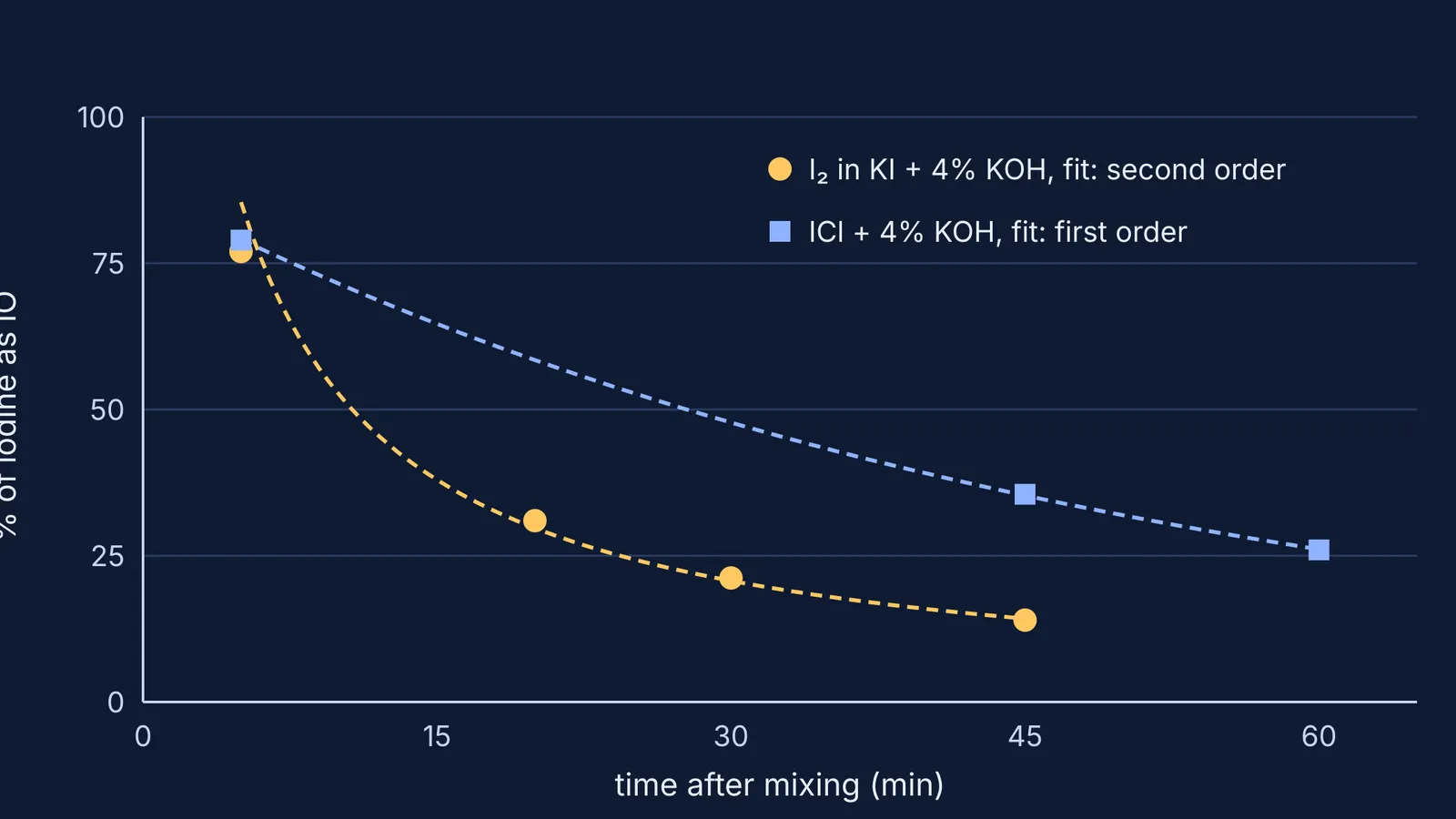
Orton and Blackman measured hypoiodite another way. Excess sodium arsenite reduces it (IO⁻ + H₃AsO₃ → I⁻ + H₃AsO₄), and the leftover arsenite is titrated with iodine. Their checks recovered 0.5904 g of potassium iodate from 0.59 g, and 0.1003 g from 0.1 g. In 4 per cent KOH at about 15 °C, 77 per cent of the iodine was hypoiodite after 5 minutes, 31 per cent after 20, 21.2 per cent after 30 and 14 per cent after 45. After 24 hours it had "practically disappeared". Light hardly mattered: after 1½ hours, dark and daylight samples used 3.86 and 3.75 c.c. of N/10 arsenite.
Worked example: electron bookkeeping in Orton's flask
Orton added 20 c.c. of N/10 iodine (1.0 mmol I₂) to 100 c.c. of 4 per cent KOH. Use the 5-minute figure of 77 per cent.
First step: 1.0 mmol I₂ gives 1.0 mmol IO⁻ and 1.0 mmol I⁻.
At 5 minutes, 0.77 mmol IO⁻ is left, so 0.23 mmol has disproportionated.
From 3IO⁻ → IO₃⁻ + 2I⁻: 0.23 mmol IO⁻ gives 0.0767 mmol IO₃⁻ and 0.153 mmol I⁻.
Electrons: each IO₃⁻ loses 4 (from +1 to +5), so 0.0767 × 4 = 0.307 mmol e⁻ lost. Each new I⁻ gains 2 (from +1 to −1), so 0.153 × 2 = 0.307 mmol e⁻ gained. They match.
Iodine atoms: 0.77 + 0.0767 + (1.0 + 0.153) = 2.0 mmol, the same as in 1.0 mmol I₂, not counting the KI the iodine was dissolved in.
Titre: each IO⁻ takes one arsenite, a 2-electron change, so 0.77 mmol is 1.54 milliequivalents, or 15.4 c.c. of N/10 arsenite. If all 1.0 mmol were still hypoiodite it would take 20.0 c.c. So 15.4/20.0 = 77 per cent.
Which rate law fits the decay?
This part is our own analysis, not the authors'. Orton and Blackman wrote that "no attempt was made to determine the velocity constant". They noted that Schwicker had tried, and found that it "varied greatly" with the starting amounts of hypoiodite and alkali.
Test the 4 per cent KOH series (x = per cent as hypoiodite at t = 5, 20, 30 and 45 min):
First order predicts a constant k = ln(x₁/x₂)/(t₂ − t₁). The three intervals give 0.061, 0.038 and 0.028 min⁻¹. k keeps falling, so this series is not first order.
Second order predicts a constant k = (1/x₂ − 1/x₁)/(t₂ − t₁). The intervals give 0.00128, 0.00149 and 0.00162 per cent⁻¹ min⁻¹. That is much flatter.
Straight-line fits agree: R² is 0.997 for 1/x against t and 0.961 for ln x.
So these four points fit second order better than first. That does not settle the rate law. The same paper has a second series in 4 per cent KOH, made from iodine monochloride (78.96 per cent at 5 min, 35.5 at 45 and 26.0 at 60). There the first-order k is 0.020 and 0.021 min⁻¹ across the two intervals, nearly constant. The solutions differ in iodide, chloride and leftover alkali, which fits Schwicker's warning that the "constant" depends on the conditions. We have not checked a modern rate law for this reaction, so we do not quote one. For the half-life side of this, see half-life for an nth-order reaction.
Where does this meet your syllabus?
Class 12 p-block and Class 11 Redox: halogens with alkali, and iodine in oxidation states 0, −1, +1 and +5.
Class 12 Chemical Kinetics: test the order of a reaction from concentration against time data with integrated rate laws.
Iodometry: hypoiodite and iodate both give iodine back on acidifying, which is why the hypoiodite titration of glucose still works when some IO⁻ has turned to IO₃⁻.
For more integrated rate law fits like this one, the Fermi Problem Library has worked problems with a step-by-step solver that explains the reasoning. For exam-style redox and kinetics practice, Fermi Test Prep is built for JEE Main and Advanced preparation, with an AI tutor.
Quick checklist
Cold alkali: I₂ + 2OH⁻ → I⁻ + IO⁻ + H₂O, but the IO⁻ lasts minutes, not hours.
3IO⁻ → IO₃⁻ + 2I⁻: 4 electrons lost by one iodine, 2 gained by each of two.
NaHCO₃ frees I₂ from IO⁻ + I⁻ but not from IO₃⁻ + I⁻.
Dilution and extra alkali slow the decay; Taylor found boiling destroys it almost at once.
For order: constant k over every interval, or a straight line in the right plot.