On this page
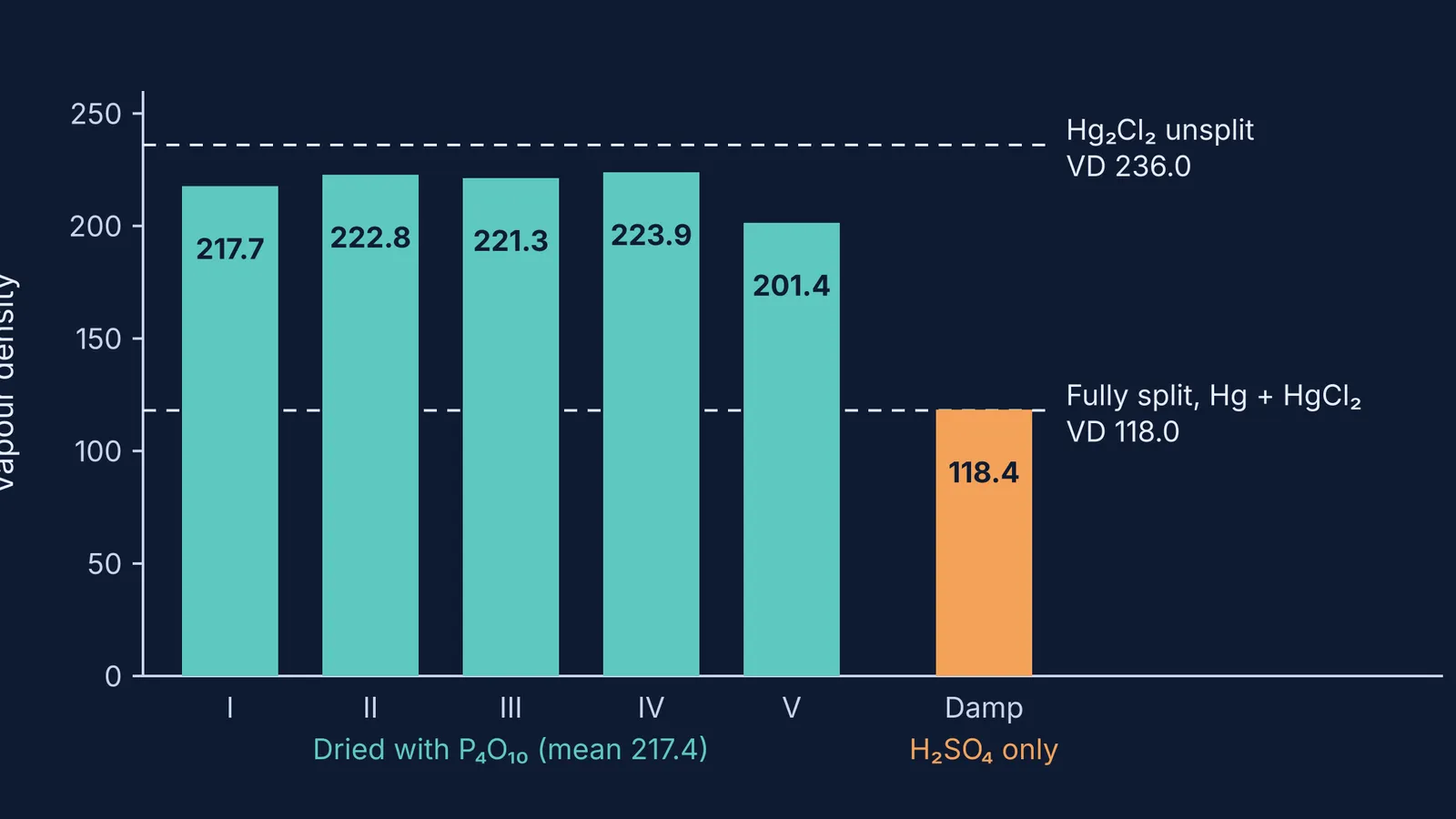
Measured in the ordinary way, calomel vapour gives a vapour density about half of what Hg₂Cl₂ should give. On density alone, that fits the simpler formula HgCl. In 1900 H. Brereton Baker, working at Dulwich College, dried calomel with phosphoric oxide for weeks and measured its vapour density again. The dried vapour came out at 217.4, close to the 235 he calculated for undissociated Hg₂Cl₂. Calomel dried only with sulphuric acid gave 118.4. Moisture, not the formula, had halved the density.
The paper is H. B. Baker, "Vapour Density of Dried Mercurous Chloride", Journal of the Chemical Society, Transactions, volume 77 (1900), pages 646 to 648 (scan on the Internet Archive). Every number below was read from the page images and recomputed with modern atomic masses. The paper gives no biographical details beyond "M.A." and Dulwich College, so none are added here. Mercury and its compounds are toxic; this is history, not a procedure to repeat.
Why did calomel's vapour density look wrong?
Vapour density (VD) is the density of a gas compared with hydrogen at the same temperature and pressure, so VD = M ÷ 2. The method Baker used is explained in the Victor Meyer method: molar mass from vapour density.
With Hg = 200.59 and Cl = 35.45:
M(Hg₂Cl₂) = 472.08, so VD = 236.0.
M(HgCl) = 236.04, so VD = 118.0.
Baker's own undried control gave 118.4. On that number alone, HgCl fits.
But there is a second way to get 118. If every Hg₂Cl₂ molecule split into two molecules, Hg₂Cl₂ → Hg + HgCl₂, the same mass would fill twice the volume, and the VD would also be 118.0. A single density reading cannot tell "HgCl" apart from "Hg + HgCl₂". Baker wrote that calomel's "dissociation under ordinary circumstances is well established", and set out to see whether it needed water.
Why did Baker think moisture mattered?
His paper opens with the reason. Among the many changes that need moisture, "only one case of dissociation has been studied, that of ammonium chloride", and that substance "has a normal density when dried". (That NH₄Cl result also comes up in Ray, Dhar and De's 1912 work on the vapour density of ammonium nitrite.) If one abnormal density was caused by water, others might be too.
He used a Victor Meyer apparatus of hard glass with plugs of phosphoric oxide (P₄O₁₀) inside, filled it with dry nitrogen and left it closed in the dark for three weeks. The bulb was heated in boiling sulphur, which boils at about 445 °C.
What did the dried calomel show?
Five determinations: 217.7, 222.8, 221.3, 223.9 and 201.4. Mean 217.4. "Calculated for no dissociation", 235. (His 235 used the atomic masses of his day; modern masses give 236.0.)
A control in nitrogen "dried only by sulphuric acid" gave 118.4. His conclusion: "the dissociation of mercurous chloride is much hindered by removing moisture as far as possible."
How did gold leaf settle it?
Baker heated purified calomel in two tubes with gold leaf, one dried with phosphoric oxide and one not specially dried. Mercury vapour attacks gold and forms an amalgam. "No amalgamation of the gold was seen in the dried tube, whilst in the other the gold had been freely attacked."
That is the step a density cannot do. Free mercury was present in the damp vapour, so the low density came from Hg + HgCl₂, not from HgCl molecules. The equation balances: 2 Hg and 2 Cl on each side.
Worked example: from vapour density to degree of dissociation
For a molecule that splits into two, start with 1 mol of Hg₂Cl₂ and let a fraction α split. You have (1 − α) mol Hg₂Cl₂, α mol Hg and α mol HgCl₂: (1 + α) mol in all. The mass is unchanged, so the observed density d is smaller than the undissociated value D by the factor (1 + α). That gives α = (D − d) ÷ d. The full derivation is in degree of dissociation of PCl₅ from vapour density.
D. 472.08 ÷ 2 = 236.04.
Apparent molar mass of the dried vapour. 2 × 217.42 = 434.8 g/mol, below 472.08.
α for the dried vapour. (236.04 − 217.42) ÷ 217.42 = 0.086. With Baker's own 235 it is 0.081. Either way about 91% of the calomel stayed as Hg₂Cl₂.
Composition. Per mole started: 0.914 mol Hg₂Cl₂, 0.086 mol Hg and 0.086 mol HgCl₂, total 1.086 mol. Mole fractions are 0.84, 0.08 and 0.08.
α for the damp vapour. (236.04 − 118.4) ÷ 118.4 = 0.99. Essentially complete.
Check the spread. Run V (201.4) alone gives α = 0.17. The other four average 221.4 and give α = 0.066. The low run pulls the mean down, but no dried run comes near 118.
What did the controls show?
Mercury alone. Dried mercury gave 107.6, 104.4 and 112.5, mean 108.1. Monatomic Hg should give 200.59 ÷ 2 = 100.3, about 8% lower. Baker concluded only that "the vapour of dried mercury is therefore probably monatomic", so drying does not make mercury vapour Hg₂.
PCl₅. His last run at 440 °C gave 89.2 against 104.2 calculated, so α = (104.2 − 89.2) ÷ 89.2 = 0.17. Earlier samples had pointed to complete dissociation, and he said only that PCl₅ "may therefore be ultimately shown to undergo no dissociation when dried", if pure enough. It was a hint, not a result.
Where does this meet your syllabus?
Class 11 Some Basic Concepts and Equilibrium: M = 2 × VD, and α = (D − d) ÷ d for one molecule giving two. Calomel is a clean example with an answer you can check against a real paper.
Class 11 Equilibrium: a catalyst does not change K. Moisture here behaves like one.
Class 12 d- and f-block: mercury(I) is Hg₂²⁺, with an Hg–Hg bond, and it disproportionates: Hg₂²⁺ → Hg + Hg²⁺ (charge +2 on both sides). The vapour reaction Hg₂Cl₂ → Hg + HgCl₂ is the same split. The magnetic and X-ray evidence for the dimer is in why the mercurous ion exists as an Hg₂²⁺ dimer.
For vapour density and α numericals in exam form, Fermi Test Prep is JEE Main and Advanced preparation with an AI tutor. If the mole table in step 4 is where you get stuck, the Fermi Problem Library has a step-by-step solver that explains the reasoning.
A footnote in the paper adds a curiosity. Working almost in the dark, Baker saw sulphur on the hot bulb burn in air with "a luminous, blue glow, very similar in character to the glow of phosphorus".
Quick checklist
VD = M ÷ 2. Hg₂Cl₂: 236.0. HgCl or fully split Hg₂Cl₂: 118.0.
A density of 118 cannot tell HgCl from Hg + HgCl₂. Gold leaf amalgamation showed free Hg.
Dried calomel: mean 217.4, α ≈ 0.086. Damp: 118.4, α ≈ 0.99.
α = (D − d) ÷ d when one molecule gives two.
Water sped up the splitting; it did not change the equilibrium constant.
The formula you write, Hg₂Cl₂, is the one the dry vapour supports.