

On this page
In 1878 the German chemist Viktor Meyer presented a way to weigh molecules using nothing more delicate than a glass tube, a burette and a balance. According to Albert B. Costa's entry on Meyer, the vapour of a weighed substance displaced an equal volume of air, which was then measured. That idea still turns up in mole concept problems.
What is the Victor Meyer method?
Meyer (1848-1897) worked in Zurich, Göttingen and Heidelberg, where he succeeded Bunsen, and he created his new method for determining gas density in 1878. One of his papers that year in the Berichte der deutschen chemischen Gesellschaft is titled Zur Dampfdichtebestimmung, on vapour density determination.
He got there in three stages from 1876, because he needed the molecular formulas of the organic compounds he was making, Costa's entry explains. The 1878 air-displacement version was his third and best-known, and Costa writes that it became more commonly used than any other method, with Meyer's apparatus found in most chemical laboratories.
How does the Victor Meyer apparatus work?
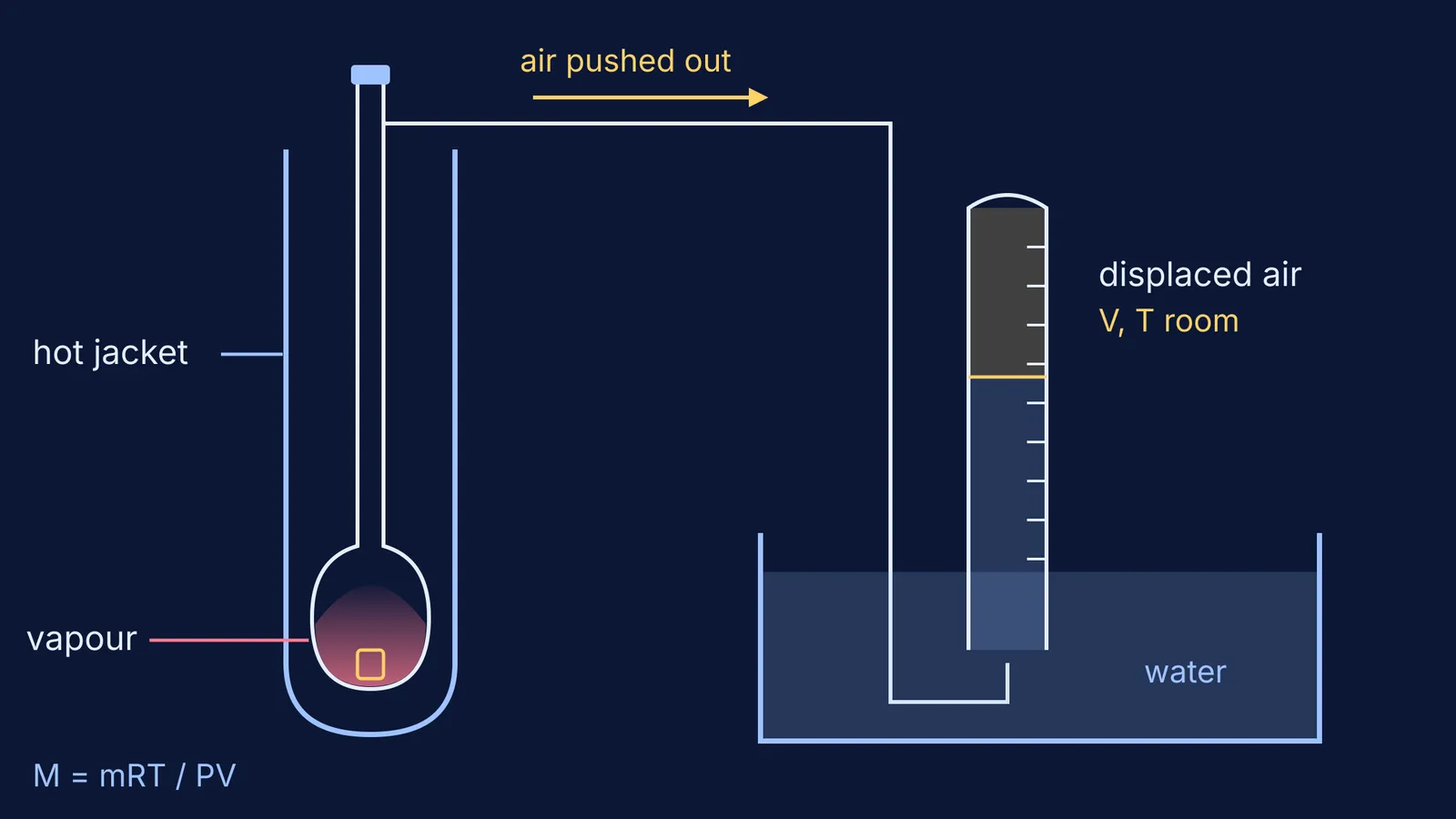
The Victor Meyer apparatus is a long vertical glass tube with a bulb at the bottom, sitting inside a heating jacket (a steam jacket in the classic version). A side tube carries any air pushed out of it to a graduated tube standing upside down in a trough of water.
Heat the jacket until the inner tube is at a steady temperature well above the boiling point of your liquid, and wait until no more air bubbles out.
Weigh a small stoppered glass vial with a little of the liquid inside, and place the graduated tube over the outlet.
Drop the vial down the inner tube. The liquid vaporises, blows out the stopper and pushes out air.
Read the volume of air collected, along with room temperature and atmospheric pressure.
Here is the clever part. The vapour pushes out as much air as it occupies at the hot temperature, and by Avogadro's law that air holds the same number of moles. The air then cools to the temperature of the water in the measuring tube, which is room temperature, so you never need the temperature inside the hot tube.
How do you calculate molar mass from vapour density?
The Wikipedia article on the apparatus notes that the moles of vapour follow from the ideal gas law, and the molar mass from that. In one line:
M = mRT / (PV), where m is the mass of liquid, T and V are the temperature and volume of the collected air, and P is the pressure of dry air.
P = atmospheric pressure minus the vapour pressure of water at room temperature, because air collected over water is saturated with water vapour (our explainer on finding pressure for gas collected over water goes through this step).
Vapour density is the density of a vapour relative to hydrogen, so molar mass is about 2 x vapour density, and vapour density = molar mass / 2 in exam problems.
The molar gas constant is 8.314 J/(mol K) in SI units; if your data come in mmHg or litres, see how to choose the right value of R.
Worked example: what is the molar mass of chloroform?
Suppose, as an illustrative set of readings, 0.240 g of chloroform is dropped into the tube. The air is collected over water at 25 °C (298.15 K), and atmospheric pressure is 101.3 kPa. The volume of air collected is 50.8 mL.
Water's vapour pressure at 25 °C is 3.17 kPa, so dry-air pressure is 101.3 - 3.17 = 98.16 kPa, or 98,160 Pa.
Convert the volume: 50.8 mL = 50.8 x 10^-6 m^3.
M = (0.240 x 8.314 x 298.15) / (98,160 x 50.8 x 10^-6) = 594.9 / 4.987 = about 119.3 g/mol.
Vapour density = 119.3 / 2 = about 59.7.
The formula CHCl3 gives a molar mass of 119.37 g/mol, so these illustrative readings land within 0.1 g/mol; real measurements are usually less exact. If you skip the water correction and use 101.3 kPa, you get about 115.6 g/mol, roughly 3% low.
Which mistakes cost marks in Victor Meyer questions?
Forgetting aqueous tension when the air is collected over water.
Using the hot jacket temperature instead of room temperature for T.
Mixing units: mL with Pa, or kPa with litres, without matching R.
Taking vapour density relative to air instead of hydrogen.
Choosing a liquid that boils above the jacket temperature or breaks down on heating.
Before you calculate, say which gas you apply PV = nRT to: always the collected air.
If you keep picking the wrong method on mixed gas-law problems, the Fermi Problem Library has worked problems with a step-by-step solver that explains the reasoning rather than printing an answer.
The water correction rests on John Dalton's work, which we cover in Dalton's law of partial pressures.


