

On this page
Mercurous chloride is written in chemistry as Hg₂Cl₂ rather than empirical HgCl, and the aqueous mercurous ion is formulated as the polyatomic cation Hg₂²⁺. Why does mercury refuse to exist as a simple Hg⁺ ion?
The answer lies in electronic structure and magnetism. A direct covalent metal-metal bond between two mercury atoms pairs up valence electrons that would otherwise remain unpaired, turning a potentially paramagnetic species into a diamagnetic dimer.
Why would a monomeric Hg⁺ ion be paramagnetic?
At the Royal Institute of Science in Bombay, Mata Prasad, S. S. Dharmatti, and A. K. Ghose measured negative magnetic susceptibilities across all mercurous salts (The Journal of Chemical Physics), proving they are strictly diamagnetic. This finding contradicts what an isolated monoatomic cation would show.
Neutral mercury (atomic number 80) has the electron configuration [Xe] 4f¹⁴ 5d¹⁰ 6s² (reviewed in our guide to the electron configuration of ions). Transition and post-transition metals lose outermost s-electrons first when forming cations.
Removing one electron would produce a monoatomic Hg⁺ ion with the configuration [Xe] 4f¹⁴ 5d¹⁰ 6s¹. With one unpaired electron in its 6s orbital, Hg⁺ would possess spin angular momentum S = 1/2 and a spin-only magnetic moment:
μ = √(n(n + 2)) ≈ 1.73 Bohr Magnetons.
An unpaired electron produces paramagnetism: the substance is drawn into magnetic fields and gives an electron paramagnetic resonance signal. Because mercury(I) salts exhibit zero paramagnetism and are diamagnetic, their 6s electrons cannot remain unpaired on isolated ions.
What experimental evidence proves the Hg₂²⁺ dimer?
Three independent experimental techniques confirm that mercury(I) exists exclusively as the dimeric cation [Hg—Hg]²⁺:
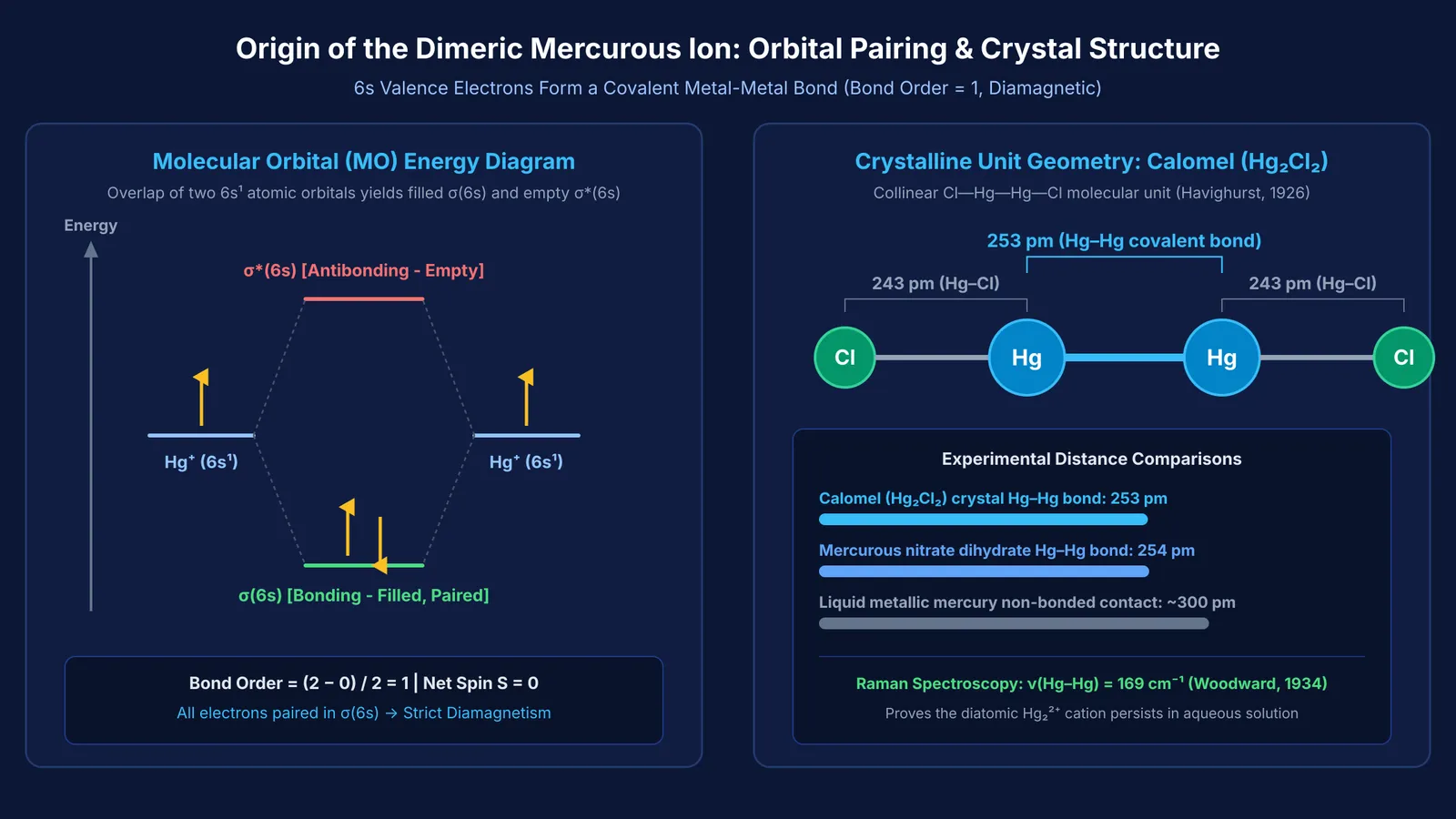
X-ray crystallography: In 1926, R. J. Havighurst determined the crystal structure of calomel (Journal of the American Chemical Society), showing solid mercurous chloride consists of linear Cl—Hg—Hg—Cl units with an Hg—Hg bond length of 253 pm and an Hg—Cl length of 243 pm. D. Grdenić confirmed this in mercurous nitrate dihydrate (Journal of the Chemical Society), measuring an Hg—Hg distance of 254 pm, shorter than the 300 pm contact in metallic mercury.
Raman spectroscopy: In aqueous solution, the Hg—Hg bond remains intact. In 1934, Leonard A. Woodward examined aqueous mercurous nitrate using Raman spectroscopy (Philosophical Magazine), detecting a sharp band at 169 cm⁻¹ from symmetric Hg–Hg stretching. Because monatomic ions lack vibrational modes, this signal proves the diatomic cation persists in water.
Concentration cells: In 1898, Alexander Ogg measured concentration cells with mercury electrodes (Zeitschrift für Physikalische Chemie), showing cell potentials obey the Nernst equation only when n = 2 electrons are transferred per ion.
This covalent linkage explains why deducing oxidation states from molecular structure gives a formal +1 state for each mercury atom in Hg₂²⁺.
How does molecular orbital theory explain the Hg–Hg bond?
Molecular orbital theory explains how two Hg⁺ ions (each with a 6s¹ valence configuration) pair their electrons:
Constructive overlap of the two 6s orbitals forms a lower-energy bonding σ(6s) orbital.
Destructive overlap forms a higher-energy antibonding σ*(6s) orbital.
The two available electrons fill the σ(6s) orbital with opposite spins (↑↓), leaving σ*(6s) vacant:
Bond order = (2 − 0) / 2 = 1.
The resulting single σ-bond links the mercury atoms into a stable Hg₂²⁺ unit. Because all electrons are paired, total spin S = 0, producing diamagnetism.
For students exploring chemical bonding, the Fermi Concept Library covers every concept in physics, chemistry, biology, mathematics and computing, each with its own lesson and its place in the map.
Why does mercury form dimeric cations while zinc does not?
Mercury shares Group 12 with zinc and cadmium, yet neither forms stable M₂²⁺ cations in water (discussed in why zinc, cadmium, and mercury have distinct d-block chemistry). Mercury's dimeric stability arises from relativistic effects.
In heavy elements like mercury (Z = 80), inner s-electrons move near the speed of light. Relativistic mass increase contracts inner s-orbitals, drawing the 6s shell closer to the nucleus. As reviewed by Pekka Pyykkö (Chemical Reviews), this relativistic 6s contraction peaks at gold and mercury.
This contraction produces two decisive consequences:
High ionization energy: Mercury holds its 6s electrons tightly, giving it a high first ionization energy of 1007 kJ/mol (versus 868 kJ/mol for cadmium). Forming isolated divalent cations requires substantially more energy.
Strong orbital overlap: The contracted 6s orbital overlaps effectively with an adjacent mercury 6s orbital to form a strong Hg–Hg covalent bond. For zinc and cadmium, diffuse s-orbitals form weaker bonds, and hydration favors monomeric Zn²⁺ and Cd²⁺ ions in aqueous solution.
How do concentration cells prove the dimer with the Nernst equation?
To see how electrochemistry confirms the dimeric formula, consider the concentration cell setup developed by Alexander Ogg (Zeitschrift für Physikalische Chemie). At 298 K, two liquid mercury electrodes contact mercurous nitrate solutions of concentrations c₁ = 0.050 M and c₂ = 0.0050 M:
Hg(l) | Hg(I) nitrate (0.0050 M) || Hg(I) nitrate (0.050 M) | Hg(l)
The measured cell potential is E_cell = 0.0295 V. We determine n by applying the Nernst equation at 298 K:
E_cell = (0.0591 V / n) log₁₀(c₁ / c₂)
Substituting the concentrations gives:
0.0295 V = (0.0591 V / n) log₁₀(0.050 / 0.0050) = 0.0591 V / n
Solving for n gives:
n = 0.0591 V / 0.0295 V ≈ 2.00
If mercurous ions were monomeric Hg⁺, the reduction half-reaction Hg⁺ + e⁻ ⇌ Hg(l) would require n = 1, predicting an electromotive force of 0.0591 V. The experimental value of 0.0295 V confirms n = 2, corresponding to:
Hg₂²⁺ + 2e⁻ ⇌ 2Hg(l)
For students practicing Nernst equation problems, the Fermi Problem Library provides worked problems with a step-by-step solver that explains the reasoning rather than printing an answer.


