On this page
Maltase splits maltose into two glucose molecules, and textbooks give it one arrow. In 1903 Arthur Croft Hill showed the Chemical Society that the arrow points both ways: in strong glucose syrup his enzyme preparations built disaccharides, and on dilution they split them again. His paper, "Reversibility of Enzyme or Ferment Action", J. Chem. Soc. Trans. 83, 578–598, is Class 11 equilibrium run by an enzyme.
What had Croft Hill shown about maltase in 1898?
Hill opens by recalling his 1898 result (Trans. 73, 634): the hydrolysis of maltose by yeast maltase "in concentrated solution was incomplete". Synthesis and hydrolysis ran "until the system approached a state of chemical equilibrium, the equilibrium point being a function of the concentration of the solution."
The 1903 paper, sent from the Davy-Faraday Laboratory in London and part of a Cambridge M.D. thesis, adds the proof. All quotes here come from it, read in the scanned volume; we have not read the 1898 paper.
How did Hill track a sugar mixture without knowing its concentration?
He used one number he called the optical factor: specific rotation divided by copper-reducing power, [α]D/R, with R = 100 for glucose. His values were 0.525 for glucose, 3.275 for maltose ("more than six times as great") and 1.91 or 1.92 for a new sugar, revertose.
The unknown concentration C cancels. With a 200 mm (2 dm) tube, [α]D = 50αD/C. If ρ is the reducing power relative to a 0.2% glucose standard, R = (ρ × 100 × 0.2)/C. Divide one by the other and C disappears:
optical factor = 5αD/(2ρ)
Try it on Hill's Experiment XI: αD = 0.44° and a reducing power equal to 0.266% glucose, so ρ = 0.266 ÷ 0.2 = 1.33. Then F = (5 × 0.44) ÷ (2 × 1.33) = 0.827; Hill printed 0.825. A rising factor means glucose is becoming disaccharide; a falling one means the reverse.
Did the reaction reach the same point from both sides?
That is the classic test of equilibrium.
With yeast extract. He describes an optical factor of 0.70 as "approximately the equilibrium factor when yeast-extract has acted on a 40 per cent. solution of either maltose or glucose." Same end point from either sugar.
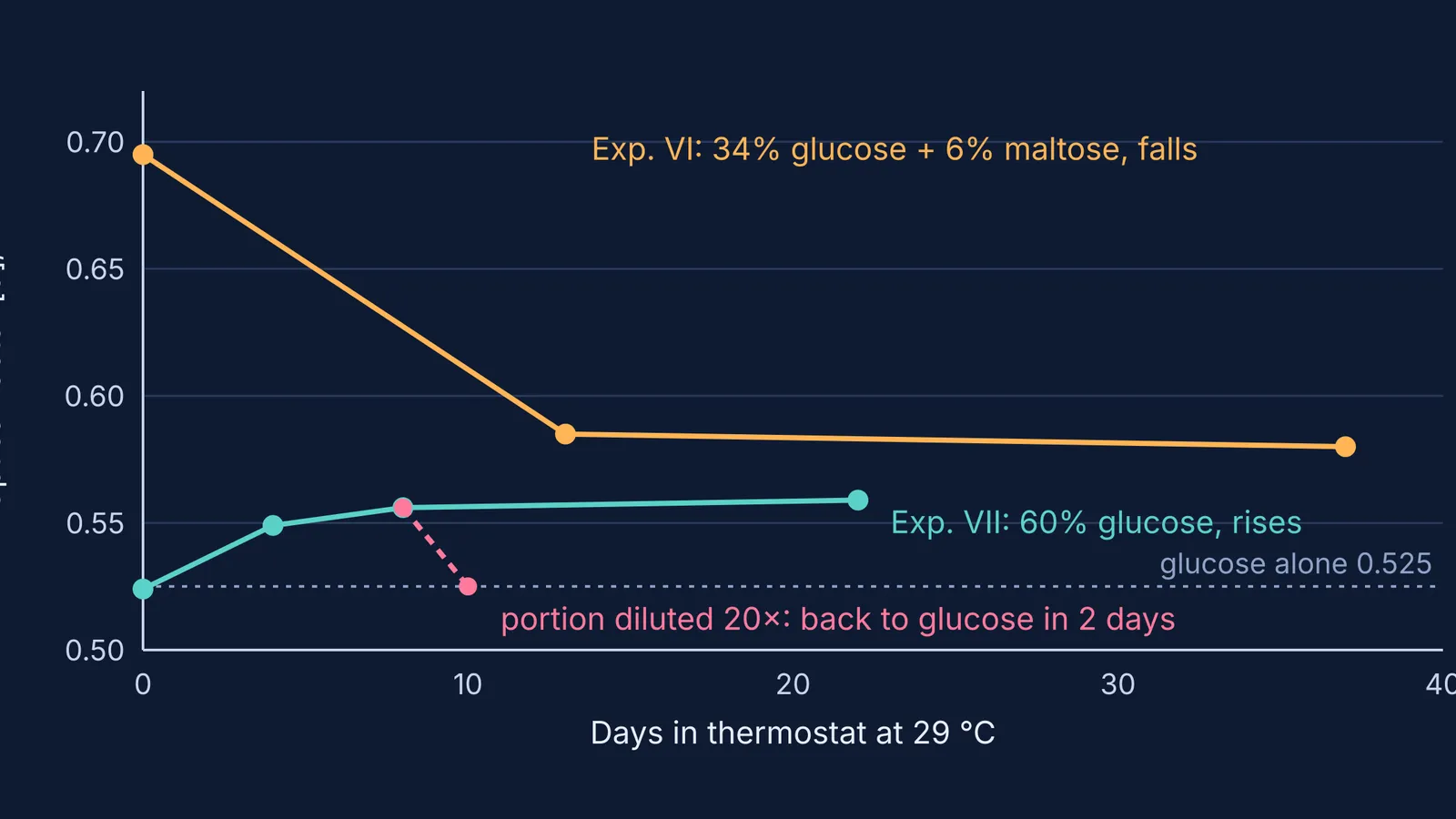
With taka-diastase, from the maltose side (Experiment VI). A 40% sugar solution, 34% glucose and 6% maltose hydrate, started at 0.695. It fell to 0.585 after 13 days and 0.580 after 37 days. "Beyond this point, no further change was noticed."
With taka-diastase, from the glucose side (Experiment VII). A 60% glucose solution started at 0.524. It rose to 0.549, 0.556 and 0.559 after 4, 8 and 22 days. Hill introduces it as "approaching the equilibrium point from the other side".
Heated controls barely moved. The two taka-diastase flasks differed in strength (40% against 60%), so read them as two flasks that each stopped short, not as one exact meeting point.
Why does diluting the flask make the enzyme split the sugar again?
C₁₂H₂₂O₁₁ + H₂O ⇌ 2 C₆H₁₂O₆ (maltose + water ⇌ glucose)
Check: 12 C, 24 H, 12 O each side. In dilute solution, with water as the solvent, Q = [glucose]²/[maltose].
Dilute 20-fold, as Hill did. Every concentration falls to 1/20, so Q becomes (1/20)² ÷ (1/20) = 1/20 of its old value. Q is now below K, so the disaccharide is hydrolysed. Extra water, a reactant, pushes the same way. It is the counting rule as in how dilution shifts an aqueous equilibrium: dilution favours the side with more dissolved particles.
A portion of the Experiment VII flask, diluted "to 20 volumes" and kept for 2 days, fell from 0.556 to 0.525, the glucose value, "showing that the reversion was reversed."
Experiment I. A boiled synthetic product (factor 0.676) was diluted with fresh yeast extract. After 10 days it read 0.537; the control without active enzyme read 0.675. "The hydrolysis in A was nearly complete."
Experiment VIII. A 40% glucose flask with taka-diastase rose from 2.06° to 2.18° in 55 days; diluted 20 times, it fell back to 2.08° in 48 hours.
In 40–60% syrups water is not in large excess and there are several products, so we give no K values from Hill's numbers.
Worked example: how much glucose was converted?
Hill's 1898 experiment with yeast extract on 40% glucose was reported as "a change of 14 per cent. of the glucose to maltose hydrate". Recover that from the optical factor.
Masses first. 2 C₆H₁₂O₆ = 2 × 180.156 = 360.312 g. C₁₂H₂₂O₁₁·H₂O = 342.297 + 18.015 = 360.312 g. So the total sugar mass never changes. Let w be the mass fraction now present as maltose hydrate.
Glucose numbers. R = 100 and factor 0.525, so [α]D = 52.5.
Maltose hydrate numbers. Hill gives R = 40 with his 1903 copper solution, so [α]D = 3.275 × 40 = 131.
Mix them. Both are per gram, so each averages by mass. Optical factor F = [52.5(1 − w) + 131w] ÷ [100(1 − w) + 40w].
Solve for F = 0.68, the value Hill quotes for this experiment with the 1903 copper solution: 68 − 40.8w = 52.5 + 78.5w, so w = 15.5 ÷ 119.3 = 0.130, about 13%.
Cross-check. His earliest copper solution gave R = 38 for maltose hydrate and a factor of 0.70. Then w = (70 − 52.5) ÷ (78.5 + 0.70 × 62) = 0.144, about 14%, matching his 1898 figure.
Hill warns that this is too small. Most of the product was revertose, whose factor (about 1.9) is far below maltose's 3.275, so the same rise in F needs more converted glucose. In his words, the total glucose changed in 41% solution "is nearly twice that calculated" as maltose only.
What was revertose?
Hill removed leftover glucose with Saccharomyces marxianus, a yeast that "ferments glucose, but not maltose". Most of the product survived. Purified, it had [α]D about +91.5°, R 47.5, and a biose osazone. He could not "identify it with any biose hitherto described", named it revertose, and "avoided the name isomaltose" because that name had been used for several substances.
The smaller product, about "one part of this sugar to five parts of revertose", behaved like maltose in every test he applied. This paper does not settle what revertose is in modern terms, and we have not checked later identifications. See how glucose units join in different ways in disaccharides and polysaccharides.
Why does Hill's experiment matter for JEE and NEET?
Class 11 Equilibrium: an equilibrium is reached from both sides, and dilution shifts it to the side with more dissolved particles.
Catalysts: the enzyme speeds both directions, as in what a catalyst does to equilibrium.
Class 12 Biomolecules: maltose is a reducing disaccharide that hydrolyses to two glucose units.
To watch an equilibrium shift as you change conditions, try the Fermi Simulation Lab, interactive simulations for ideas easier to see than read. For exam practice, Fermi Test Prep covers JEE Main and Advanced preparation with an AI tutor.
Quick checklist
Maltose + H₂O ⇌ 2 glucose; strong glucose favours synthesis, dilution favours hydrolysis.
Optical factor = [α]D/R = 5αD/(2ρ); concentration cancels.
A 20-fold dilution cuts Q to 1/20, so hydrolysis resumes.
2 glucose and 1 maltose hydrate both weigh 360.31 g.
Most of the product was revertose, so "% maltose" understates the change.