

On this page
Cook soaked sabudana in a hot pan and something odd happens. The chalk-white pearls turn glassy. The change is a piece of chemistry called starch gelatinisation, and the reason you can see through the result is plain optics.
What is sabudana made of?
Sabudana (sago) is processed cassava starch in the form of pearls typically 2 to 4.5 mm across, according to a technical leaflet from ICAR-Central Tuber Crops Research Institute. Purified cassava starch is sized into globules, then roasted or steamed, dried and polished.
The same leaflet notes that roasted sago is only partially gelatinised and opaque, while steamed "nylon" sago is fully gelatinised, has a glassy appearance and is more transparent. In short, the more the starch gelatinises, the clearer it looks.
Why does sabudana become transparent when cooked?
Starch is stored in plants as tiny, tightly packed granules. A study of starches from six cassava varieties grown in Zambia measured granules from 1.17 to 22.22 micrometres across. Gelatinisation is what happens when these granules are heated in water: they absorb it, swell and lose their packed order.
The same study found that cassava starch began to gelatinise at 56 to 63 °C and finished at 69 to 77 °C, depending on the variety. That is well below boiling, which is why soaked sabudana starts to clear quickly once it is heated.
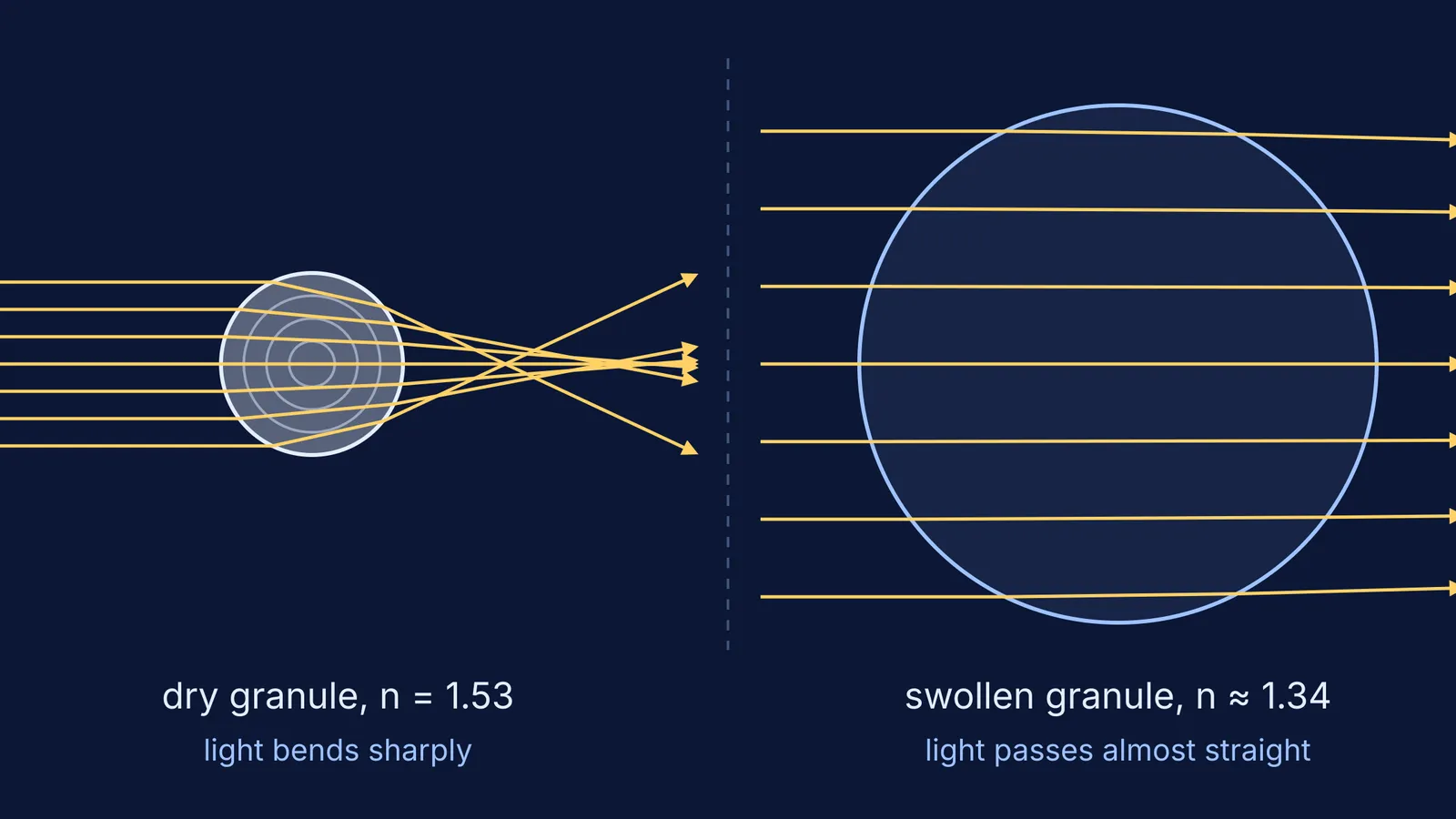
Now the optics. Light bends whenever it crosses between two materials with different refractive indices. Starch has a refractive index of about 1.530, according to the University of Sheffield's archaeobotany guide to starch. Water's is 1.333 at 20 °C (list of refractive indices). A dry pearl is packed with granules, and every granule edge is a boundary where light bends and bounces. After many such boundaries the light leaves in every direction, and your eye reads scattered light as white, the same idea behind why milk looks white.
A swollen granule is mostly water. A 1976 US patent on finding the pasting temperature of starch, US3982420, puts it directly: "As starch granules are heated in water and caused to hydrate and swell, the refractive index of the granules approaches that of water, and the initially opaque slurry becomes more transparent." With almost no index difference at each boundary, light passes nearly straight through and the pearl looks clear.
Why does sabudana khichdi turn sticky?
Gelatinised starch does not stay neatly inside the pearl. When the Zambian cassava study heated starch in water, the share that dissolved out (the solubility index) ranged from 1.62% to 71.15%. Starch that leaks out can form a paste on each pearl's surface that glues neighbours together. In the kitchen, extra soaking water, a long time on the stove and hard stirring all give it more chance to do that.
The ICAR-CTCRI leaflet notes that roasted sago keeps its size and shape because it is only partly gelatinised, while fully gelatinised nylon sago loses its uniformity. It is the same family of starch behaviour behind why some rice is sticky and basmati is not.
How do you soak sabudana so khichdi is not sticky?
The aim is to let water reach the centre of every pearl before it sees heat, without leaving extra water around to turn into paste. Here is a plan:
Rinse the pearls in a few changes of water until it runs nearly clear, washing off loose starch dust from polishing.
Add just enough water to sit level with the pearls, not a pool above them, so nothing is left over to make glue.
Cover and leave for several hours or overnight. Bigger pearls need longer.
Press one pearl between finger and thumb. It should squash flat with no hard core; if not, sprinkle a little water and wait.
Tip out any leftover water and fluff the pearls with a fork.
Cook on medium heat, fold gently rather than stir hard, and take the pan off once most pearls have turned clear.
When it goes wrong, the pearls tell you why:
Hard white centres: under-soaked. Soak longer next time, or sprinkle water and cover the pan briefly.
One big sticky lump: too much soaking water, too long on the heat, or too much stirring.
Leftovers that harden in the fridge: cooled starch slowly re-forms ordered structures, the same thing that happens to cooked rice that goes hard in the fridge.
What does sabudana teach you for physics and chemistry?
One pan touches two chapters: refraction and scattering explain the colour change, and starch chemistry explains the swelling.
If refractive index still feels abstract, the Fermi Simulation Lab has interactive simulations for ideas that are easier to see than to read, and the Fermi Concept Library gives each concept in physics, chemistry and biology its own lesson.