On this page
Milk looks solid white, yet the Tetra Pak Dairy Processing Handbook puts typical milk at about 87.5% water, and water is clear. The white comes from what floats in that water, and from what those tiny particles do to light.
What is milk actually made of?
Milk is three mixtures at once. The Dairy Processing Handbook describes the fat as an oil-in-water emulsion, the casein protein as a colloidal suspension, and the lactose and salts as a true solution.
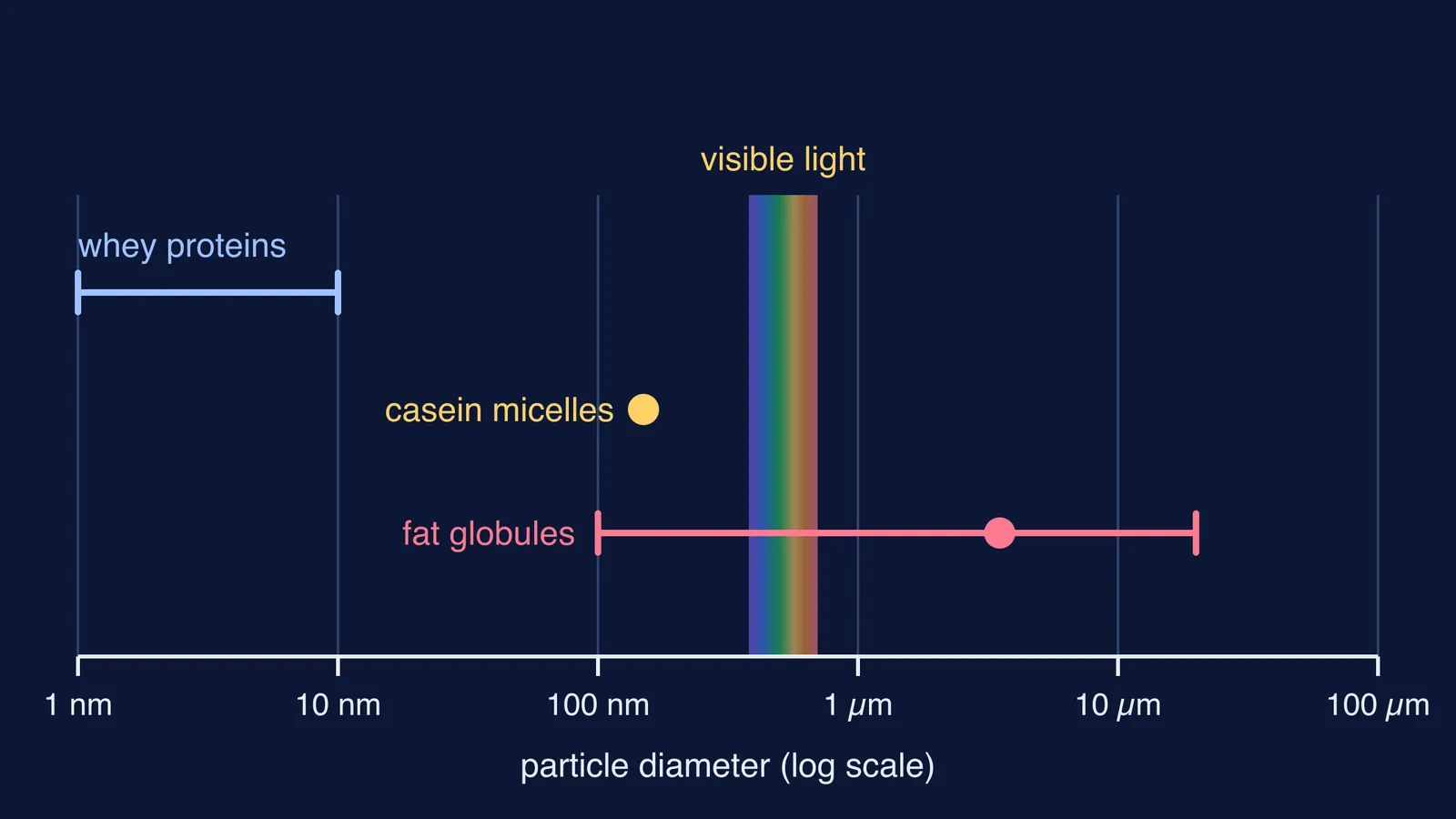
Fat globules: diameters from 0.1 to 20 µm, with an average of 3 to 4 µm.
Casein micelles: roughly spherical clusters of protein, with an average diameter of about 150 nm and a wide spread of sizes.
Whey proteins, lactose and salts: much smaller; the handbook puts whey proteins at 10⁻⁵ to 10⁻⁶ mm, which is 1 to 10 nm.
Now compare those sizes with light. Visible light runs from about 380 to 700 nanometres, according to NASA. A casein micelle, at about 150 nm, is less than half the shortest visible wavelength, while an average fat globule is several wavelengths across.
Why does milk look white and not blue?
NCERT Class 10 science has the rule. The chapter The Human Eye and the Colourful World says very fine particles scatter mainly blue light, larger particles scatter light of longer wavelengths, and "If the size of the scattering particles is large enough, then, the scattered light may even appear white."
Air molecules are much smaller than a wavelength, so the sky scatters mostly blue. Milk's fat globules are bigger than a wavelength, so they scatter red, green and blue by similar amounts. Casein micelles are smaller and favour blue a little, but there are so many particles that light is knocked about again and again before it escapes. Nearly every colour comes back out, and that even mix is what your eye reads as white.
Casein still does a large share of the work. The handbook says that because the micelles are of colloidal dimensions, "the white colour of skim milk is largely due to light scattering by the casein micelles". Fat adds to the whiteness and to the colour: Fonterra notes that fat globules can take on a yellow hue from carotenoids such as beta-carotene.
Why does skim milk look slightly blue?
Take the fat out and you are left mainly with casein micelles, which at about 150 nm are smaller than any visible wavelength. The Dairy Processing Handbook describes skim milk as "more transparent, with a slightly bluish tinge". That fits the NCERT rule: the smaller the particles, the more they favour blue.
In 2007, Jeppe Revall Frisvad, Niels Jørgen Christensen and Henrik Wann Jensen built a model of milk's appearance from its fat and protein content, using a generalised form of Lorenz-Mie theory, the theory of how spheres scatter light (ACM Transactions on Graphics). Their paper notes that an average photon in milk is scattered several thousand times. Their rendered glasses show milk growing whiter as the fat content rises, and a red shadow under skimmed milk. The paper gives no cause, but the tint fits the red-sunset picture: blue is scattered sideways, so the light that gets through is reddish.
Is milk a colloid, and where does the Tyndall effect come in?
Yes, at least its casein and fat are. The same NCERT chapter explains that a beam of light is invisible in a true solution but becomes visible in a colloid, where the particles are larger; that scattering by colloidal particles is the Tyndall effect. For the three mixture types, see our guide to true solutions, colloids and suspensions, or watch the beam appear in our Tyndall effect simulation.
How can you test it at home with a torch?
In a dark room, shine a phone torch through a clear glass of water. The beam is hard to see.
Stir in two or three drops of milk. The beam should now show up as a hazy line: the Tyndall effect.
Compare the side view with the view straight through at the torch: the side may look slightly bluish and the direct view slightly yellow-orange, the same split as sky and sunset.
Keep adding milk until the glass turns cloudy, then opaque white: light is now scattered many times over.
How do you write a 3-mark answer on why milk looks white?
If a test asks "Why does milk appear white?", these three points cover it:
Milk is a colloid: casein micelles and fat globules are dispersed in water.
Fat globules are larger than the wavelength of visible light and casein micelles are not far below it, so together they scatter all wavelengths (unlike air molecules, which scatter blue most).
Light is scattered many times inside milk, and the scattered mix of all colours reaches the eye as white.
The same reasoning explains why snow looks white. If multiple scattering is hard to picture, the Fermi Simulation Lab has interactive simulations for ideas that are easier to see than to read.